Bengaluru Engineer Builds AI Tool To Detect Potholes
Gaurav Sen's AI system detects potholes, identifies responsible contractors. System uses dashcam footage, GPS, and AI vision models.
'%3E%3Crect%20width%3D'96'%20height%3D'96'%20fill%3D'%23B3261E'%2F%3E%3Ccircle%20cx%3D'30'%20cy%3D'24'%20r%3D'44'%20fill%3D'%23fff'%20opacity%3D'.12'%2F%3E%3Ccircle%20cx%3D'60'%20cy%3D'74'%20r%3D'40'%20fill%3D'%23000'%20opacity%3D'.10'%2F%3E%3C%2Fg%3E%3Cg%20fill%3D'%23fff'%3E%3Crect%20x%3D'29'%20y%3D'49'%20width%3D'8'%20height%3D'19'%20rx%3D'1'%2F%3E%3Crect%20x%3D'39'%20y%3D'40'%20width%3D'9'%20height%3D'28'%20rx%3D'1'%2F%3E%3Crect%20x%3D'50'%20y%3D'45'%20width%3D'8'%20height%3D'23'%20rx%3D'1'%2F%3E%3Crect%20x%3D'60'%20y%3D'53'%20width%3D'7'%20height%3D'15'%20rx%3D'1'%2F%3E%3Crect%20x%3D'41'%20y%3D'34'%20width%3D'5'%20height%3D'6'%2F%3E%3C%2Fg%3E%3C%2Fsvg%3E)
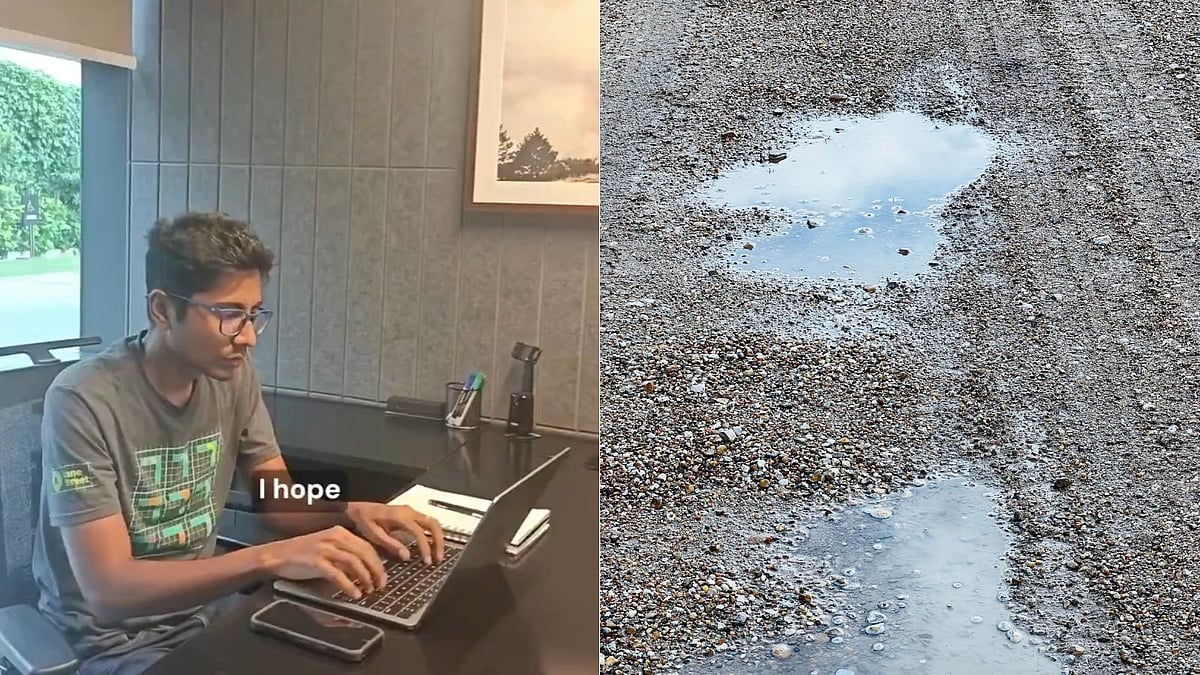
Gaurav Sen, a Bengaluru-based engineer, has developed an AI-powered system that detects potholes using dashcam footage and identifies the contractors responsible for fixing them.
The system works by equipping a car with a dashcam, GPS unit, and accelerometer to capture road footage during regular drives.
The footage is then analyzed using AI vision models that identify potholes and classify them by size.
The system cross-references the pothole's location against a database of around 2,900 government road contracts to identify the contractor responsible for that stretch of road.
This information includes the relevant tender number and the government officer overseeing it.
The system's premise is that many Indian roads remain under contractual warranty, during which the contractor who built the road is required to fix defects such as potholes without additional cost to the government.
By connecting a detected pothole to the applicable tender and contractor, the tool generates a complaint that references the specific accountability framework already in place.
In a test run, the system detected 12 potholes and generated 12 corresponding complaints.
The demonstration has drawn attention for its potential to extend beyond individual complaint filing toward a broader accountability mechanism for road maintenance.
Civic authorities could potentially adopt similar AI-based systems to survey road conditions and identify damaged stretches at scale.
This could help improve road maintenance and reduce the number of potholes on Indian roads.
The use of AI and data analytics could also help identify patterns and trends in road damage, allowing for more targeted and effective maintenance.
Overall, Gaurav Sen's AI system has the potential to make a significant impact on road maintenance in India.
The system's ability to detect potholes and identify responsible contractors could help improve road safety and reduce the risk of accidents.
It could also help reduce the financial burden on the government and taxpayers by ensuring that contractors are held accountable for their work.
The system has significant implications for civic-tech and could be adopted by civic authorities across India.
It could also be used in other countries with similar road maintenance challenges.
The use of AI and data analytics in road maintenance is a growing trend, and Gaurav Sen's system is an example of how technology can be used to improve infrastructure.
The system's potential to improve road safety and reduce maintenance costs makes it an important development in the field of civic-tech.
As the system continues to be developed and refined, it could have a major impact on road maintenance in India and beyond.
In conclusion, Gaurav Sen's AI system is a significant innovation in the field of road maintenance.
Its ability to detect potholes and identify responsible contractors has the potential to improve road safety, reduce maintenance costs, and increase accountability.
The system's implications for civic-tech are significant, and it could be adopted by civic authorities across India and beyond.
As technology continues to play a larger role in infrastructure development, innovations like Gaurav Sen's AI system will be crucial in improving road maintenance and reducing the risk of accidents.
Frequently asked questions
How does the AI system detect potholes?
The system uses dashcam footage, GPS, and AI vision models to detect potholes.
What is the potential impact of the AI system on road maintenance?
The system could improve road safety, reduce maintenance costs, and increase accountability.