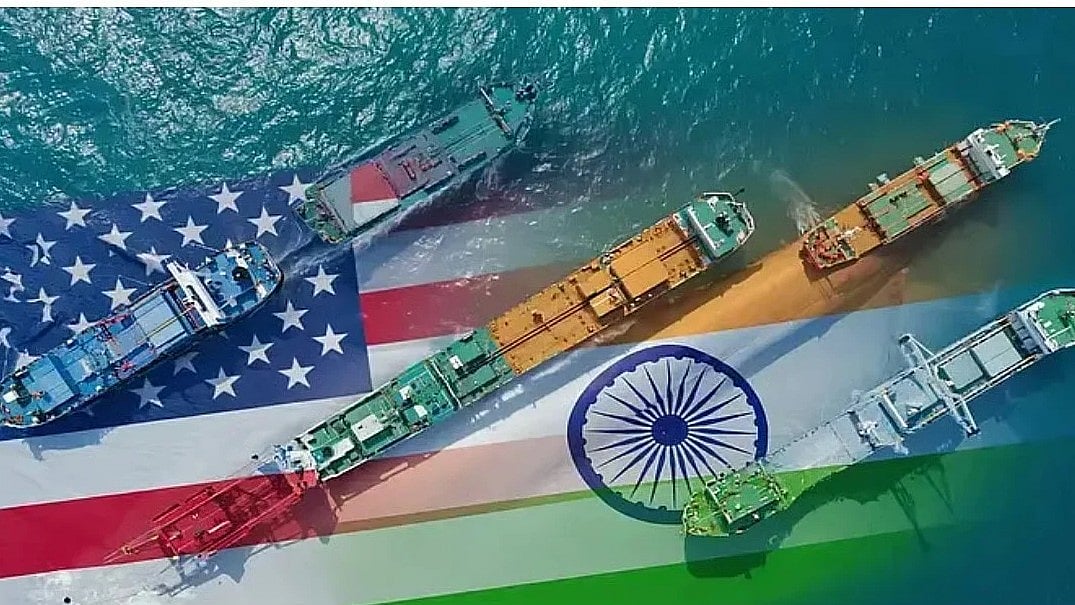
US Imposes 10% Tariff On Indian Goods
US imposes tariffs on Indian goods, cites forced labour concerns. Tariffs to affect 99.4% of US trade.
'%3E%3Crect%20width%3D'96'%20height%3D'96'%20fill%3D'%234A235A'%2F%3E%3Ccircle%20cx%3D'30'%20cy%3D'24'%20r%3D'44'%20fill%3D'%23fff'%20opacity%3D'.12'%2F%3E%3Ccircle%20cx%3D'60'%20cy%3D'74'%20r%3D'40'%20fill%3D'%23000'%20opacity%3D'.10'%2F%3E%3C%2Fg%3E%3Cg%20fill%3D'none'%20stroke%3D'%23fff'%20stroke-width%3D'3'%3E%3Ccircle%20cx%3D'48'%20cy%3D'48'%20r%3D'16'%2F%3E%3Cellipse%20cx%3D'48'%20cy%3D'48'%20rx%3D'6.5'%20ry%3D'16'%2F%3E%3Cline%20x1%3D'32'%20y1%3D'42'%20x2%3D'64'%20y2%3D'42'%2F%3E%3Cline%20x1%3D'32'%20y1%3D'54'%20x2%3D'64'%20y2%3D'54'%2F%3E%3C%2Fg%3E%3C%2Fsvg%3E)
The United States has announced a new round of tariffs on goods from 60 trading partners, including India, over concerns related to forced labour. The tariffs, which range from 10% to 12.5%, will come into effect from Friday and will apply to around 99.4% of US trade.
The US Trade Representative (USTR) announced the new tariffs, which will affect major economies such as India, China, and the European Union. The duties are based on a months-long investigation and are expected to face fewer legal challenges compared to previous measures.
According to the USTR, countries that have implemented forced labour import restrictions or committed to introducing such rules will face the lower 10% tariff rate. This group includes India, Canada, the European Union, and the United Kingdom. On the other hand, countries such as China, Japan, and South Korea will face the higher 12.5% tariff.
However, some economies such as Japan, South Korea, Taiwan, Switzerland, and the EU will receive partial relief due to existing trade agreements with the US. The tariff action is part of Washington's broader push to ensure stronger enforcement of supply chain standards and prevent goods produced using forced labour from entering the American market.
Certain categories of goods will remain exempt from the new duties. Products already subject to separate sector-specific tariffs, including steel and aluminium, will not be affected. Some energy products, fertilisers, and goods covered under the US-Mexico-Canada free trade agreement will also receive exemptions.
The latest move could have implications for global trade flows as businesses assess the impact of higher import costs and changing compliance requirements. The US has maintained a forced labour import ban for nearly a century and has argued that trading partners should adopt similar measures.
US Trade Representative Jamieson Greer said that the new tariffs are based on a thorough investigation and are expected to be more durable than previous measures. The Trump administration had introduced a temporary 10% tariff using alternative legal authority, but the measure was set to expire after 150 days.
The new tariffs are a significant development in the US trade policy and could have far-reaching implications for global trade. The move is seen as an attempt by the US to ensure that its trading partners adopt stronger measures to prevent forced labour in their supply chains.
In response to the new tariffs, Indian Commerce Minister Piyush Goyal refuted reports that India was 'holding out' on a US trade deal. The minister said that the reports were 'false' and 'baseless'.
The new tariffs will come into effect from Friday and will apply to a wide range of goods. The move is expected to affect businesses and consumers in the US and around the world.
In conclusion, the US has imposed a 10% tariff on Indian goods over concerns related to forced labour. The move is part of a broader push to ensure stronger enforcement of supply chain standards and prevent goods produced using forced labour from entering the American market. The implications of the new tariffs will be closely watched by businesses and governments around the world.
The US trade policy has been a subject of debate in recent years, with the country imposing tariffs on several trading partners. The new tariffs are seen as an attempt by the US to protect its domestic industries and ensure that its trading partners adopt stronger measures to prevent forced labour in their supply chains.
The impact of the new tariffs on global trade flows will be significant, with businesses assessing the impact of higher import costs and changing compliance requirements. The move is expected to affect not only the US but also other countries around the world.
Overall, the new tariffs imposed by the US on Indian goods are a significant development in the US trade policy. The move is expected to have far-reaching implications for global trade and will be closely watched by businesses and governments around the world.
The US has taken a strong stance on forced labour, and the new tariffs are seen as an attempt to ensure that its trading partners adopt similar measures. The move is expected to affect businesses and consumers in the US and around the world, and its implications will be closely watched in the coming days and weeks.
In the end, the new tariffs imposed by the US on Indian goods are a significant development in the US trade policy. The move is expected to have far-reaching implications for global trade and will be closely watched by businesses and governments around the world.
Frequently asked questions
What is the reason behind the US imposing tariffs on Indian goods?
The US has imposed tariffs on Indian goods over concerns related to forced labour.
What is the rate of the tariff imposed by the US on Indian goods?
The US has imposed a 10% tariff on Indian goods.