Robot XHumanoid Breaks Usain Bolt's 100m Record
A Chinese robot breaks Usain Bolt's record, robots outrun humans in physical strength and skill.
'%3E%3Crect%20width%3D'96'%20height%3D'96'%20fill%3D'%230B6E4F'%2F%3E%3Ccircle%20cx%3D'30'%20cy%3D'24'%20r%3D'44'%20fill%3D'%23fff'%20opacity%3D'.12'%2F%3E%3Ccircle%20cx%3D'60'%20cy%3D'74'%20r%3D'40'%20fill%3D'%23000'%20opacity%3D'.10'%2F%3E%3C%2Fg%3E%3Cg%20fill%3D'none'%20stroke%3D'%23fff'%20stroke-width%3D'3.2'%20stroke-linecap%3D'round'%20stroke-linejoin%3D'round'%3E%3Cpolyline%20points%3D'31%2C59%2041%2C49%2049%2C54%2063%2C37'%2F%3E%3Cpolyline%20points%3D'55%2C37%2063%2C37%2063%2C45'%2F%3E%3C%2Fg%3E%3C%2Fsvg%3E)
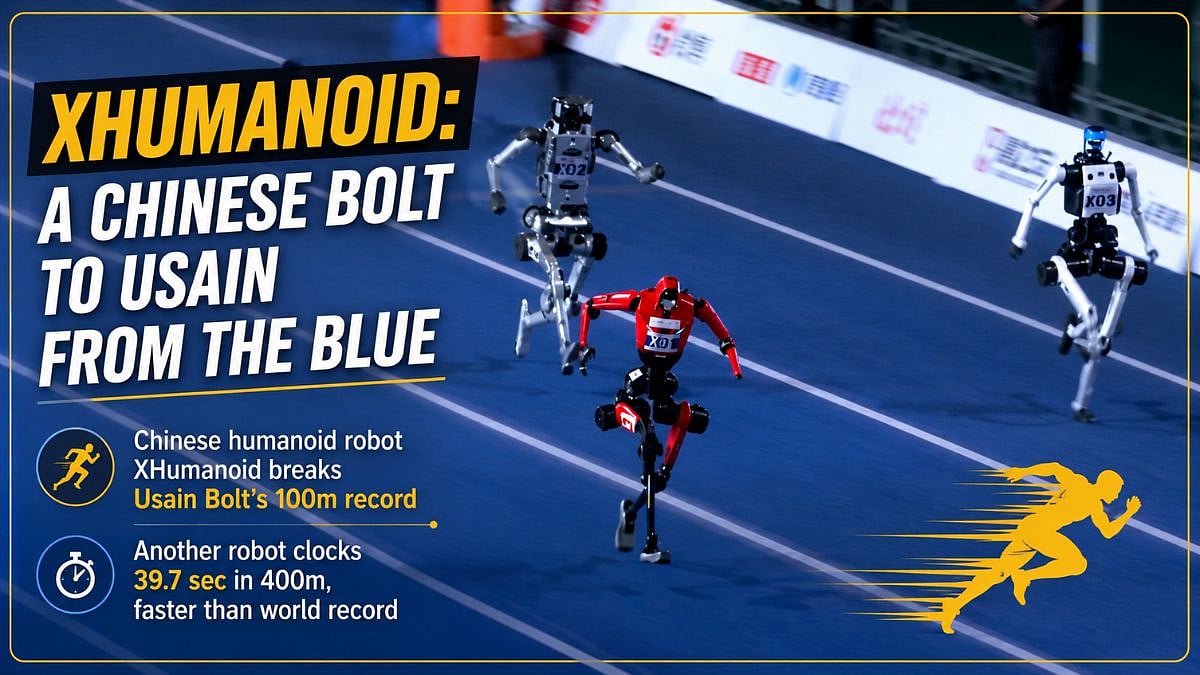
A Chinese company has developed a robot named XHumanoid that has broken the 100 meters record set by Usain Bolt in 2009. The robot completed the distance in 9.39 seconds, 0.19 seconds faster than Bolt's record. Another robot ran the 400 meters in 39.7 seconds, surpassing the current world record of 43.03 seconds.
The achievement marks the first instance of human-made machines overtaking humans in physical strength and skill. This development has sparked concerns about the future of work and the potential replacement of humans by robots. Elon Musk has predicted that in about a decade, there will be no jobs, and humans can rely on robots and bots to perform tasks.
However, officials from the Chinese company have reassured that the goal of developing robots is to make them genuinely useful beyond competition. They believe that every gain in speed, stability, and precision can bring robots closer to being useful in real-life applications.
Robotic athleticism has become a significant area of interest, with robotic games being held regularly in China. These games are expected to surpass the number of social media views of the Human Olympics. Robots can perform various tasks, including playing tennis and badminton, teaching kung fu, and even landing heavy punches.
The Indian Olympic Association may consider sending robotic athletes to the next Olympics to improve the country's medal count. The development of athletic robots has also had an impact on the stock market, with the Chinese company Unitree Robotics debuting on the Shanghai stock exchange at 460% above its quoted price.
The rise of robotic athletes raises questions about the future of human sports and the potential replacement of human athletes. Will humans be relegated to cheering on metallic marvels in stadiums? Only time will tell.
The development of robots like XHumanoid has significant implications for the future of work and human society. As robots become increasingly advanced, they may replace humans in various tasks, leading to a shift in the job market. However, it is also possible that robots could augment human capabilities, leading to new opportunities and innovations.
In conclusion, the achievement of XHumanoid and other robotic athletes marks a significant milestone in the development of artificial intelligence and robotics. As robots continue to advance, it is essential to consider their potential impact on human society and the future of work.
The future of sports and athletics may also be affected by the rise of robotic athletes. The Olympic Games and other international competitions may need to adapt to the inclusion of robotic athletes, raising questions about the nature of competition and the role of humans in sports.
Overall, the development of robots like XHumanoid is a significant achievement that has the potential to transform various aspects of human society. As robots continue to advance, it is essential to consider their potential impact and ensure that they are developed and used in ways that benefit humanity.
The potential applications of robotic athletes are vast, ranging from entertainment to education and research. Robotic athletes could be used to develop new training methods, improve athletic performance, and even help people with disabilities.
In the end, the rise of robotic athletes like XHumanoid is a reminder that technology is constantly evolving, and it is up to us to ensure that these advancements are used for the betterment of humanity.
The development of XHumanoid and other robotic athletes is a significant step forward in the field of artificial intelligence and robotics. As robots continue to advance, we can expect to see new innovations and applications that will transform various aspects of human society.
The future of work and human society will likely be shaped by the development of robots like XHumanoid. As robots become increasingly advanced, they may replace humans in various tasks, leading to a shift in the job market. However, it is also possible that robots could augment human capabilities, leading to new opportunities and innovations.
In conclusion, the achievement of XHumanoid and other robotic athletes marks a significant milestone in the development of artificial intelligence and robotics. As robots continue to advance, it is essential to consider their potential impact on human society and the future of work.
Frequently asked questions
What is the name of the robot that broke Usain Bolt's 100m record?
The robot is named XHumanoid.
How fast did the robot XHumanoid complete the 100m distance?
The robot completed the distance in 9.39 seconds.