Kingfisher Beak Inspires Japan's Bullet Train
A bird's beak solves a train problem. Japan's bullet train gets a new design
'%3E%3Crect%20width%3D'96'%20height%3D'96'%20fill%3D'%23B3261E'%2F%3E%3Ccircle%20cx%3D'30'%20cy%3D'24'%20r%3D'44'%20fill%3D'%23fff'%20opacity%3D'.12'%2F%3E%3Ccircle%20cx%3D'60'%20cy%3D'74'%20r%3D'40'%20fill%3D'%23000'%20opacity%3D'.10'%2F%3E%3C%2Fg%3E%3Cg%20fill%3D'%23fff'%3E%3Crect%20x%3D'29'%20y%3D'49'%20width%3D'8'%20height%3D'19'%20rx%3D'1'%2F%3E%3Crect%20x%3D'39'%20y%3D'40'%20width%3D'9'%20height%3D'28'%20rx%3D'1'%2F%3E%3Crect%20x%3D'50'%20y%3D'45'%20width%3D'8'%20height%3D'23'%20rx%3D'1'%2F%3E%3Crect%20x%3D'60'%20y%3D'53'%20width%3D'7'%20height%3D'15'%20rx%3D'1'%2F%3E%3Crect%20x%3D'41'%20y%3D'34'%20width%3D'5'%20height%3D'6'%2F%3E%3C%2Fg%3E%3C%2Fsvg%3E)
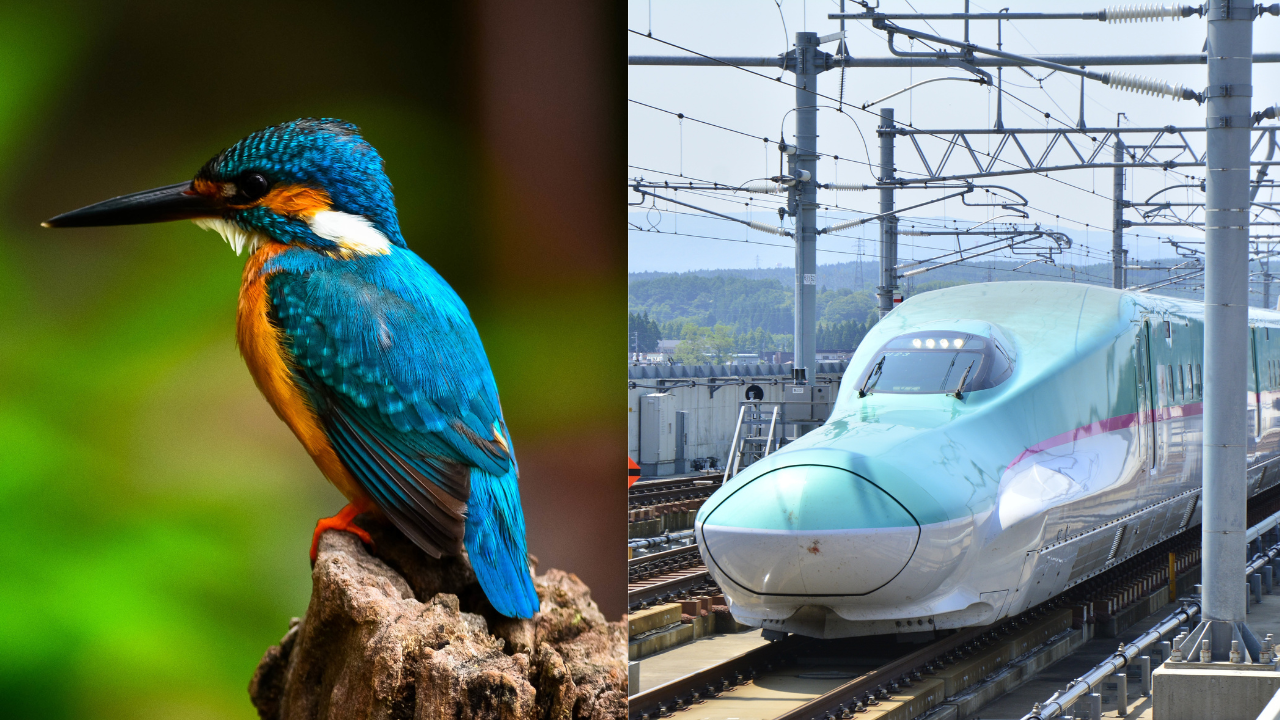
The design of Japan's bullet train was inspired by the beak of a kingfisher bird. This unique design helped solve the tunnel boom problem that the train was facing.
The tunnel boom problem occurred when the train entered a tunnel, creating a loud booming sound. This sound was not only disturbing but also caused discomfort to the passengers. The engineers were struggling to find a solution to this problem.
The kingfisher's beak was studied by the engineers, who noticed its unique shape and structure. The beak is long and pointed, allowing the bird to dive into the water with minimal splash. The engineers applied this principle to the design of the bullet train, creating a more streamlined and aerodynamic shape.
The new design of the train reduced the tunnel boom problem significantly. The streamlined shape allowed the train to enter the tunnel with less noise and disturbance. This not only improved the comfort of the passengers but also reduced the noise pollution.
The kingfisher's beak inspiration is a great example of how nature can inspire innovative solutions to complex problems. The design of the bullet train is a testament to the power of biomimicry, where nature's designs are used to solve human problems.
Japan's bullet train is one of the fastest trains in the world, with speeds reaching up to 320 kilometers per hour. The train's design has been continuously improved over the years, with the kingfisher's beak inspiration being one of the key factors in its success.
The story of the kingfisher's beak and the bullet train is a fascinating example of how nature and technology can come together to create innovative solutions. It highlights the importance of looking to nature for inspiration and the potential for biomimicry to solve complex problems.
In conclusion, the design of Japan's bullet train was inspired by the beak of a kingfisher bird, which helped solve the tunnel boom problem. This innovative solution is a testament to the power of biomimicry and the importance of looking to nature for inspiration.
The success of the bullet train has made it a popular mode of transportation in Japan, with millions of passengers using it every year. The train's design has also inspired other countries to adopt similar designs, reducing noise pollution and improving passenger comfort.
The kingfisher's beak inspiration has also led to further research and development in the field of biomimicry. Scientists and engineers are now looking to nature for inspiration to solve complex problems in various fields, from medicine to technology.
The story of the kingfisher's beak and the bullet train is a reminder of the importance of innovation and creativity in solving complex problems. It highlights the potential for nature to inspire innovative solutions and the need to continue looking to nature for inspiration in the future.
The design of the bullet train is a great example of how technology and nature can come together to create innovative solutions. It is a testament to the power of biomimicry and the importance of looking to nature for inspiration.
The bullet train has become an iconic symbol of Japan's technology and innovation. Its design has inspired other countries to adopt similar designs, reducing noise pollution and improving passenger comfort.
In the end, the kingfisher's beak inspiration has led to a more efficient, comfortable, and environmentally friendly mode of transportation. It is a great example of how nature can inspire innovative solutions to complex problems and the importance of looking to nature for inspiration in the future.