Railway Fines For Spitting, Littering Double To ₹1,000
Spitting or littering on railway premises now attracts a ₹1,000 fine. Experts stress enforcement over penalties.
'%3E%3Crect%20width%3D'96'%20height%3D'96'%20fill%3D'%23B3261E'%2F%3E%3Ccircle%20cx%3D'30'%20cy%3D'24'%20r%3D'44'%20fill%3D'%23fff'%20opacity%3D'.12'%2F%3E%3Ccircle%20cx%3D'60'%20cy%3D'74'%20r%3D'40'%20fill%3D'%23000'%20opacity%3D'.10'%2F%3E%3C%2Fg%3E%3Cg%20fill%3D'%23fff'%3E%3Crect%20x%3D'29'%20y%3D'49'%20width%3D'8'%20height%3D'19'%20rx%3D'1'%2F%3E%3Crect%20x%3D'39'%20y%3D'40'%20width%3D'9'%20height%3D'28'%20rx%3D'1'%2F%3E%3Crect%20x%3D'50'%20y%3D'45'%20width%3D'8'%20height%3D'23'%20rx%3D'1'%2F%3E%3Crect%20x%3D'60'%20y%3D'53'%20width%3D'7'%20height%3D'15'%20rx%3D'1'%2F%3E%3Crect%20x%3D'41'%20y%3D'34'%20width%3D'5'%20height%3D'6'%2F%3E%3C%2Fg%3E%3C%2Fsvg%3E)
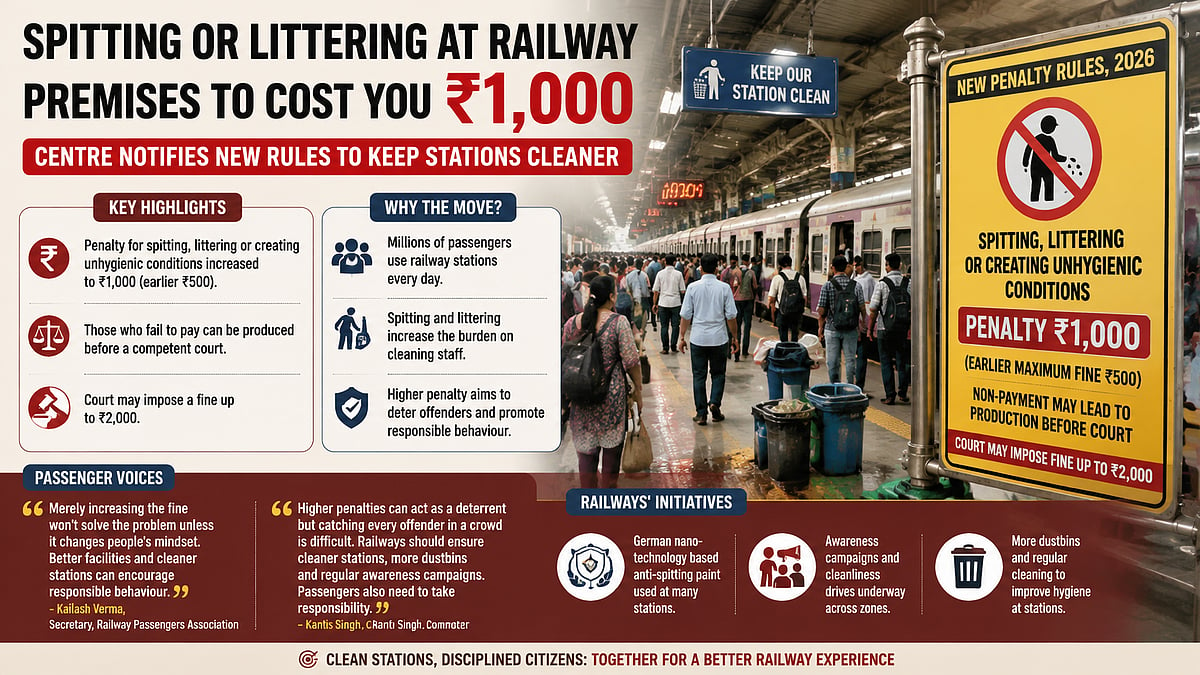
The Centre has notified the Railway Premises (Penalty for Activities Affecting Cleanliness) Amendment Rules, 2026, which doubles the fine for spitting, littering, or creating unhygienic conditions on railway premises to ₹1,000. The earlier maximum fine was ₹500.
Those who fail to pay the penalty can also be produced before a competent court, which may impose a fine of up to ₹2,000. The move aims to improve cleanliness at railway stations, which continue to struggle with spitting, littering, and other activities that add to the burden on cleaning staff.
With millions of passengers using stations every day, maintaining cleanliness remains a major challenge for railway authorities. The higher penalty is intended to act as a deterrent and encourage passengers to use railway premises more responsibly.
However, passenger representatives and commuters said that increasing the fine alone may not bring the desired change unless enforcement and awareness improve. Kailash Verma, secretary of the Railway Passengers Association, stated that merely increasing the fine from ₹500 to ₹1,000 will not solve the problem unless it brings a change in people's mindset.
Verma emphasized that better facilities and cleaner, well-maintained stations could encourage responsible behaviour, similar to the experience at Metro stations. He added that the real challenge is enforcement, identifying and penalizing someone who spits or throws garbage in a crowd of lakhs is not easy.
Commuter Kanti Singh echoed the concern, saying higher penalties could act as a deterrent but catching every offender at crowded railway stations would remain difficult. She suggested that along with penalties, the Railways should ensure cleaner stations, more dustbins, and regular awareness campaigns.
Railway authorities have already experimented with technology to tackle the problem, using German nano-technology-based anti-spitting paint at heavily affected locations to discourage people from spitting and reduce the time and effort required for cleaning.
The latest rules add a stronger financial deterrent to such measures. However, the effectiveness of the ₹1,000 penalty will largely depend on whether the Railways can consistently identify offenders and enforce the rules.
In the context of Mumbai's crowded railway network, the new rules highlight the need for a multi-faceted approach to maintaining cleanliness. While the increased penalty may act as a deterrent, it is crucial to address the root causes of the problem and promote a culture of responsibility among passengers.
The success of the new rules will depend on the ability of railway authorities to balance enforcement with awareness and education, ultimately leading to a cleaner and more hygienic environment for all passengers.
In conclusion, the new rules aim to improve cleanliness at railway stations, but their effectiveness will depend on the implementation and enforcement of the penalties, as well as a shift in the mindset of passengers towards responsible behaviour.
Frequently asked questions
What is the new fine for spitting or littering on railway premises?
The new fine is ₹1,000, double the earlier maximum fine of ₹500.
What happens if someone fails to pay the penalty?
They can be produced before a competent court, which may impose a fine of up to ₹2,000.