Crude Oil Futures Rise 2.91% to Rs 8,216 per Barrel
Crude oil futures rose for the fourth straight day due to US-Iran strikes. Fresh tensions stoked fears of supply disruption through the Strait of Hormuz.
'%3E%3Crect%20width%3D'96'%20height%3D'96'%20fill%3D'%234A235A'%2F%3E%3Ccircle%20cx%3D'30'%20cy%3D'24'%20r%3D'44'%20fill%3D'%23fff'%20opacity%3D'.12'%2F%3E%3Ccircle%20cx%3D'60'%20cy%3D'74'%20r%3D'40'%20fill%3D'%23000'%20opacity%3D'.10'%2F%3E%3C%2Fg%3E%3Cg%20fill%3D'none'%20stroke%3D'%23fff'%20stroke-width%3D'3'%3E%3Ccircle%20cx%3D'48'%20cy%3D'48'%20r%3D'16'%2F%3E%3Cellipse%20cx%3D'48'%20cy%3D'48'%20rx%3D'6.5'%20ry%3D'16'%2F%3E%3Cline%20x1%3D'32'%20y1%3D'42'%20x2%3D'64'%20y2%3D'42'%2F%3E%3Cline%20x1%3D'32'%20y1%3D'54'%20x2%3D'64'%20y2%3D'54'%2F%3E%3C%2Fg%3E%3C%2Fsvg%3E)
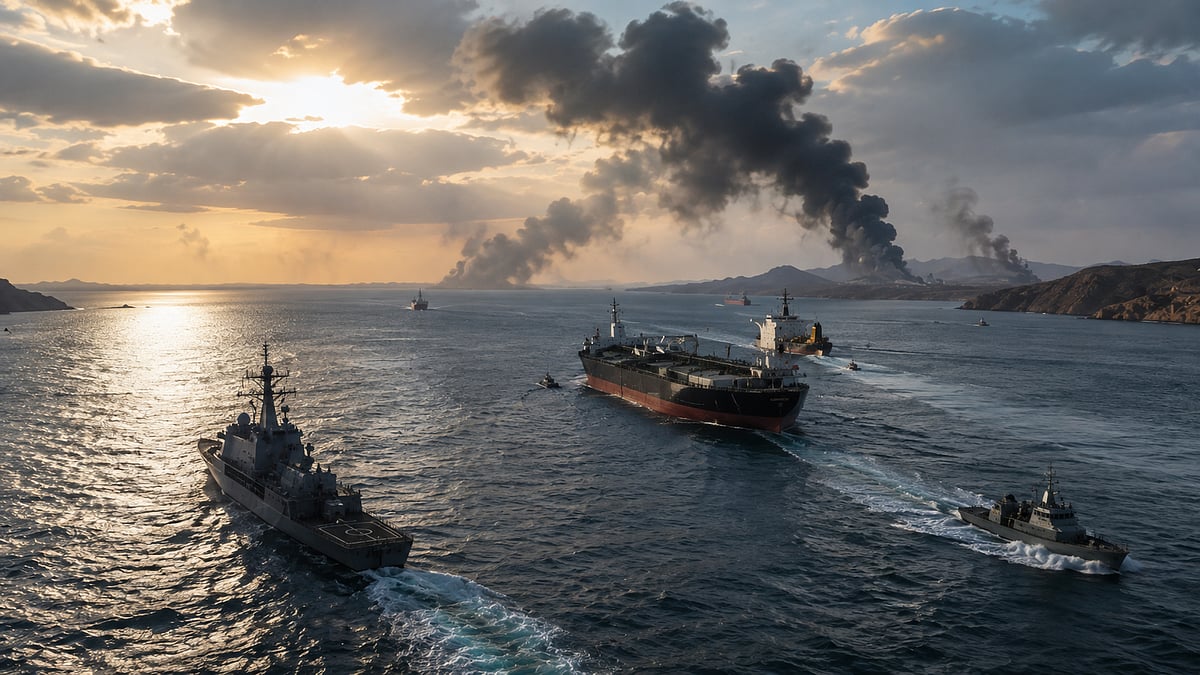
Crude oil futures rose for the fourth straight session on Monday, gaining Rs 232 to Rs 8,216 per barrel. The increase was driven by fresh US-Iran military strikes, which stoked fears of disruption to energy supplies through the Strait of Hormuz.
On the Multi Commodity Exchange (MCX), crude oil for September delivery jumped by Rs 232, or 2.91 per cent, to Rs 8,216 per barrel in 6,578 lots. The October contract also advanced Rs 100, or 1.27 per cent, to Rs 7,947 per barrel in 1,749 lots on the MCX.
According to Akshat Siddhant, Lead quant analyst at investment platform Mudrex, the rise in crude oil futures was due to Iran's retaliatory strikes on US military installations, which rekindled fears of a wider conflict. The US military had struck two rocket-launcher sites on Iran's Larak Island, prompting Iran to fire missiles at American bases in the region.
In international markets, Brent oil futures for November delivery rose USD 2.88, or 3.3 per cent, to USD 90.98 per barrel on the Intercontinental Exchange. The West Texas Intermediate (WTI) crude for October contract went up by USD 2.37, or nearly 3 per cent, to USD 85.77 per barrel on the New York Mercantile Exchange.
The escalation in tensions between the US and Iran has pushed crude oil prices higher, with Brent rising more than 3 per cent after settling near USD 89 a barrel on Friday. Anindya Banerjee, Head of Commodity and Currency Research at Kotak Securities, said that the developments have put the world's most important oil chokepoint back at the centre of the market participants' attention.
The Strait of Hormuz is a critical waterway for oil supplies, and any disruption to traffic through the strait could have significant implications for global energy markets. Banerjee noted that visible tanker transits fell to just five vessels a day over the weekend, while crude flows past the blockade averaged 6.7 million barrels a day last week, against 20 million before the war.
Looking ahead, Banerjee expects Brent to remain within the USD 85-95 range, but said that the risk has clearly shifted towards the upper end. The ongoing tensions between the US and Iran are likely to continue to impact crude oil prices, making it essential for market participants to closely monitor developments in the region.
The rise in crude oil prices could have significant implications for India, which is heavily reliant on imported oil to meet its energy needs. Any increase in crude oil prices could lead to higher fuel prices, which could have a ripple effect on the economy. Therefore, it is essential for policymakers to closely monitor the situation and take steps to mitigate the impact of any disruption to oil supplies.
In conclusion, the rise in crude oil futures was driven by fresh US-Iran military strikes, which stoked fears of disruption to energy supplies through the Strait of Hormuz. The ongoing tensions between the US and Iran are likely to continue to impact crude oil prices, making it essential for market participants to closely monitor developments in the region.
Frequently asked questions
What is the current price of crude oil futures in India?
The current price of crude oil futures in India is Rs 8,216 per barrel.
What is the main reason for the rise in crude oil prices?
The main reason for the rise in crude oil prices is the fresh US-Iran military strikes, which stoked fears of disruption to energy supplies through the Strait of Hormuz.