Supreme Court Orders Immediate FIR For Missing Persons
SC warns states of contempt action, clarifies 'person' means everyone
'%3E%3Crect%20width%3D'96'%20height%3D'96'%20fill%3D'%231A5276'%2F%3E%3Ccircle%20cx%3D'30'%20cy%3D'24'%20r%3D'44'%20fill%3D'%23fff'%20opacity%3D'.12'%2F%3E%3Ccircle%20cx%3D'60'%20cy%3D'74'%20r%3D'40'%20fill%3D'%23000'%20opacity%3D'.10'%2F%3E%3C%2Fg%3E%3Cg%20fill%3D'%23fff'%3E%3Cpath%20d%3D'M31%2041%20L48%2031%20L65%2041%20Z'%2F%3E%3Crect%20x%3D'33'%20y%3D'43'%20width%3D'4'%20height%3D'17'%2F%3E%3Crect%20x%3D'41'%20y%3D'43'%20width%3D'4'%20height%3D'17'%2F%3E%3Crect%20x%3D'51'%20y%3D'43'%20width%3D'4'%20height%3D'17'%2F%3E%3Crect%20x%3D'59'%20y%3D'43'%20width%3D'4'%20height%3D'17'%2F%3E%3Crect%20x%3D'30'%20y%3D'62'%20width%3D'36'%20height%3D'4'%20rx%3D'1'%2F%3E%3C%2Fg%3E%3C%2Fsvg%3E)
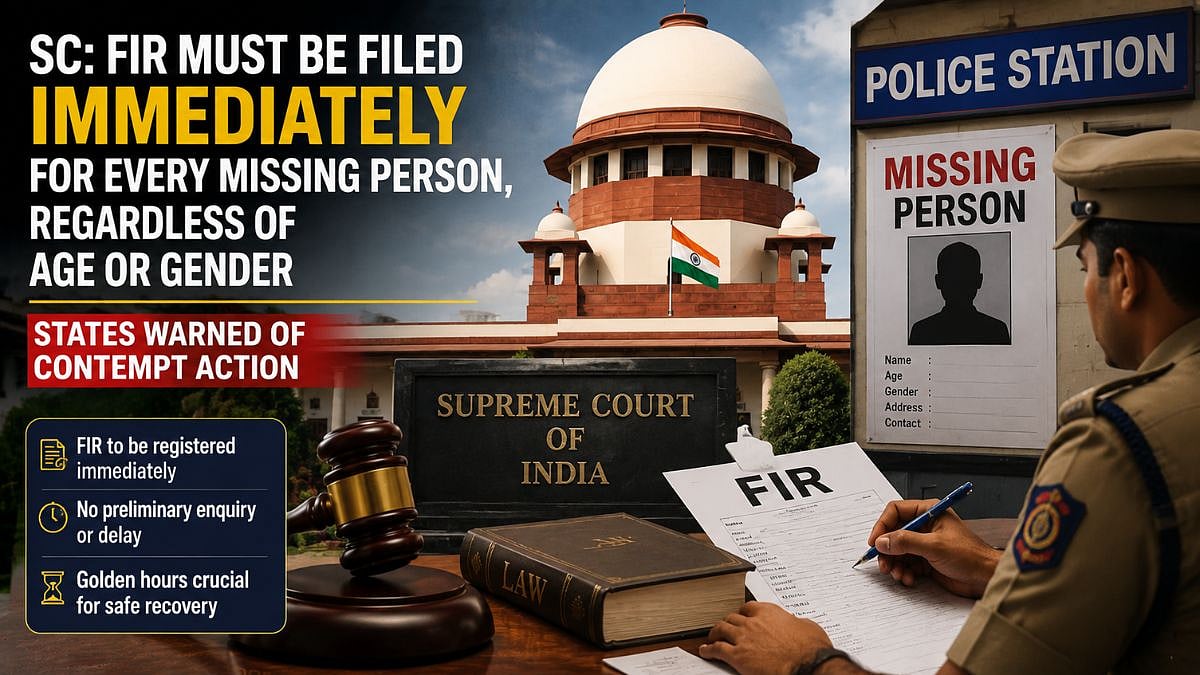
The Supreme Court has directed that police must immediately register a First Information Report (FIR) whenever they receive information about a missing person, regardless of the person's age or gender. This clarification was made by a Bench of Justices Ahsanuddin Amanullah and R. Mahadevan while reviewing compliance with its earlier orders on measures to prevent human trafficking and trace missing persons.
The court's earlier order on May 22 had directed all states to register an FIR upon receiving information that any person was missing. However, it was informed during the latest proceedings that some states had understood 'person' to mean only children. The court rejected this interpretation, calling it a 'deliberate and mala fide bogey' and stated that the language of its earlier order was clear.
The court observed that the expression 'person' means every person, irrespective of age or gender. This clarification leaves little scope for authorities to delay action based on the age or gender of a missing person. The warning of contempt proceedings signals that the court expects its directions to translate into action at police stations rather than remain only on paper.
The court has warned that if any state or Union Territory fails to comply with its earlier order, contempt notices will be issued to the Chief Secretary and Director General of Police (DGP) concerned. The officials will have to remain personally present before the court and file show-cause affidavits explaining why they should not face proceedings and punishment for deliberate defiance and non-compliance with its orders.
In its latest order dated August 5, the court noted that several states and Union Territories had not filed affidavits reporting compliance with its earlier directions and held that they were prima facie in contempt. The court directed that contempt notices be issued to the Chief Secretaries and DGPs concerned, requiring them to remain personally present and explain why contempt proceedings should not be initiated against them.
The court also noted that the Union Territory of Ladakh had not filed its response and directed the Chief Secretary and DGP of Ladakh to submit personally affirmed affidavits explaining why appropriate action should not be taken against them for non-compliance.
The Supreme Court's directive is a significant step towards ensuring that missing persons' cases are handled promptly and efficiently. It emphasizes that police cannot wait for preliminary enquiries and must register an FIR immediately upon receiving information about a missing person.
The court's warning of contempt action against non-compliant states and Union Territories is a clear indication that it expects its directions to be taken seriously. The directive is expected to have a significant impact on the handling of missing persons' cases in India, and it remains to be seen how the states and Union Territories will respond to the court's order.
In conclusion, the Supreme Court's order is a welcome step towards ensuring that missing persons' cases are handled with the urgency and seriousness they deserve. It is now up to the states and Union Territories to comply with the court's directive and ensure that police register FIRs immediately upon receiving information about missing persons.
The Supreme Court's directive is a significant development in the context of human trafficking and missing persons in India. It highlights the need for prompt and efficient action in handling such cases, and it is expected to have a positive impact on the efforts to prevent human trafficking and trace missing persons.
Overall, the Supreme Court's order is a significant step towards ensuring that missing persons' cases are handled with the seriousness and urgency they deserve. It is a welcome development, and it remains to be seen how the states and Union Territories will respond to the court's directive.
Frequently asked questions
What has the Supreme Court directed regarding missing persons' cases?
The Supreme Court has directed that police must immediately register a First Information Report (FIR) whenever they receive information about a missing person, regardless of the person's age or gender.
What action will be taken against non-compliant states and Union Territories?
The Supreme Court has warned that contempt notices will be issued to the Chief Secretary and Director General of Police (DGP) concerned, and they will have to remain personally present before the court and file show-cause affidavits explaining why they should not face proceedings and punishment for deliberate defiance and non-compliance with its orders.