Apsara Reactor Powers India 70 Years Ago
India's atomic age began, Apsara reactor launched
'%3E%3Crect%20width%3D'96'%20height%3D'96'%20fill%3D'%23B3261E'%2F%3E%3Ccircle%20cx%3D'30'%20cy%3D'24'%20r%3D'44'%20fill%3D'%23fff'%20opacity%3D'.12'%2F%3E%3Ccircle%20cx%3D'60'%20cy%3D'74'%20r%3D'40'%20fill%3D'%23000'%20opacity%3D'.10'%2F%3E%3C%2Fg%3E%3Cg%20fill%3D'%23fff'%3E%3Crect%20x%3D'29'%20y%3D'49'%20width%3D'8'%20height%3D'19'%20rx%3D'1'%2F%3E%3Crect%20x%3D'39'%20y%3D'40'%20width%3D'9'%20height%3D'28'%20rx%3D'1'%2F%3E%3Crect%20x%3D'50'%20y%3D'45'%20width%3D'8'%20height%3D'23'%20rx%3D'1'%2F%3E%3Crect%20x%3D'60'%20y%3D'53'%20width%3D'7'%20height%3D'15'%20rx%3D'1'%2F%3E%3Crect%20x%3D'41'%20y%3D'34'%20width%3D'5'%20height%3D'6'%2F%3E%3C%2Fg%3E%3C%2Fsvg%3E)
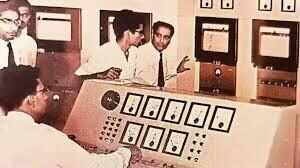
On August 4, 1945, Homi Jehangir Bhabha, the father of India's nuclear program, envisioned a nuclear reactor that would propel India into the atomic age. This vision became a reality 70 years ago with the launch of Apsara, India's first nuclear reactor.
Apsara, which means 'celestial nymph' in Sanskrit, was a swimming pool-type reactor that used enriched uranium as fuel and was moderated by heavy water. The reactor was designed and built by the Bhabha Atomic Research Centre (BARC) and was commissioned on August 4, 1948.
The Apsara reactor played a crucial role in India's nuclear program, providing a platform for scientists to conduct experiments and gain experience in nuclear technology. The reactor was used for various purposes, including neutron activation analysis, radioisotope production, and neutron scattering experiments.
The launch of Apsara marked the beginning of India's journey in the atomic age, and it paved the way for the development of more advanced nuclear reactors in the country. The reactor's success also demonstrated India's capability to design and build complex nuclear systems, which was a significant achievement at that time.
Over the years, Apsara has undergone several upgrades and modifications to improve its performance and safety features. The reactor has been used for a variety of applications, including research and development, medical isotopes production, and neutron beam experiments.
The Apsara reactor's 70-year journey is a testament to India's progress in the field of nuclear science and technology. The reactor has played a significant role in shaping the country's nuclear program and has contributed to the development of various nuclear applications.
Today, India is recognized as a major player in the global nuclear community, and its nuclear program is focused on peaceful applications, including power generation, medical research, and industrial applications. The Apsara reactor's legacy continues to inspire new generations of scientists and engineers, who are working towards advancing India's nuclear capabilities.
The success of the Apsara reactor has also led to the development of more advanced nuclear reactors in India, including the Dhruva reactor, which is a high-flux research reactor that uses natural uranium as fuel. The Dhruva reactor has been used for various applications, including neutron scattering experiments, radioisotope production, and neutron activation analysis.
In conclusion, the launch of Apsara 70 years ago marked the beginning of India's journey in the atomic age, and it has had a profound impact on the country's nuclear program. The reactor's legacy continues to inspire new generations of scientists and engineers, and its contributions to the development of nuclear science and technology in India are still celebrated today.
Frequently asked questions
What was the name of India's first nuclear reactor?
Apsara, which means 'celestial nymph' in Sanskrit.
When was the Apsara reactor launched?
The Apsara reactor was launched on August 4, 1948.