Indore Plans 25+ Flyovers, 1,500 City Buses
Indore to overhaul traffic management, removing bottlenecks and encroachments. Plans include 25+ flyovers and 1,500 city buses.
'%3E%3Crect%20width%3D'96'%20height%3D'96'%20fill%3D'%23C2185B'%2F%3E%3Ccircle%20cx%3D'30'%20cy%3D'24'%20r%3D'44'%20fill%3D'%23fff'%20opacity%3D'.12'%2F%3E%3Ccircle%20cx%3D'60'%20cy%3D'74'%20r%3D'40'%20fill%3D'%23000'%20opacity%3D'.10'%2F%3E%3C%2Fg%3E%3Cpath%20fill%3D'%23fff'%20d%3D'M48%2031%20l4.6%2010.2%2011.2%201%20-8.4%207.5%202.5%2011%20-9.9%20-5.8%20-9.9%205.8%202.5%20-11%20-8.4%20-7.5%2011.2%20-1%20z'%2F%3E%3C%2Fsvg%3E)
Indore, a city in Madhya Pradesh, is set to undergo a major transformation in its traffic management system. A high-power meeting, chaired by Mayor Pushyamitra Bhargava, was held on Saturday to finalize a three-phase plan. The plan aims to remove bottlenecks and encroachments, followed by major infrastructure projects and an integrated public transport network.
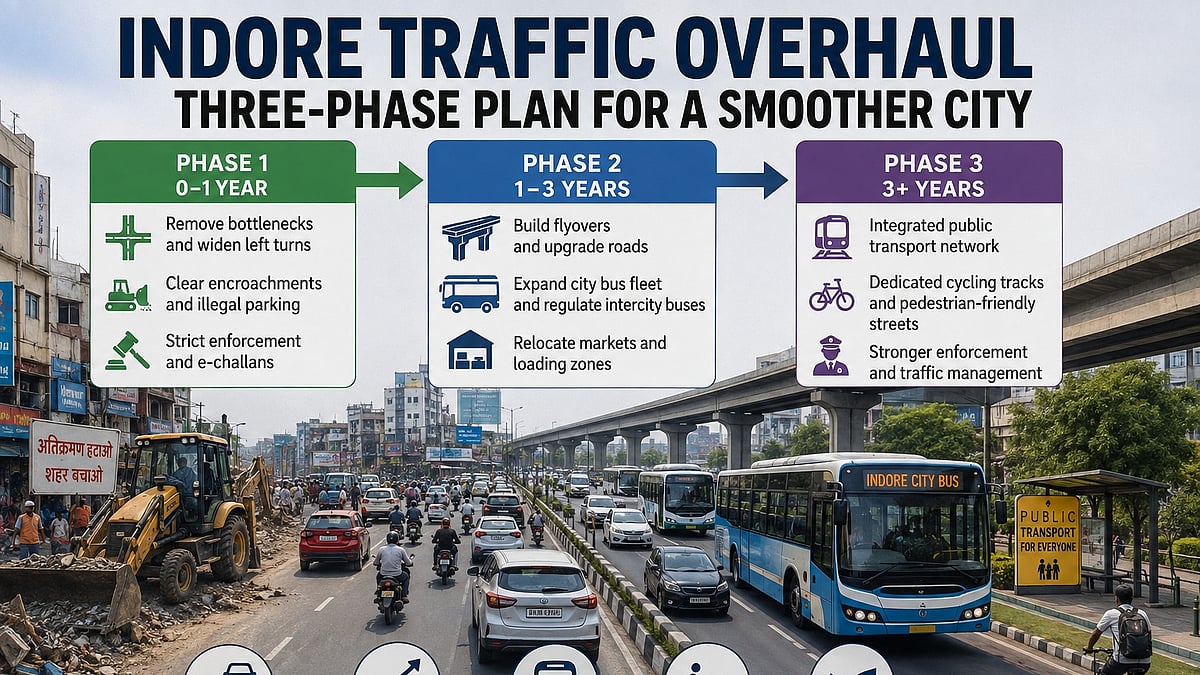
The first phase of the plan will focus on immediate measures, including widening remaining major left turns and making three major roads encroachment-free. Authorities will also target on-street parking on major roads and commercial areas and take action against stray cattle. Officials have set a one-year target for visible improvements at junctions and bottlenecks.
The 3-E Formula for Traffic Management will be implemented, which includes 70% Engineering, 15% Enforcement, and 15% Education. The engineering aspect will involve junction redesign, wider left turns, road improvement, and flyovers. Enforcement will include e-challans, lane discipline, and CCTV-based monitoring. Education will focus on traffic awareness programs in schools and colleges.
In the first year, major left turns will be widened, and road geometry will be improved. Encroachments will be removed from three key roads, and on-street parking on important routes will be restricted. E-challan and mobile court action will be intensified, and night-time loading and unloading will be reduced to decrease peak-hour congestion. Stricter action will be taken against stray cattle.
A big infrastructure push is planned over the next 1-3 years, which includes proposing more than 25 flyovers at busy locations. The city bus fleet is proposed to increase from around 350 to 1,500 buses. A policy will regulate and eventually move around 1,500 intercity buses to terminals outside the core urban area. The plan also proposes relocating wholesale markets and major loading-unloading zones that contribute to congestion.
In the long term, the plan envisages a dedicated traffic engineering cell, increasing traffic police strength from around 1,200 to 2,500-3,000, and strengthening digital enforcement. The long-term vision includes integrating metro, city buses, and suburban rail into a multimodal network, along with dedicated cycling tracks and pedestrian-friendly streets.
The three-phase timeline for the plan is as follows: 0-1 year will focus on left turns, bottlenecks, encroachments, parking, e-challans, and night freight. 1-3 years will focus on flyovers, bus expansion, intercity bus regulation, and market relocation. 3+ years will focus on traffic engineering cell, multimodal transport, cycling, and pedestrian networks.
The city's traffic management system is expected to undergo a significant transformation, making it more efficient and reducing congestion. The plan's success will depend on the effective implementation of the 3-E Formula and the cooperation of citizens.
The overhaul of Indore's traffic management system is a significant step towards making the city more livable and reducing traffic congestion. The plan's focus on engineering, enforcement, and education will help to create a more efficient and safe traffic system. The increase in city buses and the regulation of intercity buses will also help to reduce congestion and improve public transport.
In conclusion, the Indore traffic management plan is a comprehensive approach to addressing the city's traffic woes. The plan's implementation will require careful planning and execution, but it has the potential to make a significant impact on the city's traffic system.
The success of the plan will be crucial in making Indore a more attractive and livable city. The city's residents will benefit from the reduced congestion and improved public transport. The plan's focus on traffic awareness programs will also help to educate citizens about the importance of safe and responsible driving.
Overall, the Indore traffic management plan is a significant step towards creating a more efficient and safe traffic system. The plan's implementation will require cooperation from citizens, but it has the potential to make a significant impact on the city's traffic congestion.
The plan's long-term vision of integrating metro, city buses, and suburban rail into a multimodal network will help to create a more efficient and convenient public transport system. The dedicated cycling tracks and pedestrian-friendly streets will also help to promote sustainable and environmentally friendly modes of transport.
In the end, the Indore traffic management plan is a comprehensive approach to addressing the city's traffic woes. The plan's implementation will require careful planning and execution, but it has the potential to make a significant impact on the city's traffic system and improve the quality of life for its residents.
Frequently asked questions
What is the 3-E Formula for traffic management in Indore?
The 3-E Formula includes 70% Engineering, 15% Enforcement, and 15% Education.
How many flyovers are proposed in Indore's traffic management plan?
More than 25 flyovers are proposed at busy locations.