India's Life-Saving Medicines Remain Unaffordable
Supreme Court takes up access to life-saving medications, Kerala HC considers exorbitant pricing
'%3E%3Crect%20width%3D'96'%20height%3D'96'%20fill%3D'%231A5276'%2F%3E%3Ccircle%20cx%3D'30'%20cy%3D'24'%20r%3D'44'%20fill%3D'%23fff'%20opacity%3D'.12'%2F%3E%3Ccircle%20cx%3D'60'%20cy%3D'74'%20r%3D'40'%20fill%3D'%23000'%20opacity%3D'.10'%2F%3E%3C%2Fg%3E%3Cg%20fill%3D'%23fff'%3E%3Cpath%20d%3D'M31%2041%20L48%2031%20L65%2041%20Z'%2F%3E%3Crect%20x%3D'33'%20y%3D'43'%20width%3D'4'%20height%3D'17'%2F%3E%3Crect%20x%3D'41'%20y%3D'43'%20width%3D'4'%20height%3D'17'%2F%3E%3Crect%20x%3D'51'%20y%3D'43'%20width%3D'4'%20height%3D'17'%2F%3E%3Crect%20x%3D'59'%20y%3D'43'%20width%3D'4'%20height%3D'17'%2F%3E%3Crect%20x%3D'30'%20y%3D'62'%20width%3D'36'%20height%3D'4'%20rx%3D'1'%2F%3E%3C%2Fg%3E%3C%2Fsvg%3E)
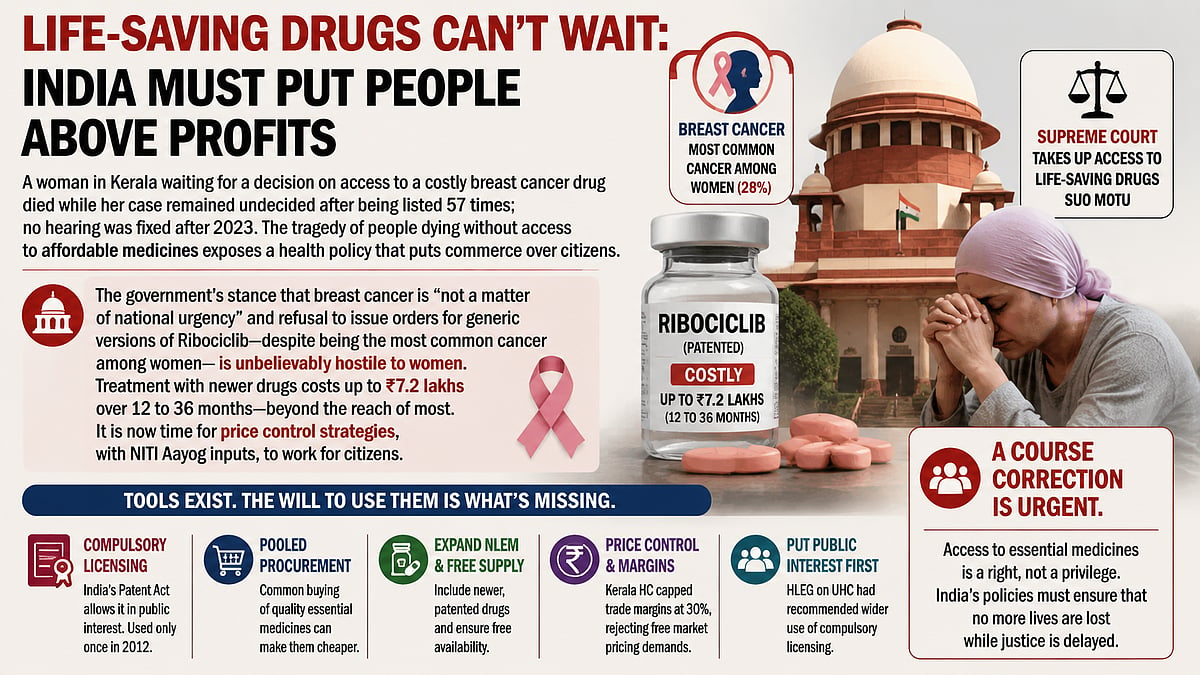
The Supreme Court of India has taken up the matter of access to life-saving medications under the Ayushman Bharat scheme, highlighting the government's inadequate policies on this crucial aspect of healthcare. A recent case in point is the death of a woman waiting for a decision by the Kerala High Court to access a costly breast cancer drug, which remained undecided after being listed 57 times.
The Kerala High Court is also considering the exorbitant pricing of life-saving patented drugs, suo motu. The issue of access to life-saving drugs has been neglected, and the tragedy of people dying without access to affordable medicines is a commentary on the country's health policy. The government has been criticized for prioritizing commercial interests over citizens' needs.
The case of Ribociclib, a life-saving drug for breast cancer, is a prime example. The government refused to issue orders to make generic versions of the drug available, citing that breast cancer is not a matter of national urgency. However, health ministry data shows that breast cancer is the most common cancer among women, accounting for 28%. The typical treatment cost for newer breast cancer drugs can range from Rs 7.2 lakhs over a 12 to 36 month cycle, making them unaffordable for most people.
The need for price control strategies is now more pressing than ever. The NITI Aayog has been tasked with providing inputs on price control, but the results have been lacking. Several tools are available to the government to make essential medicines accessible, including compulsory licensing, which allows for cheaper medicines to be produced. However, this provision has been used only once, in 2012, for a kidney cancer drug.
The Kerala High Court had suggested compulsory licensing for breast cancer drugs four years ago, but the Centre refused. In a separate matter, the court capped trade margins at 30%, ruling against the pharmaceutical sector's demand for free market prices. The erstwhile Planning Commission's High Level Expert Group on universal health coverage had recommended a wider use of compulsory licensing to make drugs affordable.
The use of common pooled procurement of quality essential medicines for public distribution could also make them cheaper. However, the government's commitment to bringing patented, expensive medicines under the national list of essential medicines (NLEM) has been lacking. While many older molecules are part of the NLEM, there is little effort to supply current NLEM drugs free.
The Supreme Court's decision to take up the matter of access to life-saving medications is a step in the right direction. It is now time for the government to prioritize citizens' needs over commercial interests and make life-saving medicines affordable for all. The use of compulsory licensing, price control strategies, and common pooled procurement could make a significant difference in the lives of people who cannot afford expensive medicines.
In conclusion, the issue of access to life-saving medications is a critical one that requires immediate attention. The government must take a course correction and prioritize the needs of citizens over commercial interests. The use of available tools and strategies could make essential medicines accessible to all, and it is time for the government to take concrete steps in this direction.
The significance of this issue cannot be overstated, as it affects the lives of millions of people in India who cannot afford expensive medicines. The government's policies on access to life-saving medications must be revised to prioritize the needs of citizens, and the use of compulsory licensing, price control strategies, and common pooled procurement could be a step in the right direction. Ultimately, it is the responsibility of the government to ensure that life-saving medicines are affordable and accessible to all, regardless of their economic status.