Rajendra Somvanshi's Poems Added To Class 4 Textbook
Two poems by children's author Rajendra Somvanshi included in Balbharati textbook. Poems promote cultural heritage and environmental awareness.
'%3E%3Crect%20width%3D'96'%20height%3D'96'%20fill%3D'%23B3261E'%2F%3E%3Ccircle%20cx%3D'30'%20cy%3D'24'%20r%3D'44'%20fill%3D'%23fff'%20opacity%3D'.12'%2F%3E%3Ccircle%20cx%3D'60'%20cy%3D'74'%20r%3D'40'%20fill%3D'%23000'%20opacity%3D'.10'%2F%3E%3C%2Fg%3E%3Cg%20fill%3D'%23fff'%3E%3Crect%20x%3D'29'%20y%3D'49'%20width%3D'8'%20height%3D'19'%20rx%3D'1'%2F%3E%3Crect%20x%3D'39'%20y%3D'40'%20width%3D'9'%20height%3D'28'%20rx%3D'1'%2F%3E%3Crect%20x%3D'50'%20y%3D'45'%20width%3D'8'%20height%3D'23'%20rx%3D'1'%2F%3E%3Crect%20x%3D'60'%20y%3D'53'%20width%3D'7'%20height%3D'15'%20rx%3D'1'%2F%3E%3Crect%20x%3D'41'%20y%3D'34'%20width%3D'5'%20height%3D'6'%2F%3E%3C%2Fg%3E%3C%2Fsvg%3E)
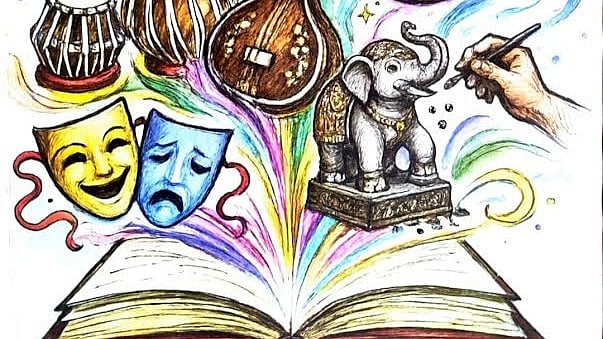
Renowned children's author Rajendra Somvanshi, a native of Niphad taluka in Nashik district, has achieved a significant milestone with two of his poems being included in the Class 4 Art Education textbook published by the Maharashtra State Bureau of Textbook Production and Curriculum Research (Balbharati).
The two poems, 'Vasudev Geet' and 'Let's Make Our School Beautiful', will be part of the curriculum from the 2026-27 academic year. 'Vasudev Geet' introduces students to the rich folk traditions of Maharashtra, highlighting the customs, heritage, and cultural significance of the Vasudev community.
On the other hand, 'Let's Make Our School Beautiful' encourages children to maintain cleanliness in schools, conserve water, adopt eco-friendly habits, and develop values of responsibility and environmental awareness. This poem aims to instill a sense of social responsibility and environmental consciousness among young students.
Literary enthusiasts have welcomed the inclusion of these poems, expressing confidence that they will inspire knowledge, values, and social awareness among students for many years to come. Rajendra Somvanshi has previously published two children's poetry collections, 'Gammadi Gammat' and 'Geet Nave Gau.' The latter, published by Chaprak Prakashan, has received three district-level and three state-level literary awards.
Somvanshi's work has also been recognized at the national level, as he represented North Maharashtra as an invited poet at the 98th All India Marathi Literary Conference held in Delhi. The inclusion of his poems in the Balbharati textbook is a testament to his contribution to children's literature and his ability to inspire young minds.
The Maharashtra State Bureau of Textbook Production and Curriculum Research (Balbharati) has been working towards creating a more inclusive and culturally relevant curriculum for students. The inclusion of Somvanshi's poems is a step in this direction, as it aims to promote cultural heritage and environmental awareness among young students.
The move is expected to have a positive impact on the educational landscape of Maharashtra, as it will expose students to the rich cultural traditions of the state and encourage them to adopt environmentally friendly practices. With the inclusion of Somvanshi's poems, the Balbharati textbook has become more comprehensive and relevant to the needs of modern students.
In conclusion, the inclusion of Rajendra Somvanshi's poems in the Class 4 Art Education textbook is a significant development in the field of children's literature and education. It is expected to inspire young students and promote cultural heritage and environmental awareness in the state of Maharashtra.
The recognition of Somvanshi's work is also a testament to the growing importance of children's literature in India. As the country continues to evolve and grow, it is essential to promote cultural heritage and environmental awareness among young students. The inclusion of Somvanshi's poems in the Balbharati textbook is a step in this direction, and it is expected to have a positive impact on the educational landscape of Maharashtra.
Overall, the inclusion of Rajendra Somvanshi's poems in the Class 4 Art Education textbook is a significant achievement that is expected to inspire young students and promote cultural heritage and environmental awareness in the state of Maharashtra.
Frequently asked questions
Which poems by Rajendra Somvanshi are included in the Class 4 textbook?
The two poems included are 'Vasudev Geet' and 'Let's Make Our School Beautiful'.
What is the significance of 'Vasudev Geet' poem?
The poem introduces students to the rich folk traditions of Maharashtra, highlighting the customs, heritage, and cultural significance of the Vasudev community.