Bombay HC Asks Centre To Respond To Kunal Kamra's Plea
Centre given time till July 29, Kamra challenges Sahyog Portal
'%3E%3Crect%20width%3D'96'%20height%3D'96'%20fill%3D'%23B3261E'%2F%3E%3Ccircle%20cx%3D'30'%20cy%3D'24'%20r%3D'44'%20fill%3D'%23fff'%20opacity%3D'.12'%2F%3E%3Ccircle%20cx%3D'60'%20cy%3D'74'%20r%3D'40'%20fill%3D'%23000'%20opacity%3D'.10'%2F%3E%3C%2Fg%3E%3Cg%20fill%3D'%23fff'%3E%3Crect%20x%3D'29'%20y%3D'49'%20width%3D'8'%20height%3D'19'%20rx%3D'1'%2F%3E%3Crect%20x%3D'39'%20y%3D'40'%20width%3D'9'%20height%3D'28'%20rx%3D'1'%2F%3E%3Crect%20x%3D'50'%20y%3D'45'%20width%3D'8'%20height%3D'23'%20rx%3D'1'%2F%3E%3Crect%20x%3D'60'%20y%3D'53'%20width%3D'7'%20height%3D'15'%20rx%3D'1'%2F%3E%3Crect%20x%3D'41'%20y%3D'34'%20width%3D'5'%20height%3D'6'%2F%3E%3C%2Fg%3E%3C%2Fsvg%3E)
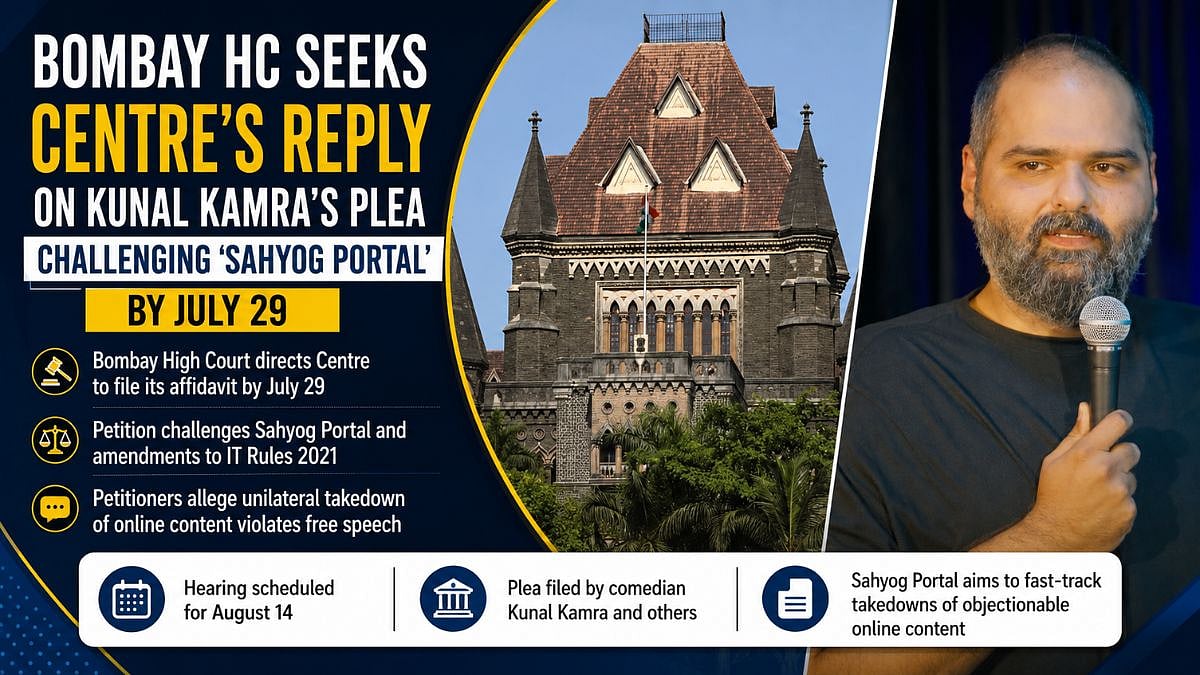
The Bombay High Court has granted the Union government time until July 29 to respond to a petition filed by stand-up comedian Kunal Kamra. The petition challenges the constitutional validity of the Centre's Sahyog Portal, a digital system designed to fast-track takedown requests to social media intermediaries.
Kamra's counsel, Senior Advocate Navroz Seervai, mentioned the plea before a Division Bench of Acting Chief Justice Ravindra Ghuge and Justice Gautam Ankhad, stating that it was an important matter. However, despite repeated directions, the government had not filed its affidavit.
The petitioners have also challenged the amendment to Rule 3(1)(d) of the Information Technology (Intermediary Guidelines and Digital Media Ethics Code) Rules, 2021. This amendment requires intermediaries to remove objectionable content.
The Sahyog Portal was launched in 2024 to expedite the blocking of objectionable content uploaded online. Kamra has contended that the portal permits blocking and unilateral takedown of online content without prior notice, violating the principles of natural justice and the guarantee of free speech.
The court has directed the Centre to file its affidavit by July 29 and has asked the petitioners to file rejoinder affidavits, if any, by the first week of August. The petitions have been posted for hearing on August 14.
Kamra's plea alleges that the amended rules amount to a flagrant violation of the fundamental rights guaranteed to every citizen under the Constitution. The plea urges the High Court to direct the government to suspend the Sahyog Portal's operation and to restrain any officer of the Central or state governments from directing the blocking or takedown of any information without following the procedure mandated under the IT Act.
The case has significant implications for the freedom of speech and expression in India. The Sahyog Portal has been designed to expedite the blocking of objectionable content, but Kamra's plea raises important questions about the balance between regulating online content and protecting individual rights.
The Bombay High Court's decision to grant the Centre time to respond to the petition suggests that the court is taking a careful and considered approach to the case. The outcome of the case will be closely watched, as it has the potential to impact the way in which online content is regulated in India.
In recent years, there have been growing concerns about the impact of online content on society. The government has introduced various measures to regulate online content, including the Sahyog Portal. However, these measures have also raised concerns about censorship and the impact on individual rights.
The case highlights the need for a balanced approach to regulating online content. While it is important to protect citizens from harmful or objectionable content, it is also important to ensure that individual rights are protected. The Bombay High Court's decision will be an important step in determining the balance between these competing interests.
The hearing on August 14 will provide an opportunity for the court to consider the arguments presented by both sides and to make a decision on the petition. The outcome of the case will have significant implications for the freedom of speech and expression in India, and will be closely watched by citizens, activists, and policymakers alike.
In conclusion, the Bombay High Court's decision to grant the Centre time to respond to Kunal Kamra's plea is an important step in the case. The outcome of the case will have significant implications for the freedom of speech and expression in India, and will be closely watched by citizens, activists, and policymakers alike. The case highlights the need for a balanced approach to regulating online content, and the importance of protecting individual rights while also protecting citizens from harmful or objectionable content.