Air Passenger Service Inflation Jumps 32% in June Quarter
Air fares soar, railway prices steady, banking services deflate
'%3E%3Crect%20width%3D'96'%20height%3D'96'%20fill%3D'%23B3261E'%2F%3E%3Ccircle%20cx%3D'30'%20cy%3D'24'%20r%3D'44'%20fill%3D'%23fff'%20opacity%3D'.12'%2F%3E%3Ccircle%20cx%3D'60'%20cy%3D'74'%20r%3D'40'%20fill%3D'%23000'%20opacity%3D'.10'%2F%3E%3C%2Fg%3E%3Cg%20fill%3D'%23fff'%3E%3Crect%20x%3D'29'%20y%3D'49'%20width%3D'8'%20height%3D'19'%20rx%3D'1'%2F%3E%3Crect%20x%3D'39'%20y%3D'40'%20width%3D'9'%20height%3D'28'%20rx%3D'1'%2F%3E%3Crect%20x%3D'50'%20y%3D'45'%20width%3D'8'%20height%3D'23'%20rx%3D'1'%2F%3E%3Crect%20x%3D'60'%20y%3D'53'%20width%3D'7'%20height%3D'15'%20rx%3D'1'%2F%3E%3Crect%20x%3D'41'%20y%3D'34'%20width%3D'5'%20height%3D'6'%2F%3E%3C%2Fg%3E%3C%2Fsvg%3E)
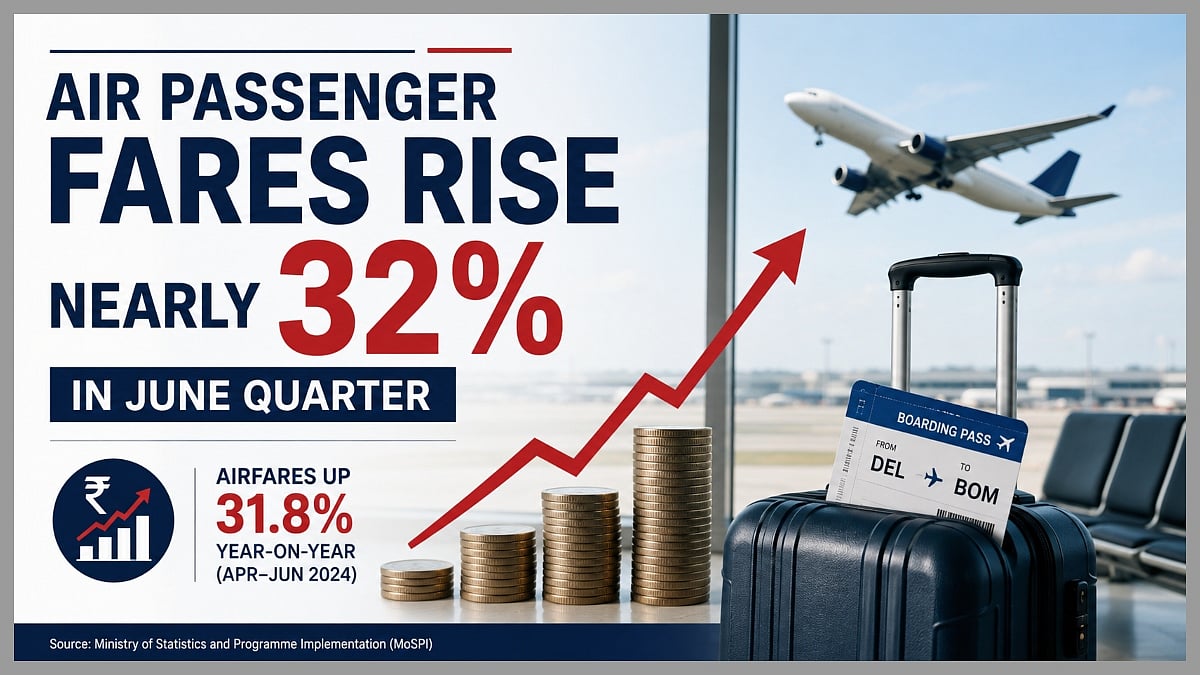
The air passenger service sector has recorded the steepest annual price inflation among seven service sectors, with a nearly 32% increase in the June quarter. According to the provisional Service Producer Price Indices (PPI) released by the Commerce and Industry Ministry, the Air Passenger Service Price Index rose 31.94% year-on-year.
The data covers seven service sectors, including banking, securities transactions, insurance, pension management, railways, air passenger services, and telecom. The reference period for the air passenger service sector was fixed as FY26, and no sequential comparison was provided.
In contrast, railway passenger service inflation stood at 3.50%, unchanged from the March quarter. Banking service contribution inflation increased to 6.90% from 3.30% in the preceding quarter. However, the Banking Service Price Index recorded deflation of 3.35%, compared with a 4.10% contraction in the March quarter.
Other service sectors also showed mixed movements. Securities transaction services posted deflation of 1.32%, reversing the previous quarter's inflation of 0.55%. Pension fund management services registered inflation of 5.20%, against deflation of 0.76% earlier. Insurance inflation edged up to 0.98% from 0.68%, while telecom inflation eased to 0.72% from 0.99%.
The government plans to add sectors to the Service PPI framework, widening its coverage of price changes across the economy. The PPI framework is intended to measure price movements from the producer's perspective and gradually replace Wholesale Price Index-based inflation figures over the next five years.
The transition to PPI follows recommendations made by a working group headed by former NITI Aayog member Ramesh Chand. The panel recommended changing the base year from 2011-12 to 2022-23, as PPI offers a more accurate assessment of prices received by producers.
The increase in air passenger service inflation may have implications for consumers, particularly during peak travel seasons. As the economy continues to grow, monitoring price movements across different sectors will be crucial for policymakers.
In the context of the Indian economy, the shift to PPI is significant, as it will provide a more comprehensive picture of price changes across the economy. The government's efforts to expand the coverage of the Service PPI framework will help in better understanding the dynamics of the service sector, which accounts for a significant share of the country's GDP.
Overall, the latest PPI data highlights the need for continued monitoring of price movements across different sectors, particularly in the service sector, which is a key driver of the Indian economy.
The increase in air passenger service inflation is likely to have a significant impact on the tourism industry, as higher air fares may deter travelers from booking flights. This, in turn, may affect the overall growth of the economy, as the tourism industry is a significant contributor to the country's GDP.
In conclusion, the latest PPI data provides valuable insights into the price movements across different service sectors. As the economy continues to grow, it is essential to monitor these movements closely to ensure that policymakers can make informed decisions to promote sustainable growth and development.
The government's efforts to improve the accuracy of price measurements will help in better understanding the dynamics of the economy, and the shift to PPI is a significant step in this direction. As the economy continues to evolve, it is crucial to have a robust framework for measuring price movements, and the PPI framework is an important step towards achieving this goal.
The implications of the increase in air passenger service inflation are far-reaching, and it is essential to consider the potential impact on the tourism industry and the overall economy. As the government continues to monitor price movements and make adjustments to the PPI framework, it is crucial to ensure that the needs of consumers and businesses are taken into account.
In the long run, the shift to PPI is likely to have a positive impact on the economy, as it will provide a more accurate picture of price movements across different sectors. This, in turn, will help policymakers make informed decisions to promote sustainable growth and development, and will ultimately benefit consumers and businesses alike.
The latest PPI data highlights the importance of continued monitoring of price movements across different sectors. As the economy continues to grow, it is essential to have a robust framework for measuring price movements, and the PPI framework is an important step towards achieving this goal.
In conclusion, the increase in air passenger service inflation is a significant development, and it is essential to consider the potential implications for the tourism industry and the overall economy. The government's efforts to improve the accuracy of price measurements will help in better understanding the dynamics of the economy, and the shift to PPI is a significant step in this direction.
Frequently asked questions
What is the current rate of air passenger service inflation?
The current rate of air passenger service inflation is 31.94%.
How does the PPI framework differ from the Wholesale Price Index?
The PPI framework measures price movements from the producer's perspective, whereas the Wholesale Price Index measures price movements from the buyer's perspective.