Jagannath Temple's Shadow Mystery Explained
The Jagannath Temple in Puri, Odisha, has a mysterious claim, visitors believe its shadow disappears.
'%3E%3Crect%20width%3D'96'%20height%3D'96'%20fill%3D'%231B5E20'%2F%3E%3Ccircle%20cx%3D'30'%20cy%3D'24'%20r%3D'44'%20fill%3D'%23fff'%20opacity%3D'.12'%2F%3E%3Ccircle%20cx%3D'60'%20cy%3D'74'%20r%3D'40'%20fill%3D'%23000'%20opacity%3D'.10'%2F%3E%3C%2Fg%3E%3Cg%3E%3Ccircle%20cx%3D'48'%20cy%3D'48'%20r%3D'15'%20fill%3D'%23fff'%2F%3E%3Cpath%20d%3D'M43%2034%20Q50%2048%2043%2062'%20fill%3D'none'%20stroke%3D'%238a94a6'%20stroke-width%3D'2.4'%2F%3E%3Cpath%20d%3D'M47%2033%20Q54%2048%2047%2063'%20fill%3D'none'%20stroke%3D'%238a94a6'%20stroke-width%3D'1.8'%20stroke-dasharray%3D'1.5%203'%2F%3E%3C%2Fg%3E%3C%2Fsvg%3E)
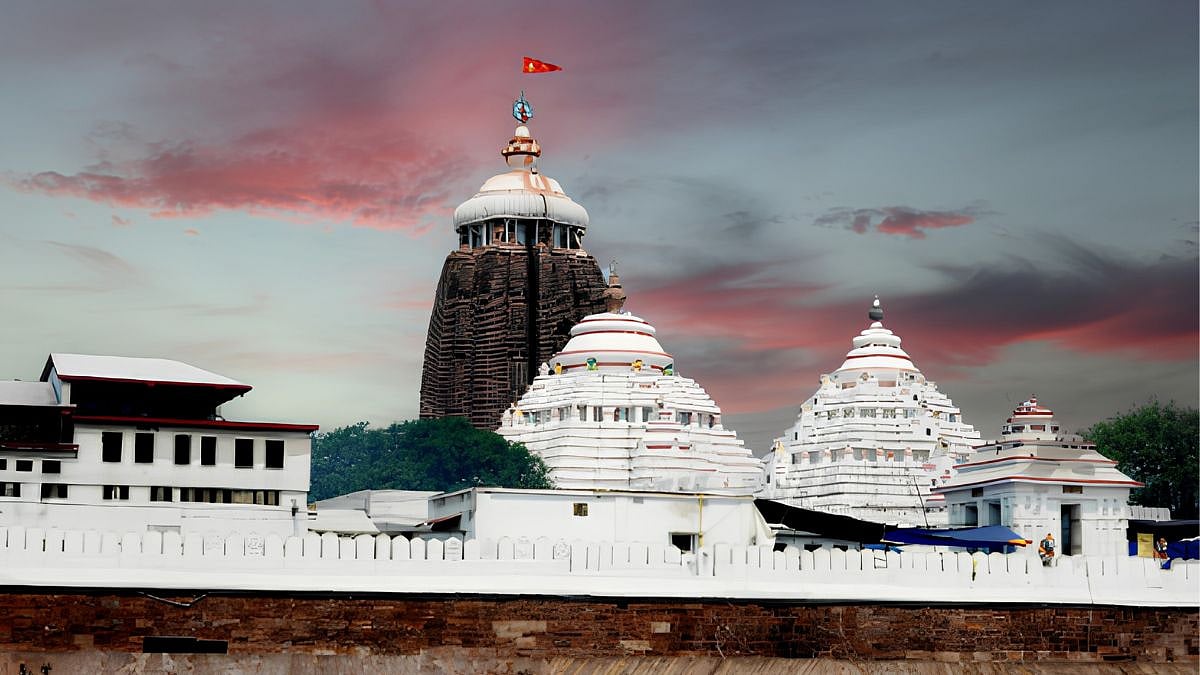
The Jagannath Temple in Puri, Odisha, is one of India's most revered pilgrimage sites, famous for its spiritual significance and the many mysteries associated with it. The temple is one of the Char Dham pilgrimage sites and is also famous for its Rath Yatra, which began on July 16 this year.
One of the most talked-about claims is that the temple's towering 214-foot-high shikhara casts no visible shadow at any time of the day. This belief has fascinated devotees and visitors for generations. However, experts explain that every physical object illuminated by sunlight casts a shadow.
The perception that the Jagannath Temple has no shadow is likely due to a combination of its towering Kalinga-style architecture, the angle of the Sun, and the way the temple complex is designed. The temple's unique curvilinear design is believed to be the reason why the main dome's shadow falls largely onto the structure itself rather than onto the surrounding ground.
For devotees, the phenomenon is regarded as one of Lord Jagannath's divine miracles. Many believe it reflects the deity's spiritual power and adds to the sacredness of the temple. From a scientific perspective, there is no evidence that the temple defies the laws of physics. Instead, the claim is generally understood as an optical illusion or a matter of perspective created by the temple's architectural design.
The Jagannath Temple is a blend of faith and science, where the absence of the shadow on the ground is widely attributed to its architectural brilliance and precise geographic alignment. The temple's design and the angle of the Sun create an optical illusion, making it seem like the shadow is not visible.
The temple's priests climb to the top of its towering Shikhara every day to hoist the sacred Patita Pavana flag, a centuries-old ritual that is an integral part of the temple's traditions. The temple's architecture and design are a testament to the ingenuity and craftsmanship of the people who built it.
The Jagannath Temple's shadow mystery is a fascinating phenomenon that has captured the imagination of people for generations. While it may not be a scientifically established fact, it is a testament to the temple's unique design and the power of faith and belief.
In conclusion, the Jagannath Temple's shadow mystery is a complex phenomenon that can be explained by a combination of its architecture, the angle of the Sun, and the way the temple complex is designed. It is a fascinating example of how faith and science can coexist and create a sense of wonder and awe in people.
The significance of the Jagannath Temple and its shadow mystery extends beyond the temple itself, representing the rich cultural and spiritual heritage of India. It is a reminder of the importance of preserving and respecting our cultural and spiritual traditions, and the role that faith and belief play in shaping our lives.
The Jagannath Temple's shadow mystery is a reminder that there is always more to learn and discover, and that the intersection of faith and science can lead to a deeper understanding and appreciation of the world around us.