Mumbai University Publishes Books on Indian Knowledge Systems in 12 Languages
Mumbai University releases books in 12 languages, promoting Indian Knowledge Systems under NEP 2020. The books are available in Marathi, English, and 10 other languages.
'%3E%3Crect%20width%3D'96'%20height%3D'96'%20fill%3D'%23B3261E'%2F%3E%3Ccircle%20cx%3D'30'%20cy%3D'24'%20r%3D'44'%20fill%3D'%23fff'%20opacity%3D'.12'%2F%3E%3Ccircle%20cx%3D'60'%20cy%3D'74'%20r%3D'40'%20fill%3D'%23000'%20opacity%3D'.10'%2F%3E%3C%2Fg%3E%3Cg%20fill%3D'%23fff'%3E%3Crect%20x%3D'29'%20y%3D'49'%20width%3D'8'%20height%3D'19'%20rx%3D'1'%2F%3E%3Crect%20x%3D'39'%20y%3D'40'%20width%3D'9'%20height%3D'28'%20rx%3D'1'%2F%3E%3Crect%20x%3D'50'%20y%3D'45'%20width%3D'8'%20height%3D'23'%20rx%3D'1'%2F%3E%3Crect%20x%3D'60'%20y%3D'53'%20width%3D'7'%20height%3D'15'%20rx%3D'1'%2F%3E%3Crect%20x%3D'41'%20y%3D'34'%20width%3D'5'%20height%3D'6'%2F%3E%3C%2Fg%3E%3C%2Fsvg%3E)
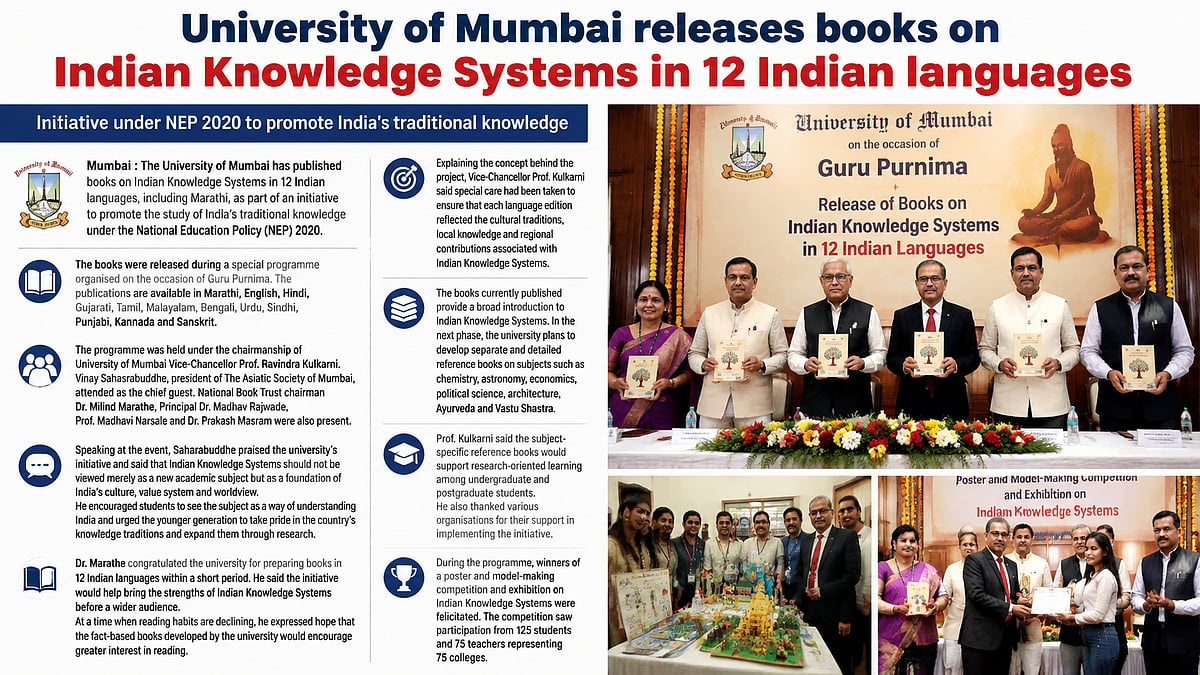
The University of Mumbai has published books on Indian Knowledge Systems in 12 Indian languages, including Marathi, as part of an initiative to promote the study of India’s traditional knowledge under the National Education Policy (NEP) 2020.
The books were released during a special programme organised on the occasion of Guru Purnima. The programme was held under the chairmanship of University of Mumbai Vice-Chancellor Prof. Ravindra Kulkarni. Vinay Sahasrabuddhe, president of The Asiatic Society of Mumbai, attended as the chief guest.
The publications are available in Marathi, English, Hindi, Gujarati, Tamil, Malayalam, Bengali, Urdu, Sindhi, Punjabi, Kannada and Sanskrit. Speaking at the event, Sahasrabuddhe praised the university’s initiative and said that Indian Knowledge Systems should not be viewed merely as a new academic subject but as a foundation of India’s culture, value system and worldview.
Dr. Milind Marathe, chairman of the National Book Trust, congratulated the university for preparing books in 12 Indian languages within a short period. He said the initiative would help bring the strengths of Indian Knowledge Systems before a wider audience. At a time when reading habits are declining, he expressed hope that the fact-based books developed by the university would encourage greater interest in reading.
Vice-Chancellor Prof. Kulkarni explained that special care had been taken to ensure that each language edition reflected the cultural traditions, local knowledge and regional contributions associated with Indian Knowledge Systems. The books currently published provide a broad introduction to Indian Knowledge Systems.
In the next phase, the university plans to develop separate and detailed reference books on subjects such as chemistry, astronomy, economics, political science, architecture, Ayurveda and Vastu Shastra. Prof. Kulkarni said the subject-specific reference books would support research-oriented learning among undergraduate and postgraduate students.
The university also felicitated winners of a poster and model-making competition and exhibition on Indian Knowledge Systems. The competition saw participation from 125 students and 75 teachers representing 75 colleges.
The initiative is a significant step towards promoting Indian Knowledge Systems and making them accessible to a wider audience. It is expected to encourage students to take pride in the country’s knowledge traditions and expand them through research.
The publication of these books is a major achievement under the National Education Policy 2020, which aims to promote India’s traditional knowledge and cultural heritage. The university’s effort is likely to have a positive impact on the education system and promote a better understanding of Indian Knowledge Systems among students and scholars.
In conclusion, the University of Mumbai’s initiative to publish books on Indian Knowledge Systems in 12 languages is a commendable effort to promote India’s traditional knowledge and cultural heritage. It is expected to have a significant impact on the education system and encourage students to take pride in the country’s knowledge traditions.
Frequently asked questions
What is the purpose of the books published by Mumbai University?
The books aim to promote the study of India’s traditional knowledge under the National Education Policy (NEP) 2020.
How many languages are the books available in?
The books are available in 12 Indian languages, including Marathi, English, and 10 other languages.