Mumbai's Oldest Ganeshotsav Celebrates 2,000-Year-Old Warli Art
Mumbai's oldest Ganeshotsav at Keshavji Naik Chawl showcases Warli art. The festival starts September 14.
'%3E%3Crect%20width%3D'96'%20height%3D'96'%20fill%3D'%23B3261E'%2F%3E%3Ccircle%20cx%3D'30'%20cy%3D'24'%20r%3D'44'%20fill%3D'%23fff'%20opacity%3D'.12'%2F%3E%3Ccircle%20cx%3D'60'%20cy%3D'74'%20r%3D'40'%20fill%3D'%23000'%20opacity%3D'.10'%2F%3E%3C%2Fg%3E%3Cg%20fill%3D'%23fff'%3E%3Crect%20x%3D'29'%20y%3D'49'%20width%3D'8'%20height%3D'19'%20rx%3D'1'%2F%3E%3Crect%20x%3D'39'%20y%3D'40'%20width%3D'9'%20height%3D'28'%20rx%3D'1'%2F%3E%3Crect%20x%3D'50'%20y%3D'45'%20width%3D'8'%20height%3D'23'%20rx%3D'1'%2F%3E%3Crect%20x%3D'60'%20y%3D'53'%20width%3D'7'%20height%3D'15'%20rx%3D'1'%2F%3E%3Crect%20x%3D'41'%20y%3D'34'%20width%3D'5'%20height%3D'6'%2F%3E%3C%2Fg%3E%3C%2Fsvg%3E)
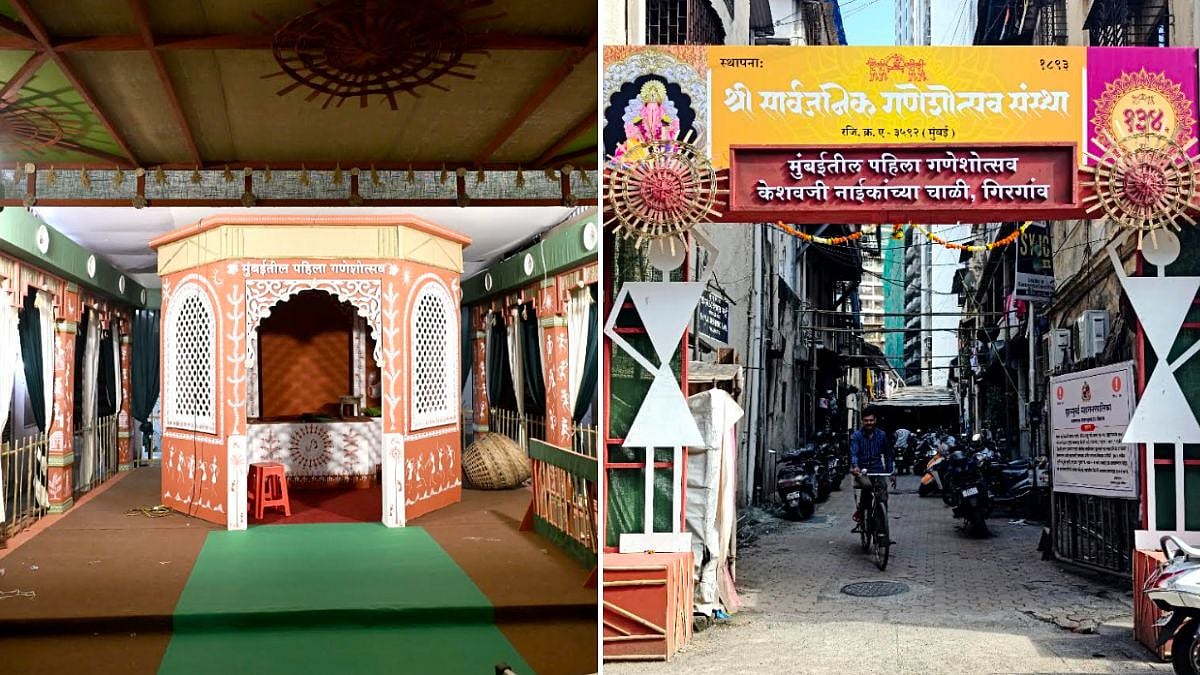
The city's oldest community Ganeshotsav celebration at Keshavji Naik Chawl in Girgaon will celebrate Warli art during this year's festival beginning September 14.
The pandal, established in 1893, has traditionally kept simplicity and tradition at the heart of its celebrations. This year, the theme was selected after the organisers approached an artist from the Sir J J School of Art, Architecture and Design, who suggested Warli art.
Warli art is one of Maharashtra's most distinctive traditional art forms, with a history spanning between 2,000 and 3,000 years. The art form uses rice paste, gum and water to create paintings on the mud walls of homes. Warli paintings are characterised by geometric forms such as lines, triangles and squares, which are used to depict scenes from everyday life and nature.
The Shree Sarvajanik Ganeshotsav Sanstha, which organises the festival, aims to strike a balance between honouring tradition and embracing modern times. Alongside the traditional theme, the mandal will organise lectures on artificial intelligence, drawing a connection with Lord Ganesh, who is worshipped as a symbol of wisdom.
Residents with expertise in the technology will speak at the sessions. A lecture on Seven Habits of Highly Effective People is also planned. The mandal will also launch a website to connect devotees digitally and make the festival more accessible and engaging.
Keshavji Naik Chawl, where the festival is held, was built as a cluster of four two-storey buildings between 1860 and 1862 by Keshavji Nayak, a shipowner, for his workers. The name underwent a change in spelling after the builder's death. A fifth building was added in 1925. Around 150 families currently live in the chawl.
The festival's emphasis on tradition and modernity reflects the evolving nature of Mumbai's cultural landscape. As the city continues to grow and change, events like the Ganeshotsav at Keshavji Naik Chawl serve as a reminder of the importance of preserving traditional art forms and cultural heritage.
The celebration of Warli art at the festival is a significant step towards promoting and preserving this ancient tribal heritage. By showcasing Warli art, the organisers aim to raise awareness about the art form and its significance in Maharashtra's cultural landscape.
In conclusion, the Ganeshotsav at Keshavji Naik Chawl is a unique blend of tradition and modernity, reflecting the city's diverse cultural heritage. The festival's emphasis on Warli art and its efforts to connect devotees digitally make it a significant event in Mumbai's cultural calendar.
The significance of the festival extends beyond the celebration of Ganeshotsav, as it highlights the importance of preserving traditional art forms and cultural heritage in the face of rapid urbanisation and modernisation. As Mumbai continues to evolve, events like the Ganeshotsav at Keshavji Naik Chawl serve as a reminder of the city's rich cultural diversity and its importance in shaping the city's identity.
Frequently asked questions
What is the theme of this year's Ganeshotsav at Keshavji Naik Chawl?
The theme of this year's Ganeshotsav at Keshavji Naik Chawl is Warli art, one of Maharashtra's most distinctive traditional art forms.
When does the festival start?
The festival starts on September 14.