Maharashtra's Protest Music Evolves Into Hip-Hop
Maharashtra's protest music transforms, blending folk with modern beats.
'%3E%3Crect%20width%3D'96'%20height%3D'96'%20fill%3D'%23B3261E'%2F%3E%3Ccircle%20cx%3D'30'%20cy%3D'24'%20r%3D'44'%20fill%3D'%23fff'%20opacity%3D'.12'%2F%3E%3Ccircle%20cx%3D'60'%20cy%3D'74'%20r%3D'40'%20fill%3D'%23000'%20opacity%3D'.10'%2F%3E%3C%2Fg%3E%3Cg%20fill%3D'%23fff'%3E%3Crect%20x%3D'29'%20y%3D'49'%20width%3D'8'%20height%3D'19'%20rx%3D'1'%2F%3E%3Crect%20x%3D'39'%20y%3D'40'%20width%3D'9'%20height%3D'28'%20rx%3D'1'%2F%3E%3Crect%20x%3D'50'%20y%3D'45'%20width%3D'8'%20height%3D'23'%20rx%3D'1'%2F%3E%3Crect%20x%3D'60'%20y%3D'53'%20width%3D'7'%20height%3D'15'%20rx%3D'1'%2F%3E%3Crect%20x%3D'41'%20y%3D'34'%20width%3D'5'%20height%3D'6'%2F%3E%3C%2Fg%3E%3C%2Fsvg%3E)
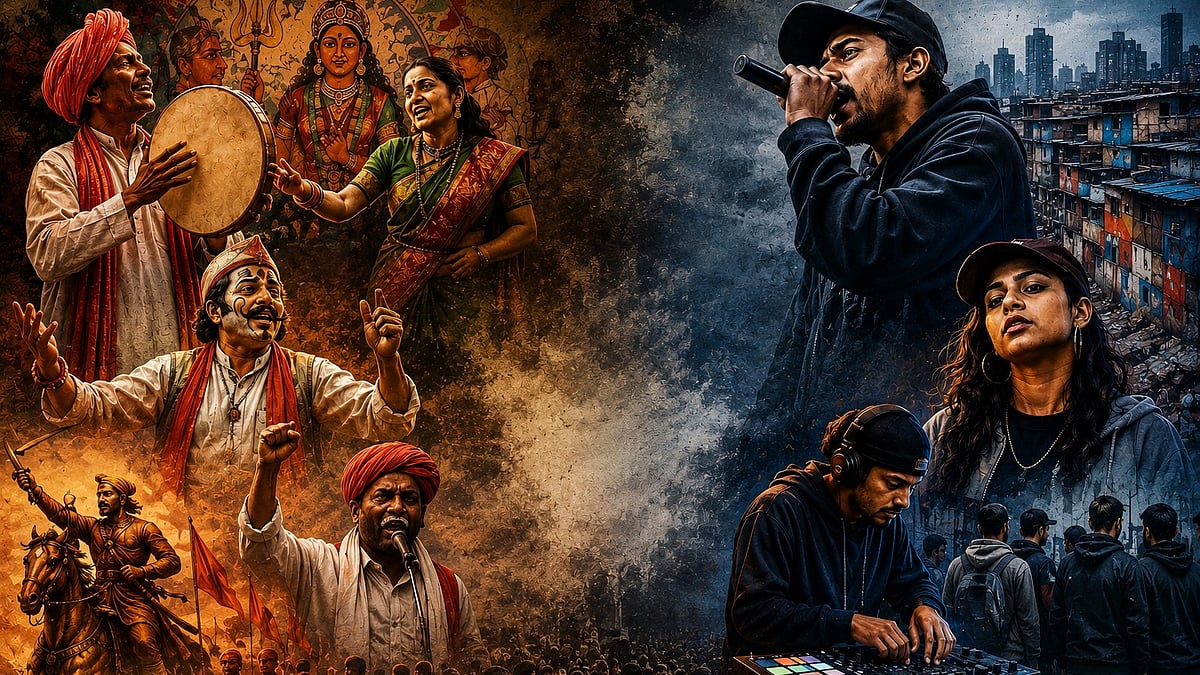
Maharashtra's protest music has a long history of challenging the status quo, dating back to medieval saint-poets who sang in the vernacular to challenge elite hegemony. Today, this tradition continues, with artists using music as a tool for social change.
The state's protest music has evolved over the centuries, from traditional folk forms like Gondhal and Bharud to modern genres like hip-hop and rap. Gondhal, a sacred ritual dedicated to goddesses like Renuka and Bhavani, has evolved beyond pure devotion to blend community gathering, patriotic fervour, and acute social commentary. Similarly, Bharud relied on narrative, humour, and theatrical address to expose societal hypocrisies.
During the COVID-19 pandemic, artists fine-tuned traditional folk forms like Powada, Gondhal, Bharud, and Lavani to communicate public health directives. This ability to adapt to modern crises has been a hallmark of Maharashtra's protest music. The Shahiri tradition, which emerged in the 19th and 20th centuries, is a direct political ancestor of modern street music. Satyashodhaki Jalsas transformed music into an ideological weapon to convey Mahatma Jyotirao Phule's anti-caste philosophy.
Veteran balladeer and music composer Sambhaji Bhagat approaches protest music with the analytical rigour of a novelist. He examines the reality of an issue, consults sociologists to study the mental makeup and language of modern youth, and identifies which forms resonate. For Bhagat, the underlying mechanics of art in social movements remain grounded in power dynamics. The oppressed rely on counter-culture, using art, music, and voice as tools against cultural hegemony.
Modern youth protests, such as the widespread NEET demonstrations, have seen a vital evolutionary leap, with young artists fusing folk traditions with modern genres. This blending of traditional and modern forms has given Maharashtra's protest music a new lease on life. As Bhagat notes, a voice cannot be shot, only a body can, making music a powerful tool for social change.
The evolution of Maharashtra's protest music is a testament to the state's rich cultural heritage and its ability to adapt to changing times. From traditional folk forms to modern genres like hip-hop and rap, music has remained a powerful tool for social change. As the state continues to grapple with social and economic issues, its protest music is likely to remain a vital part of the conversation.
In conclusion, Maharashtra's protest music has come a long way, from its roots in traditional folk forms to its modern incarnations in hip-hop and rap. Its ability to adapt to changing times and its continued relevance in modern social movements make it a powerful tool for social change.
The significance of Maharashtra's protest music lies in its ability to give voice to the marginalized and oppressed. It has been a powerful tool for social change, inspiring movements and challenging the status quo. As the state continues to evolve and grow, its protest music is likely to remain an important part of its cultural heritage.
Maharashtra's protest music is a testament to the power of art and culture to bring about social change. It has been a vital part of the state's history and continues to play an important role in modern social movements. As the state looks to the future, its protest music is likely to remain a powerful tool for inspiring change and challenging the status quo.
In the end, Maharashtra's protest music is a reminder of the importance of giving voice to the marginalized and oppressed. It has been a powerful tool for social change, and its continued relevance in modern times is a testament to its enduring power. As the state continues to grapple with social and economic issues, its protest music is likely to remain a vital part of the conversation.
Frequently asked questions
What is the significance of Maharashtra's protest music?
Maharashtra's protest music has been a powerful tool for social change, inspiring movements and challenging the status quo.
How has Maharashtra's protest music evolved over time?
Maharashtra's protest music has evolved from traditional folk forms like Gondhal and Bharud to modern genres like hip-hop and rap.