Cotton: India's Valuable White Gold
Cotton is India's white gold, but why?
'%3E%3Crect%20width%3D'96'%20height%3D'96'%20fill%3D'%23C2185B'%2F%3E%3Ccircle%20cx%3D'30'%20cy%3D'24'%20r%3D'44'%20fill%3D'%23fff'%20opacity%3D'.12'%2F%3E%3Ccircle%20cx%3D'60'%20cy%3D'74'%20r%3D'40'%20fill%3D'%23000'%20opacity%3D'.10'%2F%3E%3C%2Fg%3E%3Cpath%20fill%3D'%23fff'%20d%3D'M48%2031%20l4.6%2010.2%2011.2%201%20-8.4%207.5%202.5%2011%20-9.9%20-5.8%20-9.9%205.8%202.5%20-11%20-8.4%20-7.5%2011.2%20-1%20z'%2F%3E%3C%2Fsvg%3E)
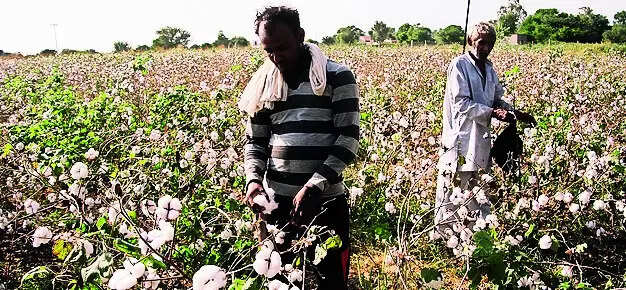
Cotton is often referred to as India's 'white gold' due to its significant economic and cultural importance. India is the second-largest producer of cotton in the world, accounting for around 15% of global production. The country's cotton industry is worth billions of dollars and provides livelihoods for millions of people.
The Indian cotton industry is primarily driven by the country's favorable climate and soil conditions, which allow for multiple harvests per year. The major cotton-producing states in India are Maharashtra, Gujarat, Punjab, and Haryana. These states account for over 80% of the country's total cotton production.
Cotton is a crucial crop for India's economy, with the textile industry being one of the largest employers in the country. The industry provides jobs for millions of people, from farmers to factory workers. India's cotton production has been increasing steadily over the years, with the country producing over 30 million bales of cotton in 2020.
The Indian government has implemented various initiatives to support the cotton industry, including the Cotton Corporation of India (CCI), which provides price support to farmers and helps to stabilize the market. The government has also launched schemes to promote the use of advanced technology and sustainable farming practices in the cotton industry.
Despite its importance, the Indian cotton industry faces several challenges, including climate change, water scarcity, and pest management. The industry is also heavily dependent on imports of cotton from other countries, which can impact the domestic market.
In recent years, there has been a growing focus on sustainable and organic cotton production in India. Many farmers are adopting environmentally friendly practices, such as using natural pesticides and reducing water usage. This shift towards sustainable cotton production is expected to have a positive impact on the environment and the industry as a whole.
In conclusion, cotton is indeed India's 'white gold', given its significant economic and cultural importance. The industry provides livelihoods for millions of people and is a crucial driver of the country's economy. With the government's support and the adoption of sustainable practices, the Indian cotton industry is expected to continue to thrive in the coming years.
The cotton industry's impact on the Indian economy cannot be overstated. It is a major contributor to the country's GDP and provides employment opportunities for millions of people. As the industry continues to grow and evolve, it is likely to play an increasingly important role in shaping India's economic future.
Overall, the significance of cotton in India is multifaceted. It is not only an important crop for the country's economy but also has cultural and historical significance. The industry's growth and development are crucial for the country's economic progress, and it is likely to remain a vital part of India's economy for years to come.
The Indian government's initiatives to support the cotton industry are expected to have a positive impact on the sector. The focus on sustainable and organic cotton production is also likely to benefit the environment and the industry as a whole. As the industry continues to evolve, it is likely to play an increasingly important role in shaping India's economic future.
In the coming years, the Indian cotton industry is expected to face several challenges, including climate change and water scarcity. However, with the government's support and the adoption of sustainable practices, the industry is likely to continue to thrive. The significance of cotton in India is undeniable, and its importance is expected to endure for years to come.
Frequently asked questions
Why is cotton important to India's economy?
Cotton is a crucial crop for India's economy, providing livelihoods for millions of people and contributing significantly to the country's GDP.
What are the major challenges facing the Indian cotton industry?
The Indian cotton industry faces several challenges, including climate change, water scarcity, and pest management.