India's Cities Leave Toxic Health Footprint
Indian cities' wastewater poses health risks, only 28% treated daily
'%3E%3Crect%20width%3D'96'%20height%3D'96'%20fill%3D'%23B3261E'%2F%3E%3Ccircle%20cx%3D'30'%20cy%3D'24'%20r%3D'44'%20fill%3D'%23fff'%20opacity%3D'.12'%2F%3E%3Ccircle%20cx%3D'60'%20cy%3D'74'%20r%3D'40'%20fill%3D'%23000'%20opacity%3D'.10'%2F%3E%3C%2Fg%3E%3Cg%20fill%3D'%23fff'%3E%3Crect%20x%3D'29'%20y%3D'49'%20width%3D'8'%20height%3D'19'%20rx%3D'1'%2F%3E%3Crect%20x%3D'39'%20y%3D'40'%20width%3D'9'%20height%3D'28'%20rx%3D'1'%2F%3E%3Crect%20x%3D'50'%20y%3D'45'%20width%3D'8'%20height%3D'23'%20rx%3D'1'%2F%3E%3Crect%20x%3D'60'%20y%3D'53'%20width%3D'7'%20height%3D'15'%20rx%3D'1'%2F%3E%3Crect%20x%3D'41'%20y%3D'34'%20width%3D'5'%20height%3D'6'%2F%3E%3C%2Fg%3E%3C%2Fsvg%3E)
A city's success is often measured by its internal achievements, but its impact on the surrounding environment and downstream communities is just as important. The Municipal Performance Index 2020 revealed that sanitation and solid waste management in Indian cities scored an average of 48.22, while water and wastewater management scored 38.06, and health scored the lowest at 26.72.
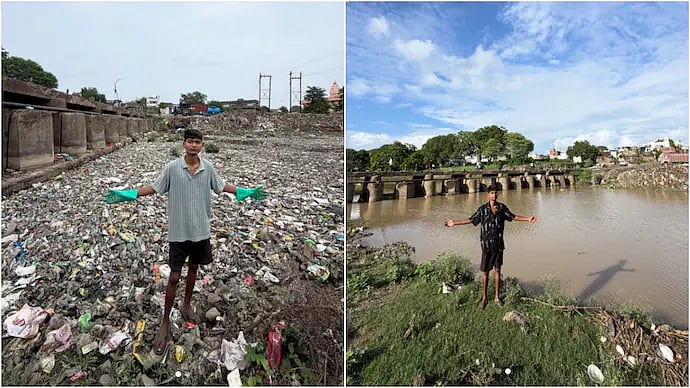
The economic activities of urbanizing cities generate large amounts of waste, including sewage that contains residues of antibiotics, antidepressants, hormones, industrial solvents, heavy metals, and microplastics. Conventional wastewater treatment plants are not equipped to handle these contaminants, which then enter rivers and pose public health risks.
According to the Central Pollution Control Board (CPCB), Indian cities generate over 72,000 million liters of sewage daily, but only around 28% is treated before being discharged into rivers and water bodies. The remaining wastewater becomes part of irrigation networks, groundwater recharge, fisheries, and food systems that sustain millions of people living downstream.
The Union Government has recognized the need to strengthen urban wastewater infrastructure and has funded sewerage and septage projects under the Atal Mission for Rejuvenation and Urban Transformation (AMRUT) scheme. The scheme aims to add roughly 5,792 Million Litre per Day (MLD) of treatment capacity. However, as of mid-2026, only 104 projects (18%) had been completed, while 398 remained under implementation, and several were yet to be tendered.
The responsibility for managing the health risks associated with wastewater falls between institutional cracks, with municipal bodies managing sewerage, pollution control boards regulating effluent, public health agencies monitoring disease, and agricultural departments overseeing food systems. Making these downstream health externalities visible is the first step towards governing them.
For decades, cities have been measured by their production of jobs, infrastructure, growth, and services. However, it is now time to consider the health footprint of cities and how their activities impact the environment and surrounding communities. This requires a new policy lens that takes into account the cumulative health externalities that cities export but rarely account for.
The extension of the AMRUT mission until March 2027 provides an opportunity for the government to reassess its strategy and prioritize the completion of pending projects. It is essential to address the issue of wastewater management to prevent the spread of waterborne diseases and protect the health of millions of people living downstream.
In conclusion, the health footprint of Indian cities is a critical issue that requires immediate attention. The government, municipal bodies, and other stakeholders must work together to strengthen urban wastewater infrastructure and ensure that the health risks associated with wastewater are mitigated. This can be achieved by implementing effective wastewater treatment systems, monitoring water quality, and promoting sustainable practices.
The impact of a city's health footprint is not limited to its boundaries; it has far-reaching consequences for the environment, surrounding communities, and the overall health of the population. Therefore, it is essential to adopt a holistic approach to urban planning and management, one that considers the health footprint of cities and strives to minimize its negative impacts.
Ultimately, the success of a city should not be measured solely by its internal achievements but also by its impact on the surrounding environment and downstream communities. By prioritizing the health footprint of cities, we can create a healthier, more sustainable, and more equitable environment for all.
Frequently asked questions
What is the daily sewage generation in Indian cities?
Indian cities generate over 72,000 million liters of sewage daily.
What percentage of sewage is treated before discharge in India?
Only around 28% of sewage is treated before being discharged into rivers and water bodies.