NCLT Rejects Canara Bank's ₹742 Crore Insolvency Plea
NCLT rejects Canara Bank's plea against NSD Nirman. Bank's claim barred by limitation.
'%3E%3Crect%20width%3D'96'%20height%3D'96'%20fill%3D'%23B3261E'%2F%3E%3Ccircle%20cx%3D'30'%20cy%3D'24'%20r%3D'44'%20fill%3D'%23fff'%20opacity%3D'.12'%2F%3E%3Ccircle%20cx%3D'60'%20cy%3D'74'%20r%3D'40'%20fill%3D'%23000'%20opacity%3D'.10'%2F%3E%3C%2Fg%3E%3Cg%20fill%3D'%23fff'%3E%3Crect%20x%3D'29'%20y%3D'49'%20width%3D'8'%20height%3D'19'%20rx%3D'1'%2F%3E%3Crect%20x%3D'39'%20y%3D'40'%20width%3D'9'%20height%3D'28'%20rx%3D'1'%2F%3E%3Crect%20x%3D'50'%20y%3D'45'%20width%3D'8'%20height%3D'23'%20rx%3D'1'%2F%3E%3Crect%20x%3D'60'%20y%3D'53'%20width%3D'7'%20height%3D'15'%20rx%3D'1'%2F%3E%3Crect%20x%3D'41'%20y%3D'34'%20width%3D'5'%20height%3D'6'%2F%3E%3C%2Fg%3E%3C%2Fsvg%3E)
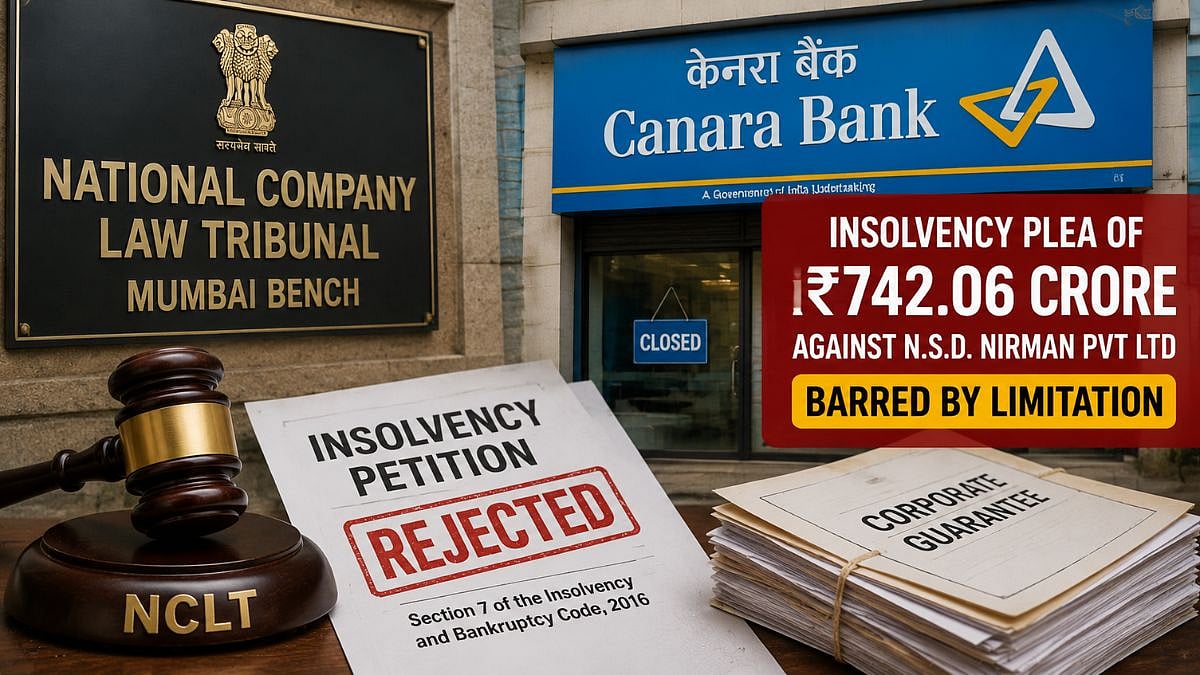
The National Company Law Tribunal (NCLT) in Mumbai has rejected Canara Bank's insolvency plea of ₹742.06 crore against NSD Nirman Private Limited. The plea was filed under Section 7 of the Insolvency and Bankruptcy Code (IBC) and sought initiation of Corporate Insolvency Resolution Process (CIRP) against NSD Nirman, which had stood as a corporate guarantor for Frost International Ltd.
The bank had claimed an outstanding amount of ₹742.06 crore as on March 31, 2025, besides future interest, costs and charges. However, the Tribunal held that the bank's claim against the corporate guarantor was barred by limitation. The main point of discussion before the tribunal was the date from which limitation for enforcing the corporate guarantee began.
The Tribunal examined an earlier notice issued on September 1, 2018, and concluded that the guarantee had already been invoked at that stage. The guarantee was an on-demand guarantee, and the September 1, 2018 notice gave five days to make payment. Consequently, limitation against the corporate guarantor commenced from September 6, 2018.
The Tribunal noted that the limitation for filing an application under Section 7 of the Code is three years and is governed by Article 137 of the Limitation Act, 1963. The bank had not produced any valid acknowledgement by NSD Nirman that could have extended this period after the 2018 invocation. The Tribunal also rejected the bank's reliance on the January 20, 2025 demand notice, holding that once the guarantee had been invoked in 2018 and the limitation period had begun, a fresh demand notice issued years later could not create a new cause of action.
The Tribunal clarified that although insolvency proceedings against a corporate guarantor can be initiated independently of proceedings against the principal borrower, such proceedings must themselves be filed within the prescribed limitation period. Concluding that the January 2025 notice was beyond the permissible limitation period, the bench held that the application was “hopelessly barred by limitation.”
This decision is significant as it highlights the importance of adhering to the limitation period in insolvency proceedings. The Tribunal's ruling also provides clarity on the invocation of corporate guarantees and the commencement of limitation periods. The decision is likely to have implications for banks and financial institutions seeking to initiate insolvency proceedings against corporate guarantors.
In recent years, there have been several instances of banks and financial institutions facing challenges in recovering debts from corporate borrowers. The Insolvency and Bankruptcy Code (IBC) was introduced to provide a framework for resolving insolvency and bankruptcy cases in a timely and efficient manner. However, the code also provides for limitation periods, which can bar claims if not adhered to.
The NCLT's decision in this case serves as a reminder to banks and financial institutions to ensure that they adhere to the limitation periods prescribed under the IBC. Failure to do so can result in claims being barred, as seen in this case. The decision also highlights the importance of careful planning and strategy in insolvency proceedings, including the invocation of corporate guarantees and the commencement of limitation periods.
In conclusion, the NCLT's rejection of Canara Bank's insolvency plea against NSD Nirman Private Limited is a significant decision that highlights the importance of adhering to limitation periods in insolvency proceedings. The decision provides clarity on the invocation of corporate guarantees and the commencement of limitation periods, and is likely to have implications for banks and financial institutions seeking to initiate insolvency proceedings against corporate guarantors.
The implications of this decision are far-reaching, and are likely to impact the way banks and financial institutions approach insolvency proceedings. The decision also underscores the need for careful planning and strategy in insolvency proceedings, including the invocation of corporate guarantees and the commencement of limitation periods. As the Indian economy continues to grow and evolve, the importance of effective insolvency resolution mechanisms cannot be overstated.
In the context of the Indian economy, the NCLT's decision is a significant development that is likely to have far-reaching implications. The decision highlights the importance of adherence to limitation periods in insolvency proceedings, and provides clarity on the invocation of corporate guarantees and the commencement of limitation periods. As the Indian economy continues to grow and evolve, the need for effective insolvency resolution mechanisms is likely to become increasingly important.
The NCLT's decision is also significant in the context of the ongoing efforts to strengthen the Indian banking system. The decision highlights the importance of careful planning and strategy in insolvency proceedings, and underscores the need for banks and financial institutions to adhere to limitation periods. As the Indian banking system continues to evolve, the importance of effective insolvency resolution mechanisms is likely to become increasingly important.
In conclusion, the NCLT's rejection of Canara Bank's insolvency plea against NSD Nirman Private Limited is a significant decision that highlights the importance of adhering to limitation periods in insolvency proceedings. The decision provides clarity on the invocation of corporate guarantees and the commencement of limitation periods, and is likely to have implications for banks and financial institutions seeking to initiate insolvency proceedings against corporate guarantors. The decision is also significant in the context of the Indian economy and the ongoing efforts to strengthen the Indian banking system.
The decision is likely to have a significant impact on the way banks and financial institutions approach insolvency proceedings, and is likely to lead to increased scrutiny of limitation periods in such proceedings. The decision also underscores the importance of careful planning and strategy in insolvency proceedings, including the invocation of corporate guarantees and the commencement of limitation periods. As the Indian economy continues to grow and evolve, the importance of effective insolvency resolution mechanisms is likely to become increasingly important.
In the final analysis, the NCLT's decision is a significant development that is likely to have far-reaching implications for banks and financial institutions seeking to initiate insolvency proceedings against corporate guarantors. The decision highlights the importance of adherence to limitation periods in insolvency proceedings, and provides clarity on the invocation of corporate guarantees and the commencement of limitation periods. As the Indian economy continues to grow and evolve, the need for effective insolvency resolution mechanisms is likely to become increasingly important.
The decision is a significant milestone in the ongoing efforts to strengthen the Indian banking system, and is likely to lead to increased scrutiny of limitation periods in insolvency proceedings. The decision also underscores the importance of careful planning and strategy in insolvency proceedings, including the invocation of corporate guarantees and the commencement of limitation periods. As the Indian economy continues to grow and evolve, the importance of effective insolvency resolution mechanisms is likely to become increasingly important.
In conclusion, the NCLT's rejection of Canara Bank's insolvency plea against NSD Nirman Private Limited is a significant decision that highlights the importance of adhering to limitation periods in insolvency proceedings. The decision provides clarity on the invocation of corporate guarantees and the commencement of limitation periods, and is likely to have implications for banks and financial institutions seeking to initiate insolvency proceedings against corporate guarantors. The decision is also significant in the context of the Indian economy and the ongoing efforts to strengthen the Indian banking system.
What it means for Mumbai is that the decision is likely to have a significant impact on the way banks and financial institutions approach insolvency proceedings in the city. The decision highlights the importance of adherence to limitation periods in insolvency proceedings, and provides clarity on the invocation of corporate guarantees and the commencement of limitation periods. As the Indian economy continues to grow and evolve, the need for effective insolvency resolution mechanisms is likely to become increasingly important.
The decision is also significant in the context of the Mumbai economy, and is likely to lead to increased scrutiny of limitation periods in insolvency proceedings. The decision underscores the importance of careful planning and strategy in insolvency proceedings, including the invocation of corporate guarantees and the commencement of limitation periods. As the Mumbai economy continues to grow and evolve, the importance of effective insolvency resolution mechanisms is likely to become increasingly important.
In the final analysis, the NCLT's decision is a significant development that is likely to have far-reaching implications for banks and financial institutions seeking to initiate insolvency proceedings against corporate guarantors in Mumbai. The decision highlights the importance of adherence to limitation periods in insolvency proceedings, and provides clarity on the invocation of corporate guarantees and the commencement of limitation periods. As the Mumbai economy continues to grow and evolve, the need for effective insolvency resolution mechanisms is likely to become increasingly important.
Frequently asked questions
What was the amount of Canara Bank's insolvency plea against NSD Nirman Private Limited?
The amount was ₹742.06 crore.
Why was Canara Bank's insolvency plea rejected?
The plea was rejected because it was barred by limitation.