India's AI Education Push Faces Challenges
Only 13% of Indian schools fully integrate AI, 91% of teachers want clear rules
'%3E%3Crect%20width%3D'96'%20height%3D'96'%20fill%3D'%23B3261E'%2F%3E%3Ccircle%20cx%3D'30'%20cy%3D'24'%20r%3D'44'%20fill%3D'%23fff'%20opacity%3D'.12'%2F%3E%3Ccircle%20cx%3D'60'%20cy%3D'74'%20r%3D'40'%20fill%3D'%23000'%20opacity%3D'.10'%2F%3E%3C%2Fg%3E%3Cg%20fill%3D'%23fff'%3E%3Crect%20x%3D'29'%20y%3D'49'%20width%3D'8'%20height%3D'19'%20rx%3D'1'%2F%3E%3Crect%20x%3D'39'%20y%3D'40'%20width%3D'9'%20height%3D'28'%20rx%3D'1'%2F%3E%3Crect%20x%3D'50'%20y%3D'45'%20width%3D'8'%20height%3D'23'%20rx%3D'1'%2F%3E%3Crect%20x%3D'60'%20y%3D'53'%20width%3D'7'%20height%3D'15'%20rx%3D'1'%2F%3E%3Crect%20x%3D'41'%20y%3D'34'%20width%3D'5'%20height%3D'6'%2F%3E%3C%2Fg%3E%3C%2Fsvg%3E)
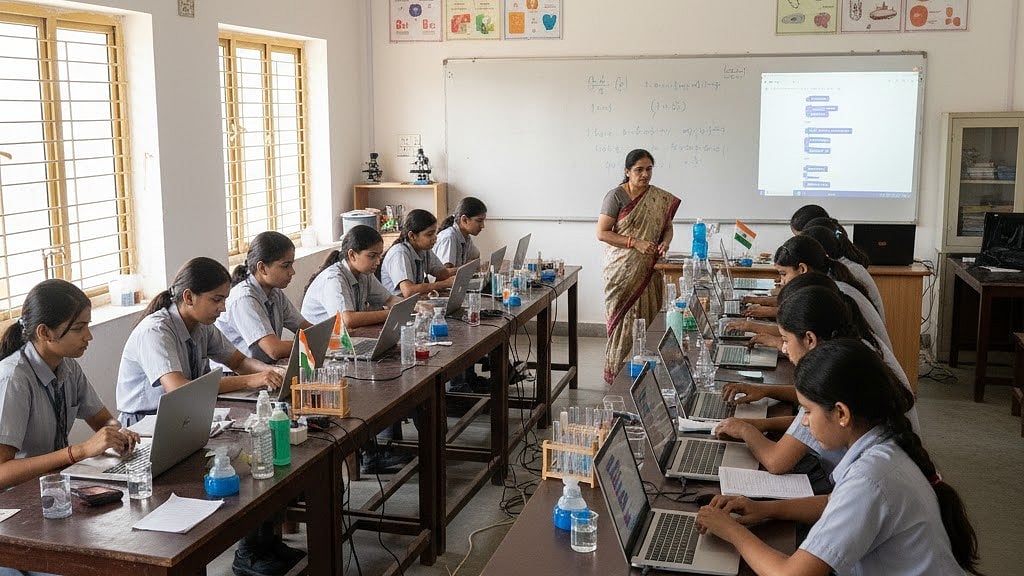
India's push to integrate artificial intelligence in education is facing a readiness gap, with only 13% of schools achieving advanced system-wide integration of AI.
A new report by QS I-GAUGE, an independent education-rating system, found that 91% of teachers believe it is necessary for schools to establish clear parameters defining boundaries for the use of AI by students in academic work.
The report is based on voluntary surveys that drew responses from 1,209 teachers from 71 K-12 institutions across 21 states and Union Territories, and 1,118 faculty responses from 146 higher education institutions across 27 states and UTs.
The surveys examined institutional readiness, teacher capacity, governance, classroom use, and concerns about integrity, privacy, and excessive dependence on automation.
Among schoolteachers, 88% said their leadership regarded AI as vital to future-ready education, and 86% said their schools were prepared to offer structured professional development.
However, institutional readiness remained uneven, with 25% of schools at the structured-implementation stage, 25% at the exploration stage, 15% at the awareness stage, 14% at the partial implementation stage, 5% at the pilot stage, and 3% reporting no readiness.
While 91% of school teachers wanted defined boundaries for student use, faculty-use protocols, cyber safety, and academic-integrity frameworks were among the top identified priorities.
Parents' leading concerns, as reported by teachers, were data privacy and cognitive dependence, both at 77%, followed by increased screen time at 76%.
In colleges and universities, 83% of faculty said AI could make administrative work more efficient, and 76% expected it to improve academic performance.
However, 78% of faculty members were concerned that relying too heavily on AI tools would reduce students' independent thinking and problem-solving skills.
The report highlights the need for clear guidelines and protocols for the use of AI in education, as well as the importance of addressing concerns about data privacy, cognitive dependence, and excessive screen time.
As India continues to push for the integration of AI in education, it is essential to address these challenges and ensure that the benefits of AI are realized while minimizing its risks.
The Indian government has been actively promoting the use of AI in education, with initiatives such as the National Education Policy 2020, which emphasizes the importance of AI and other emerging technologies in education.
However, the report suggests that more needs to be done to support the effective integration of AI in schools and colleges, including providing teachers with the necessary training and resources, and establishing clear guidelines and protocols for the use of AI.
In conclusion, while India's AI education push is a step in the right direction, it faces significant challenges, including a readiness gap and concerns about data privacy, cognitive dependence, and excessive screen time.
Addressing these challenges will be crucial to ensuring that the benefits of AI are realized in Indian education.
Frequently asked questions
What percentage of Indian schools have fully integrated AI?
Only 13% of Indian schools have achieved advanced system-wide integration of AI.
What is the main concern of teachers regarding AI use in education?
91% of teachers believe it is necessary for schools to establish clear parameters defining boundaries for the use of AI by students in academic work.