Poornima Restaurant Challenges FDA Licence Suspension
Mumbai's iconic Poornima Restaurant moves Bombay HC against FDA's FSSAI licence suspension
'%3E%3Crect%20width%3D'96'%20height%3D'96'%20fill%3D'%23B3261E'%2F%3E%3Ccircle%20cx%3D'30'%20cy%3D'24'%20r%3D'44'%20fill%3D'%23fff'%20opacity%3D'.12'%2F%3E%3Ccircle%20cx%3D'60'%20cy%3D'74'%20r%3D'40'%20fill%3D'%23000'%20opacity%3D'.10'%2F%3E%3C%2Fg%3E%3Cg%20fill%3D'%23fff'%3E%3Crect%20x%3D'29'%20y%3D'49'%20width%3D'8'%20height%3D'19'%20rx%3D'1'%2F%3E%3Crect%20x%3D'39'%20y%3D'40'%20width%3D'9'%20height%3D'28'%20rx%3D'1'%2F%3E%3Crect%20x%3D'50'%20y%3D'45'%20width%3D'8'%20height%3D'23'%20rx%3D'1'%2F%3E%3Crect%20x%3D'60'%20y%3D'53'%20width%3D'7'%20height%3D'15'%20rx%3D'1'%2F%3E%3Crect%20x%3D'41'%20y%3D'34'%20width%3D'5'%20height%3D'6'%2F%3E%3C%2Fg%3E%3C%2Fsvg%3E)
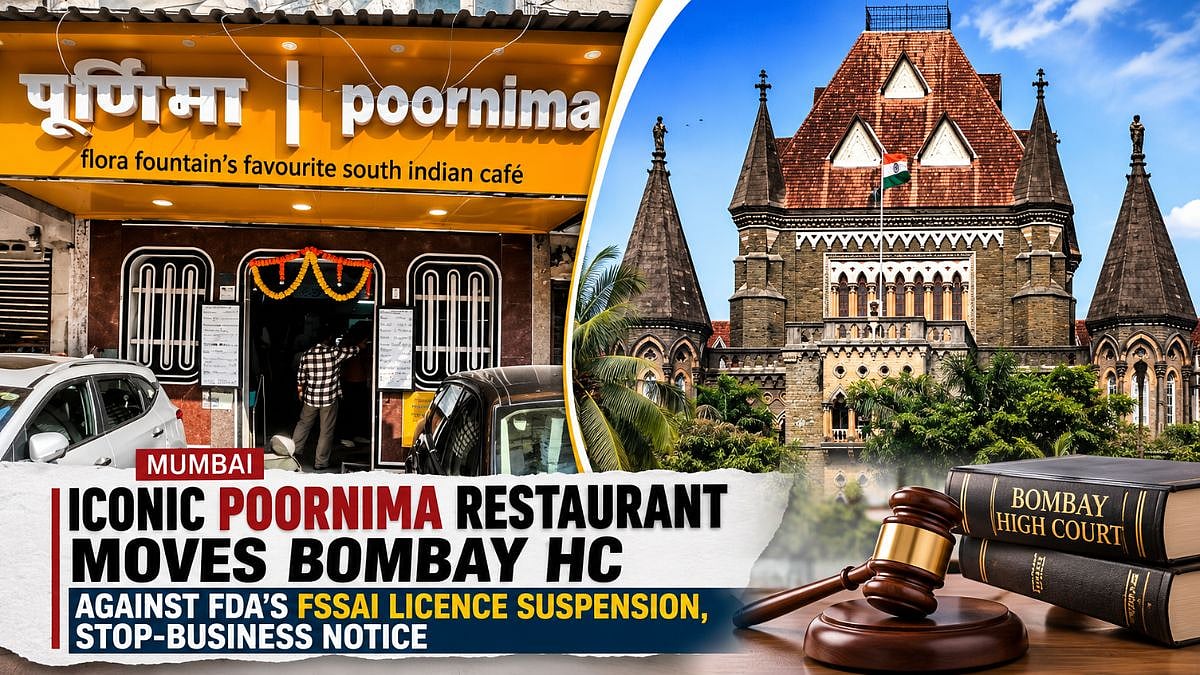
Mumbai's iconic South Mumbai eatery, M/s Poornima Restaurant, has approached the Bombay High Court challenging the suspension of its Food Safety and Standards Authority of India (FSSAI) licence and a stop-business notice issued by the Maharashtra Food and Drug Administration (FDA). The restaurant alleges that the action was arbitrary, illegal, and taken in violation of due process.
The writ petition, filed through its proprietor, Pramod Nayak, seeks to quash the notices issued on July 23 following a surprise inspection by FDA officials. The restaurant has also sought an interim stay on the suspension and closure orders, saying it should be allowed to resume operations until the matter is decided by the court.
In its petition, the iconic Udupi restaurant in Fort has levelled serious allegations of procedural irregularities against the FDA. It claimed that officials acted in a high-handed manner, manipulated records, and failed to follow the procedure prescribed under the Food Safety and Standards Act before suspending its licence.
The FDA inspection report had cited several alleged violations, including unhygienic storage conditions, wet kitchen floors, a defective refrigerator door, improper display of the FSSAI licence, and inadequate measures to prevent pest entry. However, the restaurant has denied the allegations, submitting photographs before the High Court to show that the refrigerator door was functioning properly and that protective mesh had been installed on the windows to prevent pests.
The management also said the kitchen floor was wet because routine cleaning was in progress when the inspection was carried out. The petition further alleged that food safety officials sent inspection-related emails only after completing the raid in an attempt to create records showing that proper procedure had been followed.
The restaurant also claimed that the FDA ordered the closure of a second licensed premises even though it had not been inspected. The petition stated that the impugned action has been taken in complete disregard of the statutory procedure and principles of natural justice.
According to the restaurant, the FDA failed to issue a mandatory improvement notice before suspending its licence, even though such a step is required before taking drastic action in cases where deficiencies can be rectified. The petition also alleged that the authorities have been conducting a series of raids on food establishments, immediately sharing photographs and videos on social media, and damaging the reputation of businesses before any adjudication is completed.
The suspension of the FSSAI licence and the stop-business notice have significant implications for the restaurant, its employees, and its customers. The restaurant has urged the High Court to stay the operation of the suspension and stop-business notices, contending that the action has caused irreparable harm to its reputation and business.
The case highlights the importance of following due process and adhering to statutory procedures in regulatory actions. It also raises questions about the conduct of food safety officials and the impact of their actions on businesses and the public.
In conclusion, the Poornima Restaurant's challenge to the FDA's licence suspension and stop-business notice is a significant development in the ongoing debate about food safety and regulatory oversight in Mumbai. The outcome of the case will have important implications for the restaurant industry and the public, and will likely be closely watched by stakeholders and regulators alike.
Frequently asked questions
Why was Poornima Restaurant's FSSAI licence suspended?
The FDA cited unhygienic storage conditions, wet kitchen floors, and other alleged violations.
What is the restaurant seeking from the Bombay High Court?
The restaurant is seeking to quash the suspension and stop-business notices, and to be allowed to resume operations until the matter is decided by the court.