
FCNR(B) Inflows May Cut Banks' Funding Costs By 50 Bps
Robust FCNR(B) inflows boost liquidity, reduce dependence on CDs. Banks' funding costs may decline by up to 50 basis points.
'%3E%3Crect%20width%3D'96'%20height%3D'96'%20fill%3D'%230B6E4F'%2F%3E%3Ccircle%20cx%3D'30'%20cy%3D'24'%20r%3D'44'%20fill%3D'%23fff'%20opacity%3D'.12'%2F%3E%3Ccircle%20cx%3D'60'%20cy%3D'74'%20r%3D'40'%20fill%3D'%23000'%20opacity%3D'.10'%2F%3E%3C%2Fg%3E%3Cg%20fill%3D'none'%20stroke%3D'%23fff'%20stroke-width%3D'3.2'%20stroke-linecap%3D'round'%20stroke-linejoin%3D'round'%3E%3Cpolyline%20points%3D'31%2C59%2041%2C49%2049%2C54%2063%2C37'%2F%3E%3Cpolyline%20points%3D'55%2C37%2063%2C37%2063%2C45'%2F%3E%3C%2Fg%3E%3C%2Fsvg%3E)
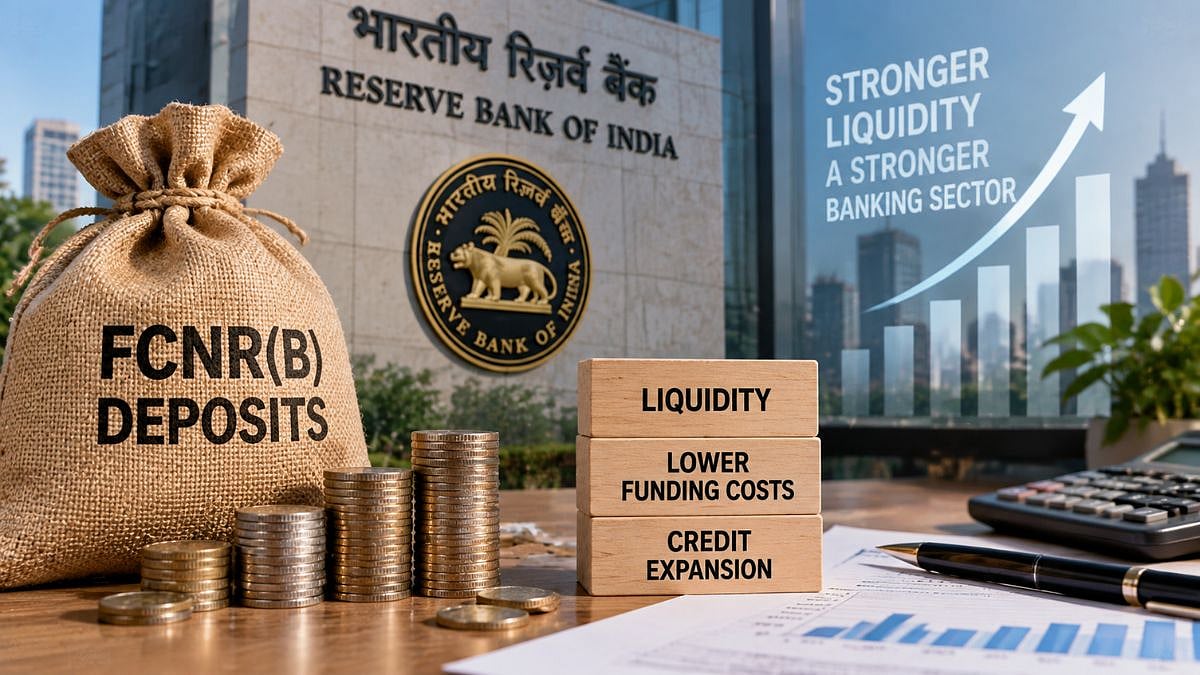
The cost of funds for Indian banks is expected to decline by up to 50 basis points due to robust Foreign Currency Non-Resident (Bank), or FCNR(B), inflows. This influx of funds is boosting liquidity and reducing dependence on higher-cost certificates of deposit (CDs).
According to multiple reports, the surplus liquidity is expected to support credit expansion, particularly in short-term lending. It will also enable refinancing agencies to prepay costlier loans. Banks' liquidity coverage ratio (LCR) may improve by up to 1 percentage point.
The impact of FCNR(B) inflows is visible in the CD market, with banks raising Rs 68,130 crore in August, the lowest since April. In comparison, issuances were Rs 1.11 lakh crore in May, Rs 1.80 lakh crore in June, and Rs 95,945 crore in July.
CD rates have also declined sharply since the Reserve Bank of India (RBI) announced the FCNR(B) swap facility on June 8. The three-month rate fell 130 bps to 5.86 per cent on September 3 from 7.16 per cent on June 8, while the one-year rate declined 50 bps to 7.02 per cent.
Global brokerage Jefferies estimates that FCNR(B) deposits could create an additional annual profit pool of Rs 10,000-11,000 crore for banks, equivalent to around 2 per cent of their profit before tax. Banks could deploy the funds in fresh loans, refinance older high-cost borrowings, or park them with the RBI under the Standing Deposit Facility.
The RBI reported strong FCNR(B) mobilisation, with banks mobilising $127.23 billion through FCNR(B) deposits by August 31. Overseas foreign currency borrowing and external commercial borrowing contributed $5.26 billion and $3.89 billion, respectively, taking the total to $136.38 billion.
The decline in funding costs is expected to have a positive impact on the banking sector, with improved liquidity and reduced dependence on higher-cost CDs. This, in turn, is expected to support credit expansion and improve the overall financial health of banks.
In the long run, the increased liquidity and reduced funding costs are expected to have a positive impact on the Indian economy, with increased credit availability and reduced borrowing costs for businesses and individuals.
The RBI's move to introduce the FCNR(B) swap facility has been instrumental in boosting liquidity and reducing funding costs for banks. The facility has enabled banks to raise funds at a lower cost, which is expected to have a positive impact on their profitability.
Overall, the robust FCNR(B) inflows are expected to have a positive impact on the Indian banking sector, with improved liquidity, reduced funding costs, and increased credit expansion. This, in turn, is expected to have a positive impact on the Indian economy, with increased credit availability and reduced borrowing costs for businesses and individuals.
The impact of FCNR(B) inflows on the banking sector is a significant development, and it will be interesting to see how it plays out in the coming months. With the RBI's efforts to boost liquidity and reduce funding costs, the Indian banking sector is expected to become more competitive and efficient.
In conclusion, the FCNR(B) inflows are expected to have a positive impact on the Indian banking sector, with improved liquidity, reduced funding costs, and increased credit expansion. This is expected to have a positive impact on the Indian economy, with increased credit availability and reduced borrowing costs for businesses and individuals.
Frequently asked questions
What is FCNR(B)?
Foreign Currency Non-Resident (Bank) is a type of deposit that allows non-resident Indians to deposit funds in foreign currency.
How will FCNR(B) inflows impact banks' funding costs?
FCNR(B) inflows are expected to reduce banks' funding costs by up to 50 basis points, as they reduce dependence on higher-cost certificates of deposit (CDs).