India's Aviation Traffic Growth Slows to 1-3% in FY27
India's aviation sector faces slow growth due to geopolitical pressures and fuel prices. Passenger traffic expected to grow 1-3% in FY27.
'%3E%3Crect%20width%3D'96'%20height%3D'96'%20fill%3D'%23B3261E'%2F%3E%3Ccircle%20cx%3D'30'%20cy%3D'24'%20r%3D'44'%20fill%3D'%23fff'%20opacity%3D'.12'%2F%3E%3Ccircle%20cx%3D'60'%20cy%3D'74'%20r%3D'40'%20fill%3D'%23000'%20opacity%3D'.10'%2F%3E%3C%2Fg%3E%3Cg%20fill%3D'%23fff'%3E%3Crect%20x%3D'29'%20y%3D'49'%20width%3D'8'%20height%3D'19'%20rx%3D'1'%2F%3E%3Crect%20x%3D'39'%20y%3D'40'%20width%3D'9'%20height%3D'28'%20rx%3D'1'%2F%3E%3Crect%20x%3D'50'%20y%3D'45'%20width%3D'8'%20height%3D'23'%20rx%3D'1'%2F%3E%3Crect%20x%3D'60'%20y%3D'53'%20width%3D'7'%20height%3D'15'%20rx%3D'1'%2F%3E%3Crect%20x%3D'41'%20y%3D'34'%20width%3D'5'%20height%3D'6'%2F%3E%3C%2Fg%3E%3C%2Fsvg%3E)
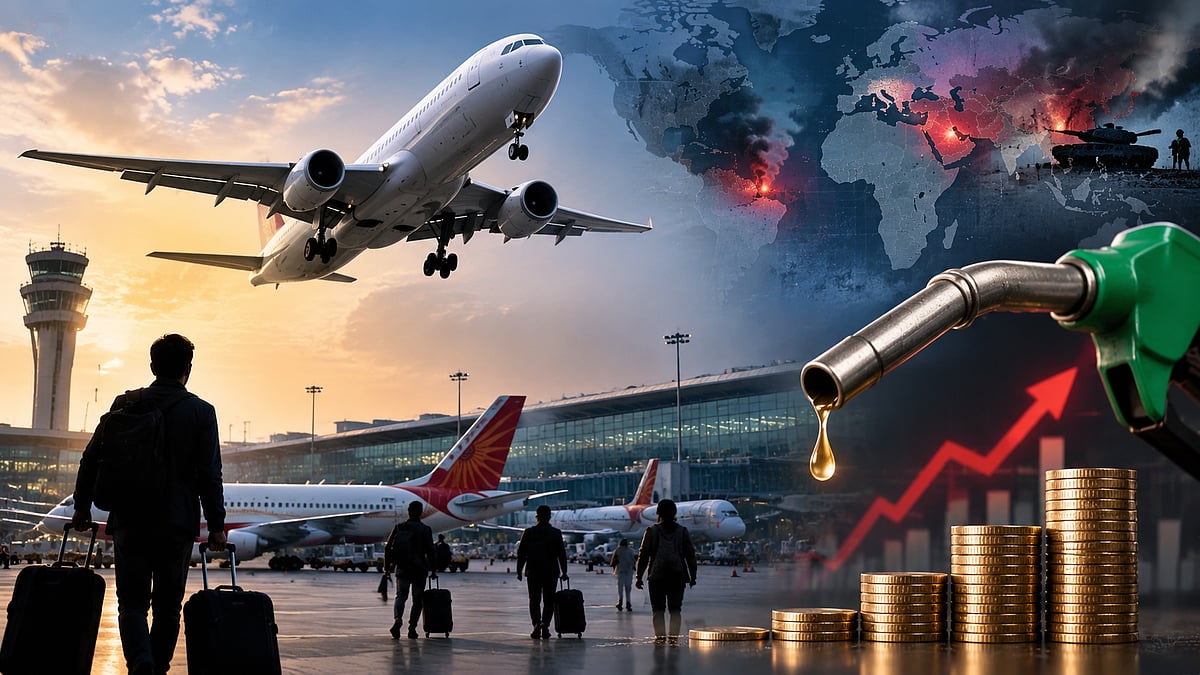
India's civil aviation sector is expected to experience a significant slowdown in growth, with total air passenger traffic at Indian airports projected to grow by a modest 1% to 3% in the financial year 2026-27. According to credit rating agency ICRA, this growth will result in between 424 million and 432 million passengers.
The slowdown is attributed to various factors, including escalating geopolitical volatility in West Asia, persistent supply chain bottlenecks, and stubborn fuel prices. The West Asian crisis has severely disrupted long-haul international corridors linking India to Europe and the Middle East, resulting in a sharp decline in international passenger volumes and aircraft movements.
In March 2026, international passenger volumes and aircraft movements plunged by roughly 20% annually and 17% month-on-month. Although international travel has shown a steady month-on-month recovery, international passenger volumes remained down by 9% year-on-year over the first four months of FY2027.
Domestic operations have also been hampered by structural supply-side challenges, such as groundings of Indian aircraft due to engine maintenance issues and global supply chain bottlenecks. The strict adherence to updated flight duty time limitations guidelines has constrained pilot deployment, leading to selective schedule rationalisations across networks.
Despite the muted volume growth, airport operators are expected to present a resilient financial picture, with airport revenues forecasted to expand by 6% to 8% in FY2027. The top-line growth is driven by incoming tariff revisions and strong momentum in non-aeronautical streams, such as retail, duty-free, dining, and real estate monetisation.
Operating margins for airport operators are expected to remain robust at around 50% through both FY2027 and FY2028. The long-term infrastructure commitments are expected to remain unaffected by short-term turbulence, with ICRA estimating that infrastructure spending will continue.
The slowdown in India's aviation sector is a significant concern, as it was previously one of the fastest-growing aviation markets in the world. The compounded impact of external shocks and domestic operational constraints has clipped the wings of the sector, resulting in a protracted period of sluggish growth.
The Indian government and aviation industry stakeholders will need to work together to address the challenges facing the sector and restore growth. This may involve investing in infrastructure, improving supply chain efficiency, and developing strategies to mitigate the impact of geopolitical volatility.
In conclusion, the slowdown in India's aviation sector is a significant challenge that requires immediate attention. With the right strategies and investments, the sector can recover and regain its position as one of the fastest-growing aviation markets in the world.
The growth of the aviation sector is crucial for India's economic development, as it plays a vital role in connecting the country to the rest of the world. The sector's growth is also closely tied to the country's tourism industry, which is a significant contributor to India's GDP.
Overall, the slowdown in India's aviation sector is a concern that needs to be addressed urgently. With the right policies and investments, the sector can recover and continue to play a vital role in India's economic development.
The impact of the slowdown will be felt across the industry, from airlines to airport operators. The sector's growth is also closely tied to the country's economic development, making it essential to address the challenges facing the sector.
In the coming months, the Indian government and aviation industry stakeholders will need to work together to develop strategies to restore growth and mitigate the impact of external shocks. This may involve investing in infrastructure, improving supply chain efficiency, and developing strategies to mitigate the impact of geopolitical volatility.
The future of India's aviation sector depends on the ability of the government and industry stakeholders to work together to address the challenges facing the sector. With the right strategies and investments, the sector can recover and continue to play a vital role in India's economic development.
Frequently asked questions
What is the expected growth rate of India's aviation traffic in FY27?
The expected growth rate is 1-3%.
What are the main factors affecting the growth of India's aviation sector?
The main factors are geopolitical pressures, fuel prices, and supply chain bottlenecks.