India Faces Challenge In Aligning Education With Employment
India's education system struggles to keep pace with international quality norms, 65% of population below 35, and growing need for employment alignment.
'%3E%3Crect%20width%3D'96'%20height%3D'96'%20fill%3D'%23B3261E'%2F%3E%3Ccircle%20cx%3D'30'%20cy%3D'24'%20r%3D'44'%20fill%3D'%23fff'%20opacity%3D'.12'%2F%3E%3Ccircle%20cx%3D'60'%20cy%3D'74'%20r%3D'40'%20fill%3D'%23000'%20opacity%3D'.10'%2F%3E%3C%2Fg%3E%3Cg%20fill%3D'%23fff'%3E%3Crect%20x%3D'29'%20y%3D'49'%20width%3D'8'%20height%3D'19'%20rx%3D'1'%2F%3E%3Crect%20x%3D'39'%20y%3D'40'%20width%3D'9'%20height%3D'28'%20rx%3D'1'%2F%3E%3Crect%20x%3D'50'%20y%3D'45'%20width%3D'8'%20height%3D'23'%20rx%3D'1'%2F%3E%3Crect%20x%3D'60'%20y%3D'53'%20width%3D'7'%20height%3D'15'%20rx%3D'1'%2F%3E%3Crect%20x%3D'41'%20y%3D'34'%20width%3D'5'%20height%3D'6'%2F%3E%3C%2Fg%3E%3C%2Fsvg%3E)
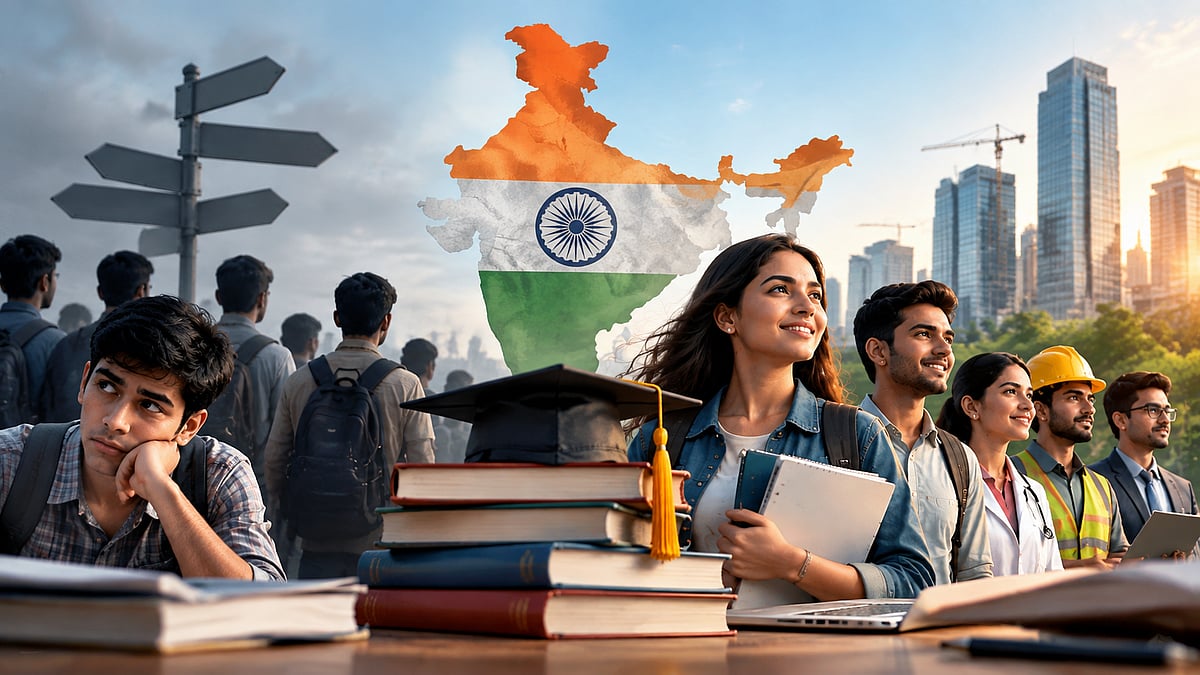
The Indian education system is currently facing a critical phase, with its structure and processes not meeting international quality standards. Despite the recommendations of the National Education Policy (NEP) 2020, the system is struggling to provide quality education that aligns with the needs of the employment market.
One of the major issues in recent times is the debate on education and its impact on employability. With around 65% of the Indian population, approximately 95 crores, below the age of 35, and a median age of about 29 years, India is a country with a large young population. This demographic dividend presents a significant challenge in terms of providing employment opportunities to the growing number of young people.
According to the All India Survey on Higher Education (AISHE) reports, more than 1.04 crores students graduate from various courses every year, and around 1.5 to 2.0 crores of people are added to the workforce annually. The question arises whether the country can create sufficient suitable and appropriate jobs to absorb this large number of young people.
The problem is further complicated by the fact that many government departments and public sector units are not creating new jobs, and artificial intelligence is replacing many traditional jobs. A recent report by NITI Aayog has highlighted an alarming situation, with around 8.7 crore young people (15-29 years age) being classified as NEET (neither in education, employment, or training).
The main challenge before educators is to provide holistic development to students, which includes not only academic knowledge but also skills that are in demand in the industry. However, there are several dimensions to this problem, including a mindset syndrome among people, where skills that are in demand are often considered below par.
There is also a curriculum-industry mismatch, where many academic programs emphasize theoretical knowledge, while industries demand practical competencies. Rapid technological advancements, particularly in artificial intelligence, automation, robotics, cybersecurity, and data analytics, are changing the nature of work much faster than revisions in curricula.
As a result, graduates often possess degrees but lack the skills required by employers. Studies have shown that hardly a quarter of graduates are job-ready on entering the job market. There is an inadequate focus on critical employability skills, such as communication, teamwork, and problem-solving, which are essential for success in the workplace.
To address this challenge, it is essential to speed up the pace of creating suitable job opportunities for the rapidly expanding youth population. This requires a multi-faceted approach, including changes in the education system, industry partnerships, and a shift in the mindset of people towards skills that are in demand.
The government, educators, and industry leaders must work together to provide education and training that aligns with the needs of the employment market. This includes providing vocational training, apprenticeships, and internships that equip students with the skills required by employers.
In conclusion, the alignment of education with employment is a critical challenge facing India today. With a large young population and a growing need for employment opportunities, it is essential to provide education and training that prepares students for the workforce. This requires a collaborative effort from all stakeholders, including the government, educators, and industry leaders.
The future of India's economy and the well-being of its young population depend on the ability to provide suitable job opportunities. It is time for educators, policymakers, and industry leaders to come together to address this challenge and ensure that India's education system is aligned with the needs of the employment market.
The significance of this issue cannot be overstated, as it has far-reaching implications for India's economic growth, social stability, and the well-being of its citizens. It is essential to take immediate action to address this challenge and provide education and training that prepares students for the workforce.
In the long run, this will require a fundamental transformation of the education system, including changes in curriculum, teaching methods, and industry partnerships. It will also require a shift in the mindset of people towards skills that are in demand and a recognition of the importance of vocational training and apprenticeships.
Ultimately, the alignment of education with employment is critical to India's future prosperity and the well-being of its citizens. It is time for all stakeholders to come together to address this challenge and ensure that India's education system is equipped to provide students with the skills and knowledge required to succeed in the workforce.
Frequently asked questions
What is the main challenge facing India's education system?
The main challenge is to provide education and training that aligns with the needs of the employment market.
How many young people are classified as NEET in India?
Around 8.7 crore young people (15-29 years age) are classified as NEET (neither in education, employment, or training).