BMC Considers Octroi Naka Plots For Ganpati Idol Remains
BMC to store PoP Ganpati idol remains, considers Octroi Naka plots. Scientific recycling planned.
'%3E%3Crect%20width%3D'96'%20height%3D'96'%20fill%3D'%23B3261E'%2F%3E%3Ccircle%20cx%3D'30'%20cy%3D'24'%20r%3D'44'%20fill%3D'%23fff'%20opacity%3D'.12'%2F%3E%3Ccircle%20cx%3D'60'%20cy%3D'74'%20r%3D'40'%20fill%3D'%23000'%20opacity%3D'.10'%2F%3E%3C%2Fg%3E%3Cg%20fill%3D'%23fff'%3E%3Crect%20x%3D'29'%20y%3D'49'%20width%3D'8'%20height%3D'19'%20rx%3D'1'%2F%3E%3Crect%20x%3D'39'%20y%3D'40'%20width%3D'9'%20height%3D'28'%20rx%3D'1'%2F%3E%3Crect%20x%3D'50'%20y%3D'45'%20width%3D'8'%20height%3D'23'%20rx%3D'1'%2F%3E%3Crect%20x%3D'60'%20y%3D'53'%20width%3D'7'%20height%3D'15'%20rx%3D'1'%2F%3E%3Crect%20x%3D'41'%20y%3D'34'%20width%3D'5'%20height%3D'6'%2F%3E%3C%2Fg%3E%3C%2Fsvg%3E)
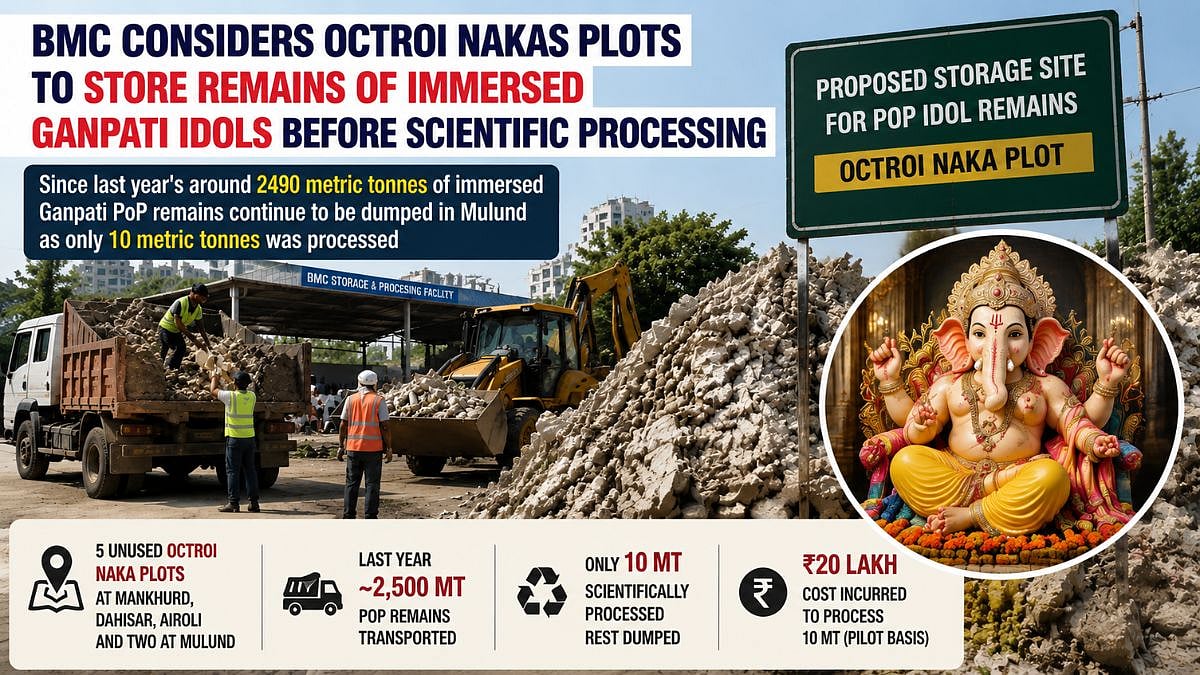
The Brihanmumbai Municipal Corporation (BMC) is considering using the city's defunct Octroi Naka plots to store the remains of Plaster of Paris (PoP) Ganesh idols collected after immersion.
The BMC struggled to store the PoP remains at its construction and demolition facility in Shil Phata, Thane district, during last year's Ganpati festival. Since then, the remains have been stored at an open plot in Mulund, which was formerly a dumping ground but has been scientifically remediated and maintained.
The introduction of GST in 2017 has left Mumbai with five unused Octroi Naka plots, located at Mankhurd, Dahisar, Airoli, and two in Mulund. These plots are being considered for storing the PoP remains.
On Tuesday, the Solid Waste Management (SWM) Department held a meeting on the collection, transportation, and scientific recycling of PoP remains. According to Kiran Dighavkar, Deputy Municipal Commissioner, SWM, the BMC is looking for open plots to store and facilitate the transportation of PoP remains, and options such as the Octroi Nakas are being considered.
The BMC transported around 2,500 metric tonnes of PoP remains after Ganpati Visarjan last year but scientifically processed only 10 metric tonnes to make benches and other usable items. The exercise was carried out on a pilot basis, while the remaining material continues to be stored.
The BMC will soon float tenders to appoint an agency for the scientific processing of the collected, stored, and transported remains of immersed Ganesh idols. The processing will be done in accordance with the two methods recommended by the state-appointed expert committee: chemical disintegration and the calcination process.
Under the calcination process, used PoP idols can be calcined at a suitable temperature and, after fine grinding, the material may be used for making new idols, plaster boards, or other products. The chemical disintegration process involves mixing used idols with ammonium bicarbonate solution to form ammonium sulphate and calcium carbonate, which can be used as a micronutrient and soil conditioner, respectively.
The BMC's plan to scientifically recycle the PoP remains is a step towards reducing waste and promoting sustainability in the city. The use of Octroi Naka plots for storing the remains is a feasible solution, given their location at the city's entry points.
The BMC's efforts to recycle the PoP remains are expected to have a positive impact on the environment and the city's waste management system. The scientific recycling of the remains will help reduce the amount of waste generated during the Ganpati festival and promote a more sustainable approach to waste management.
In conclusion, the BMC's consideration of Octroi Naka plots for storing PoP Ganpati idol remains is a significant step towards promoting sustainability and reducing waste in the city. The scientific recycling of the remains will help reduce the environmental impact of the Ganpati festival and promote a more eco-friendly approach to waste management.
Frequently asked questions
What is the BMC planning to do with the PoP Ganpati idol remains?
The BMC is planning to store the remains at Octroi Naka plots and scientifically recycle them using chemical disintegration or calcination process.
How much PoP remains were collected by the BMC last year?
The BMC collected around 2,500 metric tonnes of PoP remains after Ganpati Visarjan last year.