Western Railway Orders Stray Dog Removal from Mumbai Stations
Western Railway's move to remove stray dogs from Mumbai stations sparks controversy. Animal welfare groups warn of escalating conflicts.
'%3E%3Crect%20width%3D'96'%20height%3D'96'%20fill%3D'%23B3261E'%2F%3E%3Ccircle%20cx%3D'30'%20cy%3D'24'%20r%3D'44'%20fill%3D'%23fff'%20opacity%3D'.12'%2F%3E%3Ccircle%20cx%3D'60'%20cy%3D'74'%20r%3D'40'%20fill%3D'%23000'%20opacity%3D'.10'%2F%3E%3C%2Fg%3E%3Cg%20fill%3D'%23fff'%3E%3Crect%20x%3D'29'%20y%3D'49'%20width%3D'8'%20height%3D'19'%20rx%3D'1'%2F%3E%3Crect%20x%3D'39'%20y%3D'40'%20width%3D'9'%20height%3D'28'%20rx%3D'1'%2F%3E%3Crect%20x%3D'50'%20y%3D'45'%20width%3D'8'%20height%3D'23'%20rx%3D'1'%2F%3E%3Crect%20x%3D'60'%20y%3D'53'%20width%3D'7'%20height%3D'15'%20rx%3D'1'%2F%3E%3Crect%20x%3D'41'%20y%3D'34'%20width%3D'5'%20height%3D'6'%2F%3E%3C%2Fg%3E%3C%2Fsvg%3E)
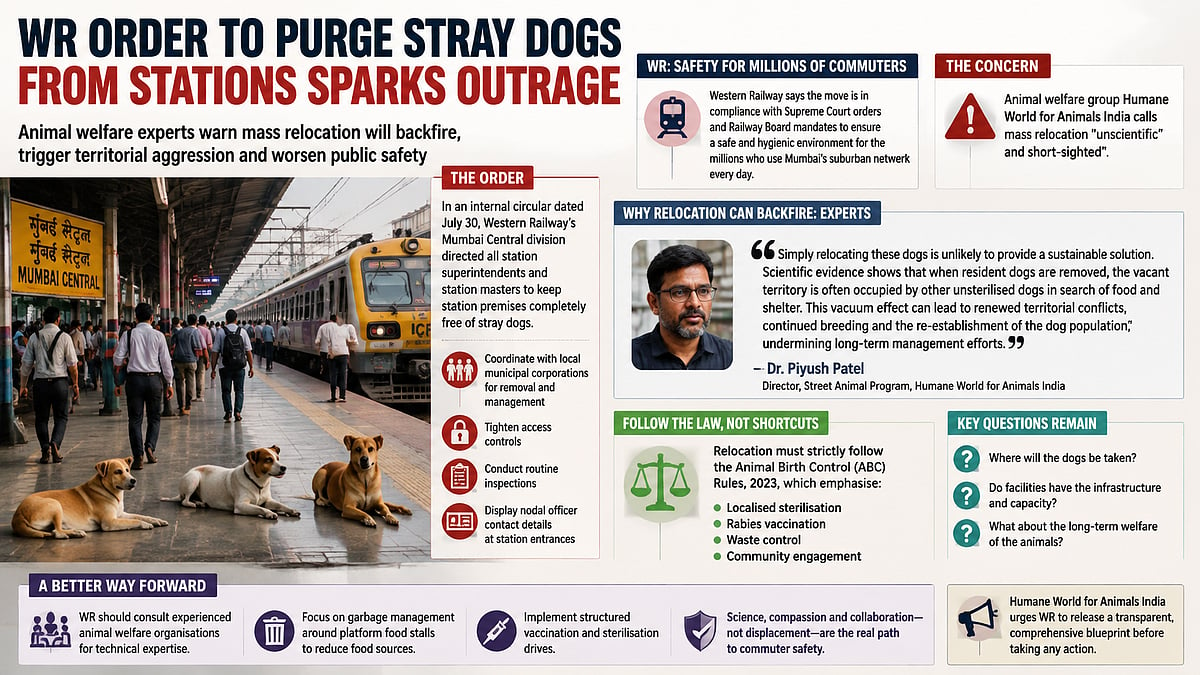
Western Railway has issued a directive to remove stray dogs from its Mumbai Division stations, citing compliance with Supreme Court orders and Railway Board mandates. The order, issued on July 30, designates station superintendents and station masters as nodal officers to coordinate with local municipal corporations for the removal and management of stray dogs.
The move has drawn criticism from animal welfare experts, who warn that mass relocation will backfire and trigger territorial aggression, worsening public safety. Animal rights advocacy group Humane World for Animals India has opposed the plan, labelling unscientific relocation a short-sighted tactic.
According to Dr. Piyush Patel, director of the street animal program at Humane World for Animals India, community dogs residing on platforms are well-known to station staff, licensed porters, local vendors, and regular commuters. Removing established, territorial canines rarely clears the area for long, instead creating an ecological void.
The NGO has emphasized that scientific evidence shows that when resident dogs are removed, the vacant territory is often occupied by other unsterilised dogs in search of food and shelter. This vacuum effect can lead to renewed territorial conflicts, continued breeding, and the re-establishment of the dog population, undermining long-term management efforts.
Humane World for Animals India has called on Western Railway authorities to comply with the Animal Birth Control (ABC) Rules, 2023, which emphasize localized sterilization, rabies vaccination, waste control, and community engagement over indiscriminate removal. The NGO has urged WR to consult experienced animal welfare organizations for technical expertise and to focus on garbage management around platform food stalls and structured vaccination programs.
The controversy highlights the need for a comprehensive and sustainable solution to manage stray dog populations in Mumbai's railway stations. Western Railway's move has sparked concerns among animal welfare groups, who argue that a more nuanced approach is required to address the issue.
The Animal Birth Control (ABC) Rules, 2023, provide a framework for managing stray dog populations, emphasizing the importance of localized sterilization, rabies vaccination, and community engagement. By complying with these rules, Western Railway can ensure a more effective and humane approach to managing stray dogs in its Mumbai Division stations.
In the meantime, the fate of the stray dogs residing in Mumbai's railway stations remains uncertain. As the controversy continues to unfold, it is clear that a more sustainable and compassionate solution is needed to address the issue.
The move by Western Railway has significant implications for public safety and animal welfare in Mumbai. As the city's railway network is used by millions of commuters daily, it is essential to find a solution that balances the need to ensure public safety with the need to protect animal welfare.
In conclusion, the controversy surrounding Western Railway's move to remove stray dogs from its Mumbai Division stations highlights the need for a comprehensive and sustainable solution to manage stray dog populations. By complying with the Animal Birth Control (ABC) Rules, 2023, and consulting with experienced animal welfare organizations, Western Railway can ensure a more effective and humane approach to managing stray dogs in its Mumbai Division stations.
Frequently asked questions
Why is Western Railway removing stray dogs from Mumbai stations?
Western Railway is removing stray dogs from its Mumbai Division stations to comply with Supreme Court orders and Railway Board mandates.
What are the concerns of animal welfare groups regarding the removal of stray dogs?
Animal welfare groups are concerned that mass relocation will backfire and trigger territorial aggression, worsening public safety.