Maharashtra Women Keep Ovi Tradition Alive
Rural women in Maharashtra preserve traditional grindmill songs, ovi, as a secret archive of female endurance. Their voices, though silenced in public, find solace in the stone mill's rhythmic whir.
'%3E%3Crect%20width%3D'96'%20height%3D'96'%20fill%3D'%23B3261E'%2F%3E%3Ccircle%20cx%3D'30'%20cy%3D'24'%20r%3D'44'%20fill%3D'%23fff'%20opacity%3D'.12'%2F%3E%3Ccircle%20cx%3D'60'%20cy%3D'74'%20r%3D'40'%20fill%3D'%23000'%20opacity%3D'.10'%2F%3E%3C%2Fg%3E%3Cg%20fill%3D'%23fff'%3E%3Crect%20x%3D'29'%20y%3D'49'%20width%3D'8'%20height%3D'19'%20rx%3D'1'%2F%3E%3Crect%20x%3D'39'%20y%3D'40'%20width%3D'9'%20height%3D'28'%20rx%3D'1'%2F%3E%3Crect%20x%3D'50'%20y%3D'45'%20width%3D'8'%20height%3D'23'%20rx%3D'1'%2F%3E%3Crect%20x%3D'60'%20y%3D'53'%20width%3D'7'%20height%3D'15'%20rx%3D'1'%2F%3E%3Crect%20x%3D'41'%20y%3D'34'%20width%3D'5'%20height%3D'6'%2F%3E%3C%2Fg%3E%3C%2Fsvg%3E)
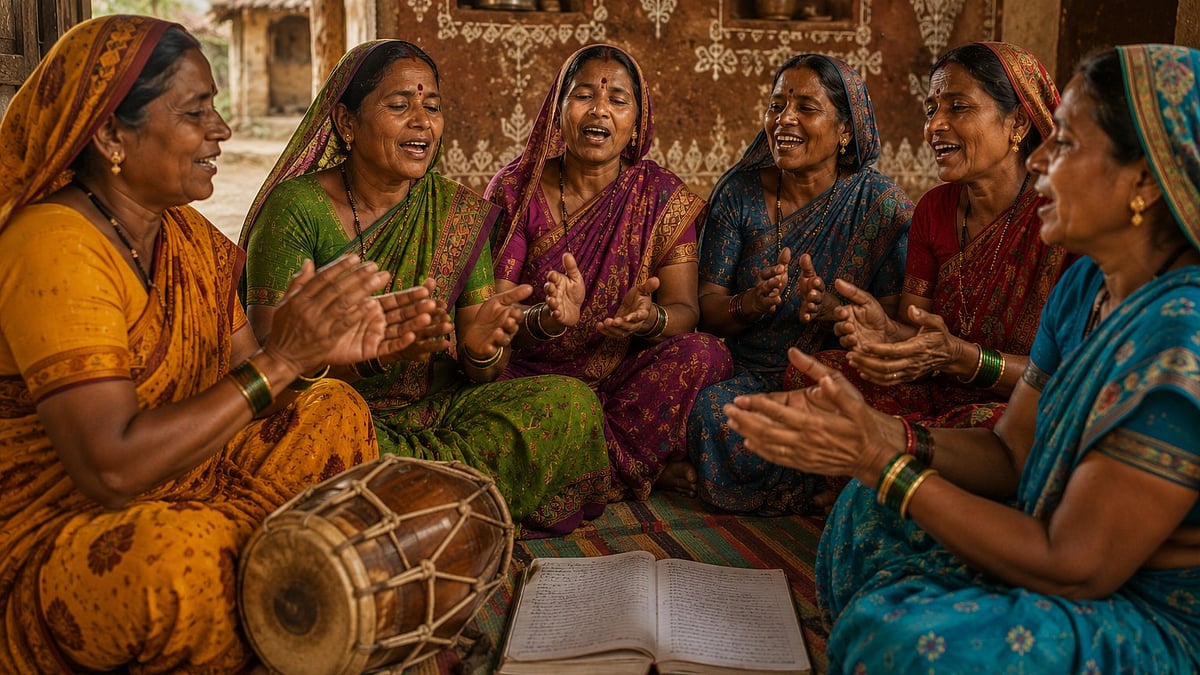
In rural Maharashtra, the pre-dawn hours are filled with the sound of the jaat, a twin-layered stone mill, as women begin their daily grind. As they rotate the upper stone to pulverize grain into meal, they sing traditional songs known as ovi. These verses, passed down from mother to daughter, are a testament to the endurance of rural women in the face of adversity.
The ovi tradition is unique in that it is a private and intimate form of expression, unlike other folk music genres in Maharashtra that are performed in public spaces. The Powada, Bharud, Abhang, Gondhalis, Bhaleri, and Lavani are all forms of music that are typically performed by men or in public spaces, leaving little room for women's voices to be heard.
For rural women, the jaat became a sanctuary, a place where they could express their emotions and find solace in the rhythmic whir of the stone mill. The physical exertion of grinding grain was a way for them to release their pent-up emotions and find catharsis. The ovi songs were a way for them to turn their agony into poetry, and to survive the hardships of their lives.
The significance of the ovi tradition lies in its ability to provide a platform for rural women to express themselves, albeit in a private and intimate setting. In a world where women's voices were silenced in public, the ovi tradition became a way for them to assert their presence and to leave a mark on their community.
The ovi tradition is also a testament to the resourcefulness and resilience of rural women. Despite being denied an education and a public voice, they found ways to express themselves and to preserve their cultural heritage. The ovi songs are a sacred archive of female endurance, a reminder of the struggles and hardships that rural women have faced, and a celebration of their strength and resilience.
In recent years, there has been an effort to preserve and promote the ovi tradition, recognizing its importance as a part of Maharashtra's cultural heritage. However, much work remains to be done to ensure that this tradition is preserved for future generations.
The ovi tradition is a reminder of the importance of preserving cultural heritage and promoting the rights of rural women. It is a testament to the power of music and art to provide a platform for self-expression and empowerment. As we celebrate the ovi tradition, we must also recognize the struggles and hardships that rural women continue to face, and work towards creating a more just and equitable society.
In conclusion, the ovi tradition is a unique and important part of Maharashtra's cultural heritage, providing a platform for rural women to express themselves and preserve their cultural identity. It is a testament to the endurance and resilience of rural women, and a reminder of the importance of preserving cultural heritage and promoting the rights of rural women.
Frequently asked questions
What is the ovi tradition in Maharashtra?
The ovi tradition is a form of traditional grindmill songs sung by rural women in Maharashtra, passed down from mother to daughter.
Why is the ovi tradition important?
The ovi tradition is important because it provides a platform for rural women to express themselves and preserve their cultural heritage, despite being denied a public voice and education.