Germany Sees Mass Protests Amid Far-Right AfD Rise
Thousands protest, AfD eyes first govt since Nazi Party, sparking widespread concern
'%3E%3Crect%20width%3D'96'%20height%3D'96'%20fill%3D'%234A235A'%2F%3E%3Ccircle%20cx%3D'30'%20cy%3D'24'%20r%3D'44'%20fill%3D'%23fff'%20opacity%3D'.12'%2F%3E%3Ccircle%20cx%3D'60'%20cy%3D'74'%20r%3D'40'%20fill%3D'%23000'%20opacity%3D'.10'%2F%3E%3C%2Fg%3E%3Cg%20fill%3D'none'%20stroke%3D'%23fff'%20stroke-width%3D'3'%3E%3Ccircle%20cx%3D'48'%20cy%3D'48'%20r%3D'16'%2F%3E%3Cellipse%20cx%3D'48'%20cy%3D'48'%20rx%3D'6.5'%20ry%3D'16'%2F%3E%3Cline%20x1%3D'32'%20y1%3D'42'%20x2%3D'64'%20y2%3D'42'%2F%3E%3Cline%20x1%3D'32'%20y1%3D'54'%20x2%3D'64'%20y2%3D'54'%2F%3E%3C%2Fg%3E%3C%2Fsvg%3E)
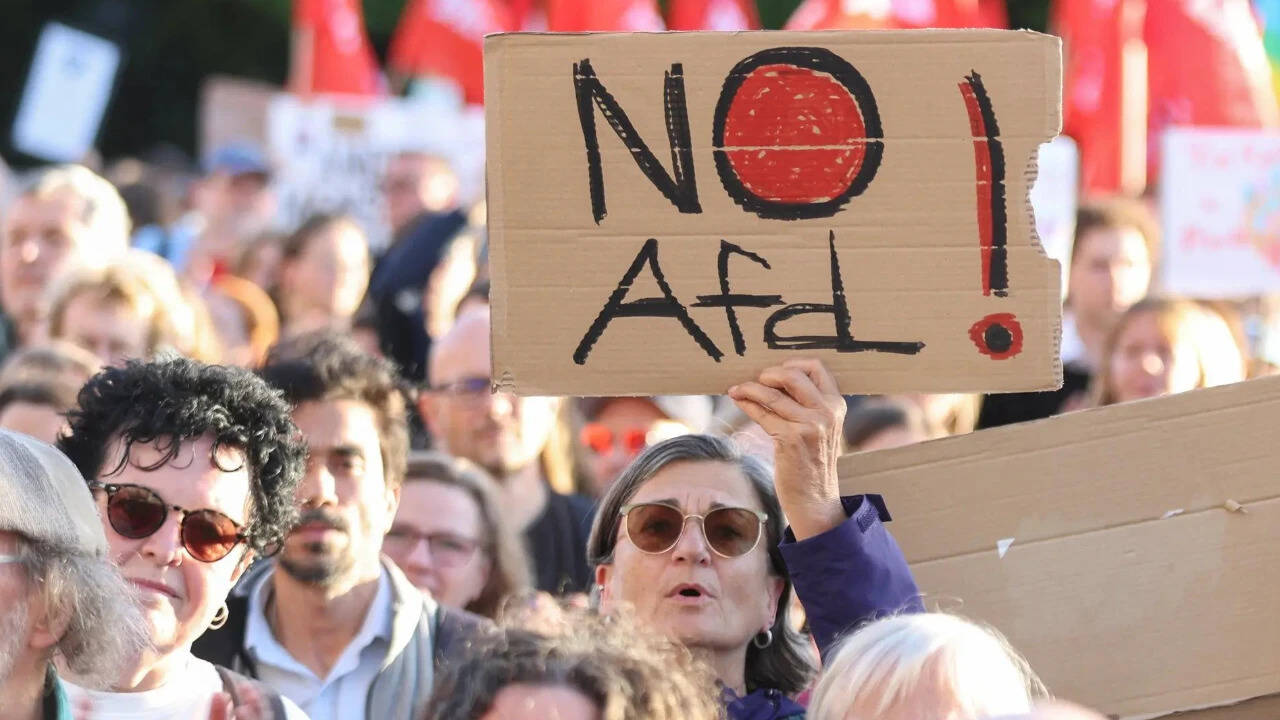
Thousands of people took to the streets in Germany to protest against the rising influence of the far-right Alternative for Germany (AfD) party. The AfD is poised to become the first far-right party to enter a state government in Germany since the Nazi Party.
The protests were held in several cities across the country, with demonstrators expressing their concern over the AfD's extremist views and its potential impact on German society. The party has been gaining popularity in recent years, particularly in the eastern states, where it has tapped into discontent over issues such as immigration and economic inequality.
The AfD's rise has sparked widespread concern among Germans, with many fearing that the party's extremist views could undermine the country's democratic values and social cohesion. The party's leaders have been accused of promoting hate speech and xenophobia, and its members have been linked to neo-Nazi groups.
The protests were organized by a coalition of left-wing groups, trade unions, and civil society organizations, who are determined to stop the AfD's march towards power. The demonstrators carried banners and placards condemning the AfD's extremist views and calling for a more inclusive and tolerant society.
Germany has a dark history of far-right extremism, and the rise of the AfD has raised fears that the country could be heading towards a repeat of its past mistakes. The Nazi Party's rise to power in the 1930s led to one of the darkest periods in human history, and many Germans are determined to prevent a similar scenario from unfolding again.
The AfD's success in the recent state elections has given it a significant foothold in German politics, and the party is now poised to enter a state government for the first time. This has sparked concerns that the party could use its newfound power to promote its extremist agenda and undermine the country's democratic institutions.
The German government has condemned the AfD's extremist views and has vowed to take action against hate speech and xenophobia. However, the party's rise has also sparked a debate about the need for greater tolerance and inclusivity in German society, and the importance of protecting democratic values and social cohesion.
In the coming months, Germany will be closely watching the AfD's next moves, and the international community will be monitoring the situation with great interest. The rise of far-right extremism in Germany has significant implications for European politics and society, and it remains to be seen how the country will respond to this challenge.
The protests against the AfD's rise are a testament to the strong democratic values and social cohesion that exist in Germany, and they demonstrate the determination of the German people to prevent the spread of extremist views. As the situation continues to unfold, it is clear that the AfD's rise will be a major challenge for Germany and the international community in the months and years to come.
In conclusion, the rise of the AfD in Germany has sparked widespread concern and protests, and it remains to be seen how the country will respond to this challenge. The international community will be closely watching the situation, and it is clear that the AfD's rise has significant implications for European politics and society.
Frequently asked questions
What is the AfD party in Germany?
The Alternative for Germany (AfD) is a far-right political party in Germany that has been gaining popularity in recent years.
Why are people protesting against the AfD?
People are protesting against the AfD due to its extremist views and concerns that it could undermine Germany's democratic values and social cohesion.