IIM Indore Study Finds Unfair Service Turns Customers Into Critics
Unfair service can lead to customer rage and negative word-of-mouth. A study by IIM Indore reveals the impact of service failures on customer trust and brand reputation.
'%3E%3Crect%20width%3D'96'%20height%3D'96'%20fill%3D'%23B3261E'%2F%3E%3Ccircle%20cx%3D'30'%20cy%3D'24'%20r%3D'44'%20fill%3D'%23fff'%20opacity%3D'.12'%2F%3E%3Ccircle%20cx%3D'60'%20cy%3D'74'%20r%3D'40'%20fill%3D'%23000'%20opacity%3D'.10'%2F%3E%3C%2Fg%3E%3Cg%20fill%3D'%23fff'%3E%3Crect%20x%3D'29'%20y%3D'49'%20width%3D'8'%20height%3D'19'%20rx%3D'1'%2F%3E%3Crect%20x%3D'39'%20y%3D'40'%20width%3D'9'%20height%3D'28'%20rx%3D'1'%2F%3E%3Crect%20x%3D'50'%20y%3D'45'%20width%3D'8'%20height%3D'23'%20rx%3D'1'%2F%3E%3Crect%20x%3D'60'%20y%3D'53'%20width%3D'7'%20height%3D'15'%20rx%3D'1'%2F%3E%3Crect%20x%3D'41'%20y%3D'34'%20width%3D'5'%20height%3D'6'%2F%3E%3C%2Fg%3E%3C%2Fsvg%3E)
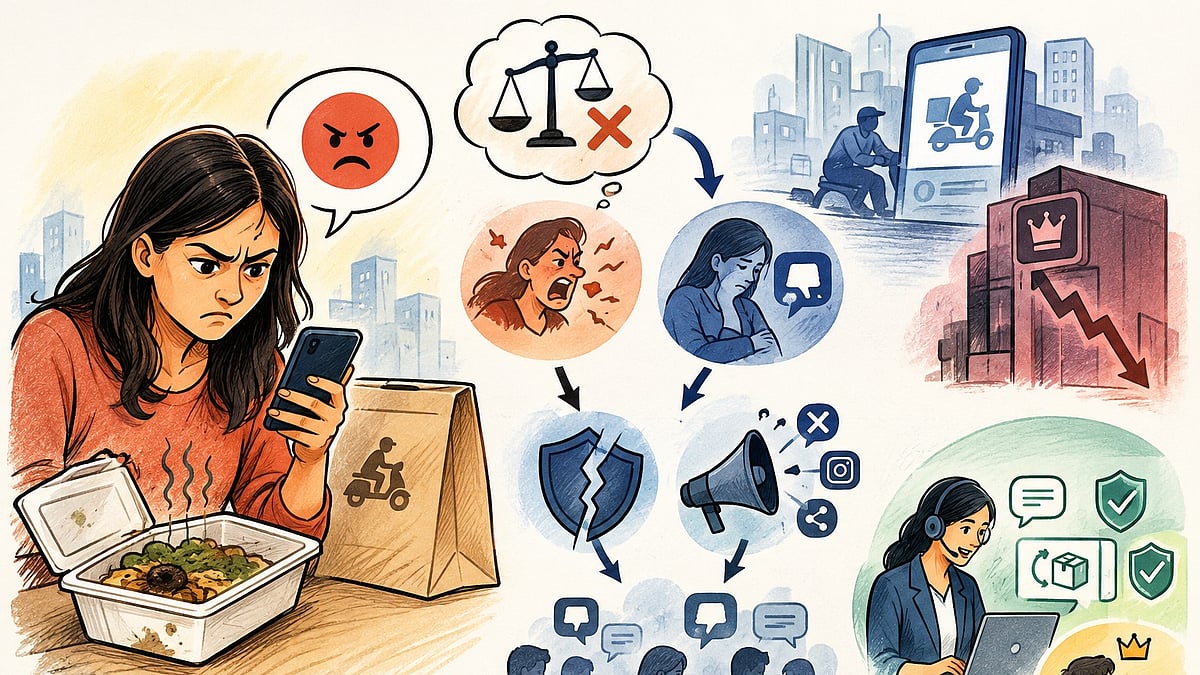
A recent study co-authored by Prof Deepa Halder of IIM Indore has found that serious service failures can trigger customer rage, weaken trust in brands, and fuel negative word-of-mouth. The study, titled The Dark Side of Customer Emotion and Engagement: An Antecedent–Consequence Model, examines how consumers react when their expectations from digital services are not met.
The researchers found that it is not merely the service failure that angers customers, but whether they perceive the experience as unfair. Customers assess whether the outcome was fair, whether the complaint-resolution process was reasonable, and whether they were treated respectfully. When these expectations are violated, the resulting sense of injustice can set off a chain reaction.
This reaction takes two forms — customer rage and negative customer engagement. Rage is an immediate, intense emotional response to a particularly bad experience, while negative engagement is more sustained, with customers continuing to think, feel, and act negatively towards the brand. Both can hurt businesses, as the study found that perceived injustice directly damages brand trust and increases negative word-of-mouth.
The study used realistic e-service failure scenarios, including contaminated food delivered through a fictitious app called Deliverista, to test their model. A pilot study involved 176 participants, followed by two larger samples of 454 and 217 frequent e-service users. The researchers also examined the role of self-esteem, finding that customers with higher self-esteem were more likely to translate rage and negative engagement into negative word-of-mouth.
The findings carry a warning for quick-commerce and other digital service companies: a refund may not be enough to repair a bad experience. The researchers recommend proactive and transparent service recovery, including easy complaint-resolution systems, real-time support, clear refund or replacement procedures, and empathetic communication. Training customer-support teams through simulated service-failure situations could also help employees handle angry customers before situations escalate.
In a marketplace where complaints can spread across social media in seconds, the study's message is clear: when customers feel wronged, brands can pay a much bigger price than the cost of replacing a product or providing a refund. The study's findings have significant implications for businesses, highlighting the importance of fair and respectful treatment of customers, even in the face of service failures.
The study's authors suggest that businesses should prioritize building trust with their customers and ensuring that their complaint-resolution processes are fair, reasonable, and respectful. By doing so, businesses can reduce the risk of customer rage and negative word-of-mouth, and maintain a positive reputation in the market.
In conclusion, the IIM Indore study provides valuable insights into the impact of service failures on customer trust and brand reputation. The findings emphasize the importance of fair and respectful treatment of customers, and highlight the need for businesses to prioritize proactive and transparent service recovery. By taking these steps, businesses can reduce the risk of customer rage and negative word-of-mouth, and maintain a positive reputation in the market.
The study's findings are particularly relevant in today's digital age, where customers have the power to share their experiences with others through social media. As such, businesses must be proactive in addressing customer complaints and ensuring that their customers feel valued and respected. By doing so, businesses can build trust with their customers and maintain a positive reputation in the market.
Overall, the IIM Indore study provides a timely reminder of the importance of fair and respectful treatment of customers, and highlights the need for businesses to prioritize proactive and transparent service recovery. By taking these steps, businesses can reduce the risk of customer rage and negative word-of-mouth, and maintain a positive reputation in the market.
The study's implications are far-reaching, and highlight the need for businesses to rethink their approach to customer service. Rather than simply providing a refund or replacement, businesses must prioritize building trust with their customers and ensuring that their complaint-resolution processes are fair, reasonable, and respectful. By doing so, businesses can reduce the risk of customer rage and negative word-of-mouth, and maintain a positive reputation in the market.
In the end, the IIM Indore study serves as a reminder that customer service is not just about resolving complaints, but about building trust and maintaining a positive reputation. By prioritizing fair and respectful treatment of customers, businesses can reduce the risk of customer rage and negative word-of-mouth, and maintain a positive reputation in the market.
The study's findings have significant implications for businesses, and highlight the need for a proactive and transparent approach to customer service. By taking these steps, businesses can reduce the risk of customer rage and negative word-of-mouth, and maintain a positive reputation in the market.
The IIM Indore study is a timely reminder of the importance of fair and respectful treatment of customers, and highlights the need for businesses to prioritize proactive and transparent service recovery. By doing so, businesses can reduce the risk of customer rage and negative word-of-mouth, and maintain a positive reputation in the market.
For businesses, the study's findings are a wake-up call to prioritize customer service and ensure that their complaint-resolution processes are fair, reasonable, and respectful. By doing so, businesses can reduce the risk of customer rage and negative word-of-mouth, and maintain a positive reputation in the market.
In conclusion, the IIM Indore study provides valuable insights into the impact of service failures on customer trust and brand reputation. The findings emphasize the importance of fair and respectful treatment of customers, and highlight the need for businesses to prioritize proactive and transparent service recovery. By taking these steps, businesses can reduce the risk of customer rage and negative word-of-mouth, and maintain a positive reputation in the market.
What it means for Mumbai and India is that businesses must be proactive in addressing customer complaints and ensuring that their customers feel valued and respected. By doing so, businesses can build trust with their customers and maintain a positive reputation in the market. The study's findings are particularly relevant in today's digital age, where customers have the power to share their experiences with others through social media. As such, businesses must be proactive in addressing customer complaints and ensuring that their customers feel valued and respected.
Frequently asked questions
What happens when customers feel they have been treated unfairly?
Customers can experience rage and negative engagement, which can damage brand trust and lead to negative word-of-mouth.
How can businesses prevent customer rage and negative word-of-mouth?
Businesses can prioritize proactive and transparent service recovery, including easy complaint-resolution systems, real-time support, and empathetic communication.