Maharashtra Expands 'Drugs-Free Mumbai' Campaign
Maharashtra to launch 'Drugs-Free Mumbai' campaign across state, setting up counselling committees in schools and colleges.
'%3E%3Crect%20width%3D'96'%20height%3D'96'%20fill%3D'%23B3261E'%2F%3E%3Ccircle%20cx%3D'30'%20cy%3D'24'%20r%3D'44'%20fill%3D'%23fff'%20opacity%3D'.12'%2F%3E%3Ccircle%20cx%3D'60'%20cy%3D'74'%20r%3D'40'%20fill%3D'%23000'%20opacity%3D'.10'%2F%3E%3C%2Fg%3E%3Cg%20fill%3D'%23fff'%3E%3Crect%20x%3D'29'%20y%3D'49'%20width%3D'8'%20height%3D'19'%20rx%3D'1'%2F%3E%3Crect%20x%3D'39'%20y%3D'40'%20width%3D'9'%20height%3D'28'%20rx%3D'1'%2F%3E%3Crect%20x%3D'50'%20y%3D'45'%20width%3D'8'%20height%3D'23'%20rx%3D'1'%2F%3E%3Crect%20x%3D'60'%20y%3D'53'%20width%3D'7'%20height%3D'15'%20rx%3D'1'%2F%3E%3Crect%20x%3D'41'%20y%3D'34'%20width%3D'5'%20height%3D'6'%2F%3E%3C%2Fg%3E%3C%2Fsvg%3E)
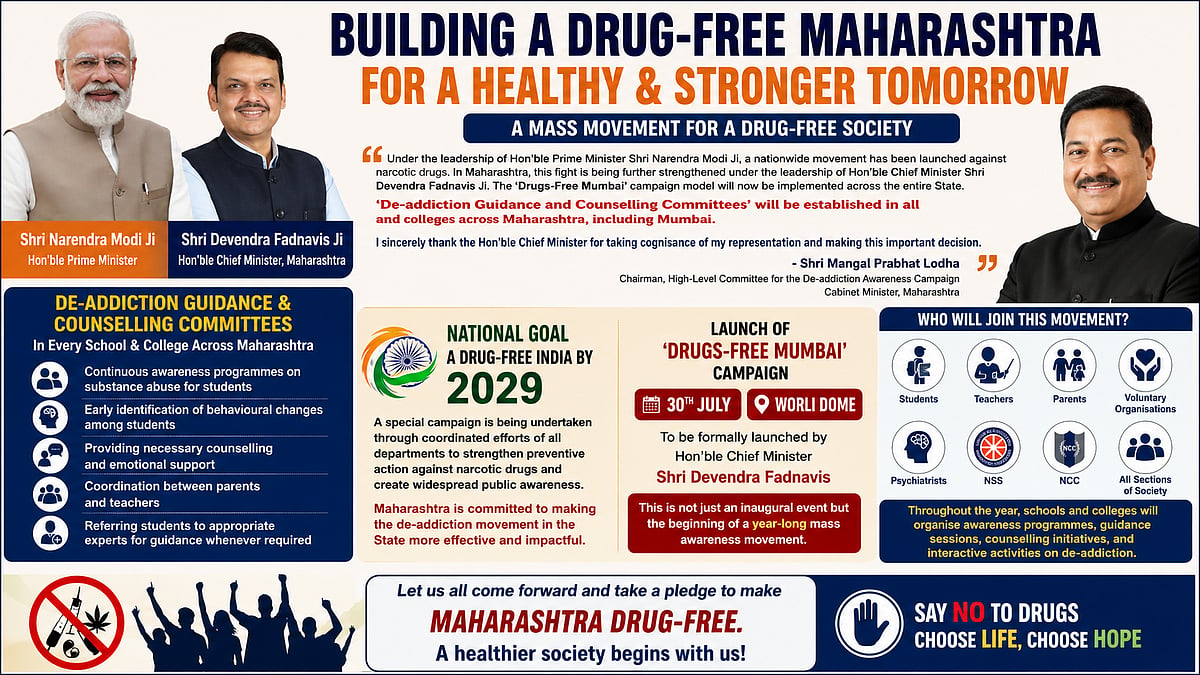
Mumbai: The 'Drugs-Free Mumbai' campaign, launched to combat narcotic drugs, will now be expanded across Maharashtra. Under the leadership of Chief Minister Devendra Fadnavis, the state will establish 'De-addiction Guidance and Counselling Committees' in all schools and colleges.
The committees will conduct awareness programs on substance abuse, identify behavioral changes among students, and provide necessary counselling. They will also facilitate coordination between parents and teachers and refer students to experts when needed.
The Government of India aims to make the country drug-free by 2029. To achieve this, the Maharashtra government has initiated various measures, including the 'Drugs-Free Mumbai' campaign. The campaign will be formally launched on July 30 at the Worli Dome and will involve a year-long mass awareness movement.
The movement will include active participation from students, teachers, parents, voluntary organizations, psychiatrists, the National Service Scheme (NSS), and the National Cadet Corps (NCC). Throughout the year, schools and colleges will organize awareness programs, guidance sessions, and interactive activities on de-addiction.
Cabinet Minister Mangal Prabhat Lodha has appealed to citizens to participate in this people's movement to build a drug-free Maharashtra. The campaign aims to strengthen preventive action against narcotic drugs and create widespread public awareness.
The 'Drugs-Free Mumbai' campaign model has been successful in Mumbai, and its expansion across the state is expected to have a significant impact. The establishment of counselling committees in schools and colleges will help identify and address substance abuse issues at an early stage.
The Maharashtra government's efforts to combat narcotic drugs are part of a larger nationwide movement. The Government of India has set a target to make the country drug-free by 2029, and various states are taking initiatives to achieve this objective.
The 'Drugs-Free Mumbai' campaign is a significant step towards creating a drug-free society in Maharashtra. With the active participation of citizens, the campaign aims to make a positive impact on the lives of people, especially students, and help them stay away from narcotic drugs.
The campaign's launch on July 30 will mark the beginning of a year-long effort to create awareness and prevent substance abuse. The Maharashtra government's initiative is expected to inspire other states to take similar measures and work towards a drug-free India.
In conclusion, the expansion of the 'Drugs-Free Mumbai' campaign across Maharashtra is a significant step towards combating narcotic drugs. The establishment of counselling committees in schools and colleges, along with the year-long mass awareness movement, will help create a drug-free society in the state.
The success of the campaign will depend on the active participation of citizens, and it is essential for everyone to come together to support this initiative. By working together, we can create a drug-free Maharashtra and contribute to the nationwide effort to make India drug-free by 2029.
The 'Drugs-Free Mumbai' campaign is an example of the Maharashtra government's commitment to addressing social issues and creating a better society for its citizens. The campaign's expansion across the state is a positive step towards creating a drug-free society, and it is expected to have a significant impact on the lives of people in Maharashtra.
Frequently asked questions
What is the 'Drugs-Free Mumbai' campaign?
The 'Drugs-Free Mumbai' campaign is an initiative to combat narcotic drugs in Maharashtra, which will be expanded across the state.
What is the role of the counselling committees in schools and colleges?
The counselling committees will conduct awareness programs, identify behavioral changes among students, and provide necessary counselling to help them stay away from narcotic drugs.