India, Uzbekistan Upgrade Ties To Strategic Partnership
India and Uzbekistan elevate ties, set $5 billion trade target by 2030.
'%3E%3Crect%20width%3D'96'%20height%3D'96'%20fill%3D'%234A235A'%2F%3E%3Ccircle%20cx%3D'30'%20cy%3D'24'%20r%3D'44'%20fill%3D'%23fff'%20opacity%3D'.12'%2F%3E%3Ccircle%20cx%3D'60'%20cy%3D'74'%20r%3D'40'%20fill%3D'%23000'%20opacity%3D'.10'%2F%3E%3C%2Fg%3E%3Cg%20fill%3D'none'%20stroke%3D'%23fff'%20stroke-width%3D'3'%3E%3Ccircle%20cx%3D'48'%20cy%3D'48'%20r%3D'16'%2F%3E%3Cellipse%20cx%3D'48'%20cy%3D'48'%20rx%3D'6.5'%20ry%3D'16'%2F%3E%3Cline%20x1%3D'32'%20y1%3D'42'%20x2%3D'64'%20y2%3D'42'%2F%3E%3Cline%20x1%3D'32'%20y1%3D'54'%20x2%3D'64'%20y2%3D'54'%2F%3E%3C%2Fg%3E%3C%2Fsvg%3E)
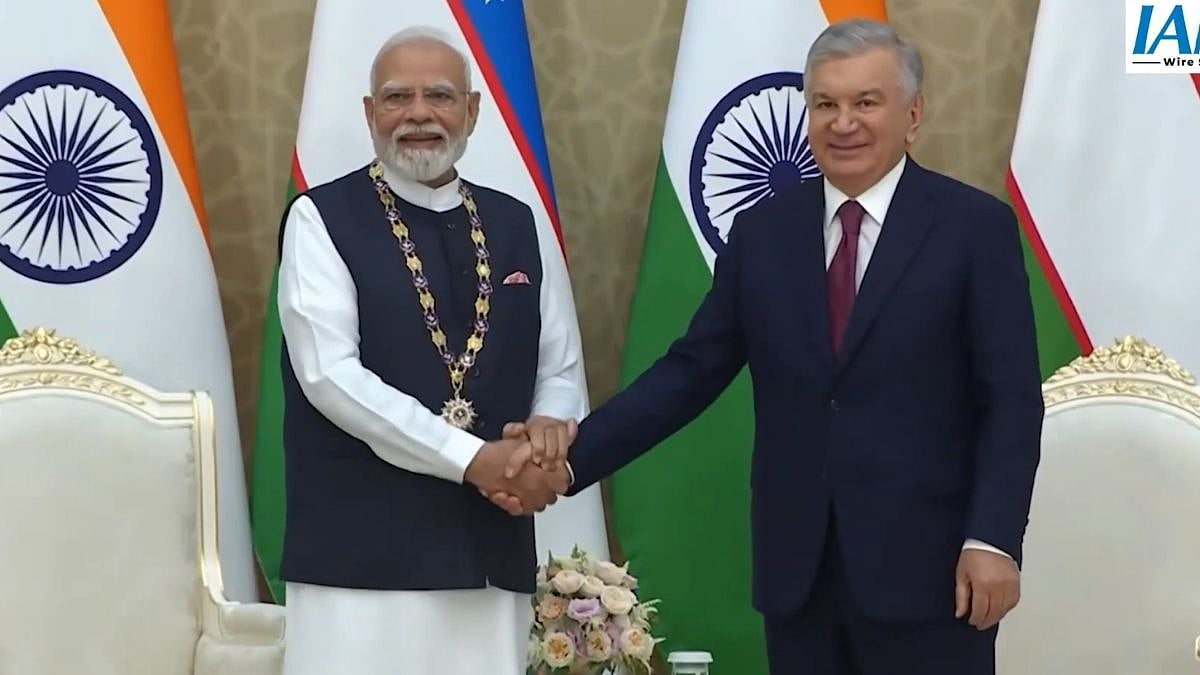
India and Uzbekistan have elevated their ties to a Comprehensive Strategic Partnership, with a focus on expanding cooperation in various sectors. This development came after talks between Prime Minister Narendra Modi and Uzbek President Shavkat Mirziyoyev on Sunday.
The two countries have set an annual bilateral trade target of $5 billion by 2030, a significant increase from the current $1 billion. They also agreed to establish a framework for the long-term supply of uranium from Uzbekistan to India, as part of cooperation in the civil nuclear energy sector.
The talks between Modi and Mirziyoyev covered a range of areas, including trade, investment, infrastructure, critical minerals, mining, defence and security, agriculture, pharmaceuticals, health, information technology, and education. The leaders also witnessed the exchange of several agreements covering areas such as mining, culture, education, tourism, and ayurveda.
Modi highlighted the importance of Uzbekistan in India's engagement in Central Asia, stating that a stronger partnership between the two countries would be a powerful force for peace, progress, and prosperity in the region. He also outlined the agenda for future cooperation, including encouraging defence industries to explore co-development and co-production of military hardware.
The two countries have also agreed to address issues relating to market access, banking, payment systems, and connectivity in a structured manner. Modi emphasized the need for close defence and security cooperation between India and Uzbekistan, reflecting their deep mutual trust.
In addition to the economic and strategic partnerships, India and Uzbekistan have also agreed on a Letter of Intent for the restoration and conservation of the Buddhist sites of Fayaz Tepa and Kara Tepa in Uzbekistan. These ancient Buddhist monasteries highlight the spread of Buddhism along the Silk Road and its presence in Central Asia.
Modi's visit to Tashkent was aimed at strengthening ties with Uzbekistan in areas including trade, investment, defence, and clean energy. The elevation of ties to a Comprehensive Strategic Partnership marks a significant milestone in the relationship between the two countries.
The partnership is expected to have a positive impact on the region, with both countries committed to promoting peace, progress, and prosperity. The agreement on long-term uranium supply and cooperation in the civil nuclear energy sector is also expected to contribute to India's energy security.
In the coming years, India and Uzbekistan are expected to work closely together to achieve their trade target and strengthen their cooperation in various sectors. The partnership is a testament to the growing relationship between the two countries and is expected to have a positive impact on the region.
The elevation of ties to a Comprehensive Strategic Partnership is a significant development in the relationship between India and Uzbekistan. It marks a new era of cooperation and partnership between the two countries, with a focus on promoting peace, progress, and prosperity in the region.
In conclusion, the upgrade of ties between India and Uzbekistan to a Comprehensive Strategic Partnership is a significant milestone in the relationship between the two countries. The partnership is expected to have a positive impact on the region, with both countries committed to promoting peace, progress, and prosperity.
Frequently asked questions
What is the trade target set by India and Uzbekistan by 2030?
The trade target set by India and Uzbekistan is $5 billion by 2030.
What is the significance of the Comprehensive Strategic Partnership between India and Uzbekistan?
The Comprehensive Strategic Partnership marks a significant milestone in the relationship between the two countries, with a focus on promoting peace, progress, and prosperity in the region.