Brent Crude Hits $90 Amid Middle East Conflict Uncertainty
Oil prices rise as conflict escalates, Brent crude crosses $90 threshold.
'%3E%3Crect%20width%3D'96'%20height%3D'96'%20fill%3D'%234A235A'%2F%3E%3Ccircle%20cx%3D'30'%20cy%3D'24'%20r%3D'44'%20fill%3D'%23fff'%20opacity%3D'.12'%2F%3E%3Ccircle%20cx%3D'60'%20cy%3D'74'%20r%3D'40'%20fill%3D'%23000'%20opacity%3D'.10'%2F%3E%3C%2Fg%3E%3Cg%20fill%3D'none'%20stroke%3D'%23fff'%20stroke-width%3D'3'%3E%3Ccircle%20cx%3D'48'%20cy%3D'48'%20r%3D'16'%2F%3E%3Cellipse%20cx%3D'48'%20cy%3D'48'%20rx%3D'6.5'%20ry%3D'16'%2F%3E%3Cline%20x1%3D'32'%20y1%3D'42'%20x2%3D'64'%20y2%3D'42'%2F%3E%3Cline%20x1%3D'32'%20y1%3D'54'%20x2%3D'64'%20y2%3D'54'%2F%3E%3C%2Fg%3E%3C%2Fsvg%3E)
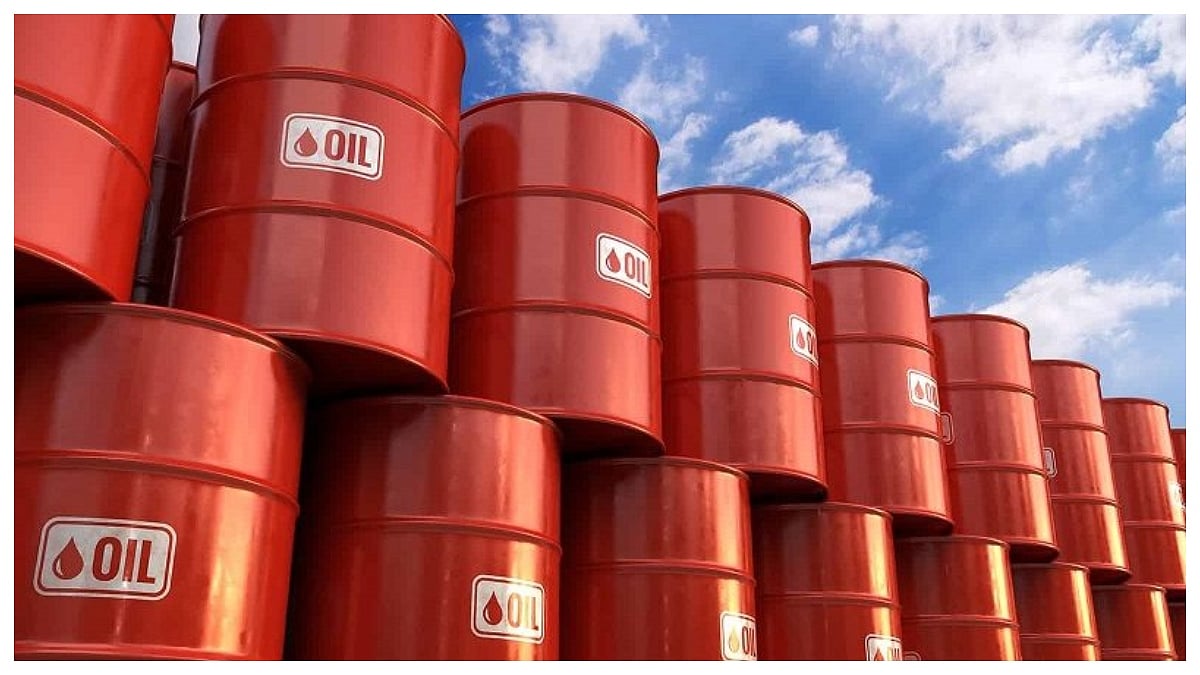
Brent crude oil prices have surpassed the $90-a-barrel mark as uncertainty surrounding the Middle East conflict continues to grow. The rise in oil prices comes after Iran indicated a tougher military approach and the US ruled out extending the temporary ceasefire.
As a result, Brent crude rose 0.75% to $91.55 a barrel, while WTI crude was trading at $85.28 a barrel, up 0.92%. The increase in oil prices has been driven by concerns over the disruption to shipping through the Strait of Hormuz, a key waterway for global crude supplies.
The conflict in the Middle East has led to a significant reduction in tanker traffic through the Strait of Hormuz. According to data from Kpler, only five commodity vessels crossed the strait on Saturday, while no vessels were recorded passing through on Sunday. This compares to 31 vessels during the previous weekend.
The tensions have also spread beyond the Gulf, with Yemen's Houthis claiming to have attacked a Saudi military vessel and four escort ships using missiles. Meanwhile, Iran has been conducting separate discussions with Oman concerning arrangements for managing traffic through the Strait of Hormuz.
The diplomatic situation remains fluid, with US President Donald Trump reportedly threatening military action against Oman. However, there are indications that diplomatic channels could remain open, with media reports suggesting that Trump has begun back-channel discussions with representatives of Iran's Islamic Revolutionary Guard Corps.
The combination of uncertain diplomacy, military escalation, and reduced tanker traffic has kept traders focused on the possibility of further disruptions to global crude supplies. The rise in oil prices has also had an impact on the Indian stock market, with the Sensex and Nifty falling as crude oil prices rise.
The conflict in the Middle East has significant implications for the global economy, particularly for countries that rely heavily on crude oil imports. The rise in oil prices could lead to higher inflation and slower economic growth, making it a major concern for policymakers and investors.
In conclusion, the escalation of the Middle East conflict has led to a significant increase in oil prices, with Brent crude surpassing the $90-a-barrel mark. The uncertainty surrounding the conflict and the disruption to shipping through the Strait of Hormuz are likely to continue to drive oil prices higher, making it a major concern for the global economy.
The situation in the Middle East remains volatile, and any further escalation of the conflict could lead to even higher oil prices. As such, traders and investors will be closely watching the developments in the region, looking for any signs of a resolution to the conflict or a reduction in tensions.
The impact of the conflict on the global economy will depend on the duration and severity of the disruption to crude oil supplies. If the conflict is resolved quickly, the impact on the economy is likely to be minimal. However, if the conflict continues for an extended period, it could lead to significant economic disruption and higher oil prices.
The Indian government will also be closely watching the developments in the Middle East, as the country relies heavily on crude oil imports. The rise in oil prices could lead to higher inflation and slower economic growth, making it a major concern for policymakers.
In terms of the oil market, the combination of uncertain diplomacy, military escalation, and reduced tanker traffic has kept traders focused on the possibility of further disruptions to global crude supplies. The rise in oil prices has also led to an increase in demand for alternative energy sources, such as renewable energy.
Overall, the escalation of the Middle East conflict has significant implications for the global economy, particularly for countries that rely heavily on crude oil imports. The rise in oil prices could lead to higher inflation and slower economic growth, making it a major concern for policymakers and investors.