Centre Allows FDI In Inventory-Based E-Commerce For Export
India permits FDI in e-commerce for export, boosts outbound shipments. E-commerce firms can maintain inventory for export purposes.
'%3E%3Crect%20width%3D'96'%20height%3D'96'%20fill%3D'%230B6E4F'%2F%3E%3Ccircle%20cx%3D'30'%20cy%3D'24'%20r%3D'44'%20fill%3D'%23fff'%20opacity%3D'.12'%2F%3E%3Ccircle%20cx%3D'60'%20cy%3D'74'%20r%3D'40'%20fill%3D'%23000'%20opacity%3D'.10'%2F%3E%3C%2Fg%3E%3Cg%20fill%3D'none'%20stroke%3D'%23fff'%20stroke-width%3D'3.2'%20stroke-linecap%3D'round'%20stroke-linejoin%3D'round'%3E%3Cpolyline%20points%3D'31%2C59%2041%2C49%2049%2C54%2063%2C37'%2F%3E%3Cpolyline%20points%3D'55%2C37%2063%2C37%2063%2C45'%2F%3E%3C%2Fg%3E%3C%2Fsvg%3E)
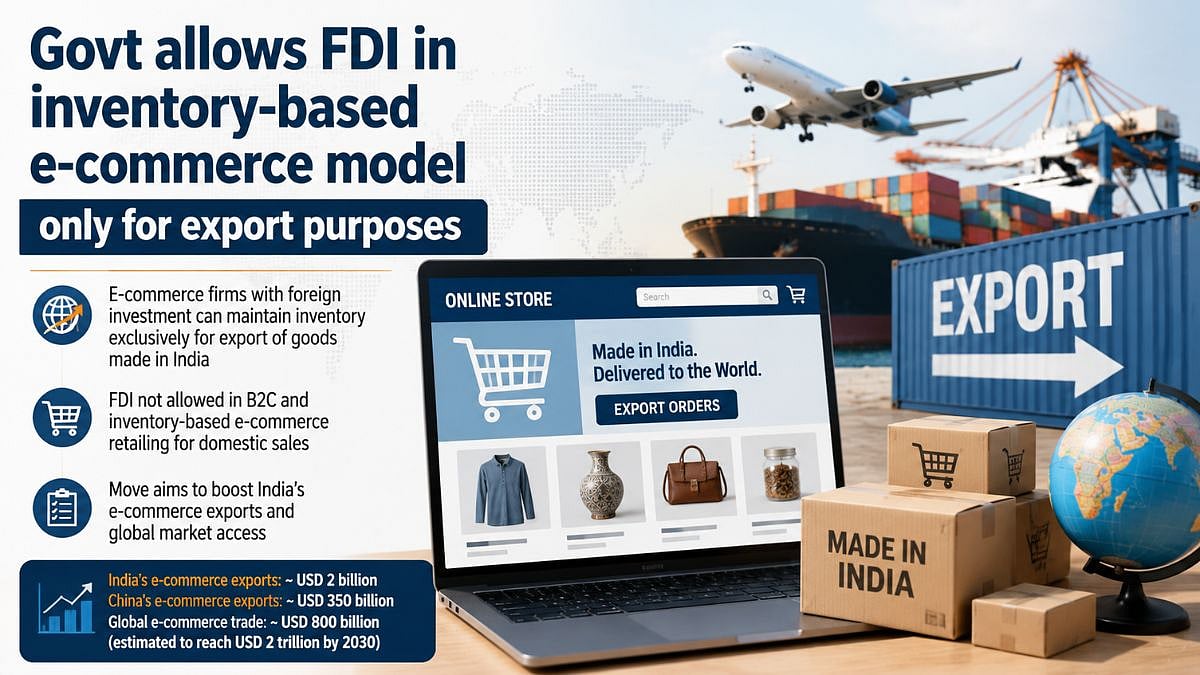
The Indian government has permitted foreign direct investment (FDI) in an inventory-based e-commerce model exclusively for export purposes. This move aims to increase India's outbound shipments without impacting the businesses of small retailers.
The decision was announced by the Department for Promotion of Industry and Internal Trade (DPIIT) in a Press Note, which stated that the restrictions on the inventory-based model of e-commerce shall not apply in the case of exports of domestically manufactured and/or produced goods/products.
This means that e-commerce firms with foreign investment can now maintain inventory only for export purposes. Earlier, the policy did not explicitly specify this. The DPIIT, an arm of the Commerce and Industry Ministry, deals with foreign direct investment (FDI)-related issues.
As per the current FDI policy, overseas investments are permitted in business-to-business e-commerce and marketplace models. However, FDI is not allowed in business-to-consumer e-commerce and inventory-based e-commerce models, where the inventory of goods and services is owned by an online retailer and is sold directly to consumers.
The DPIIT has inserted a clause in the policy, which states that an e-commerce entity is permitted to engage in an inventory-based model of e-commerce exclusively for the export of goods/products manufactured and/or produced in India.
The decision will come into effect from the date of the FEMA (Foreign Exchange Management Act) notification. This move is expected to boost India's exports through e-commerce, which is currently estimated to be around USD 2 billion, compared to China's USD 350 billion.
The global e-commerce trade is about USD 800 billion and is estimated to reach USD 2 trillion by 2030. The government is working on other measures to boost exports through e-commerce, such as setting up e-commerce export hubs.
The proposal was initially mooted by the Directorate General of Foreign Trade (DGFT) to boost India's exports through e-commerce. E-commerce stakeholders have also demanded the same.
Industry officials have welcomed the move, saying it is a positive step to facilitate exports through e-commerce and improve global market access for Indian manufacturers.
The decision is significant as it will help increase India's outbound shipments and provide a boost to the country's e-commerce sector. It will also provide opportunities for Indian manufacturers to export their products to global markets.
In conclusion, the government's decision to permit FDI in inventory-based e-commerce for export purposes is a significant move that is expected to boost India's exports and provide a boost to the country's e-commerce sector.
This move is part of the government's efforts to increase India's outbound shipments and provide opportunities for Indian manufacturers to export their products to global markets. The decision is expected to have a positive impact on the country's economy and trade sector.
Frequently asked questions
What is the current size of India's e-commerce exports?
India's e-commerce exports are currently estimated to be around USD 2 billion.
What is the expected impact of the government's decision on India's economy?
The decision is expected to have a positive impact on the country's economy and trade sector, boosting India's outbound shipments and providing opportunities for Indian manufacturers to export their products to global markets.