India Needs Structural Transformation To Reach $2 Trillion Export Goal
India aims to double exports to $2 trillion by FY31. Requires major transformation.
'%3E%3Crect%20width%3D'96'%20height%3D'96'%20fill%3D'%230B6E4F'%2F%3E%3Ccircle%20cx%3D'30'%20cy%3D'24'%20r%3D'44'%20fill%3D'%23fff'%20opacity%3D'.12'%2F%3E%3Ccircle%20cx%3D'60'%20cy%3D'74'%20r%3D'40'%20fill%3D'%23000'%20opacity%3D'.10'%2F%3E%3C%2Fg%3E%3Cg%20fill%3D'none'%20stroke%3D'%23fff'%20stroke-width%3D'3.2'%20stroke-linecap%3D'round'%20stroke-linejoin%3D'round'%3E%3Cpolyline%20points%3D'31%2C59%2041%2C49%2049%2C54%2063%2C37'%2F%3E%3Cpolyline%20points%3D'55%2C37%2063%2C37%2063%2C45'%2F%3E%3C%2Fg%3E%3C%2Fsvg%3E)
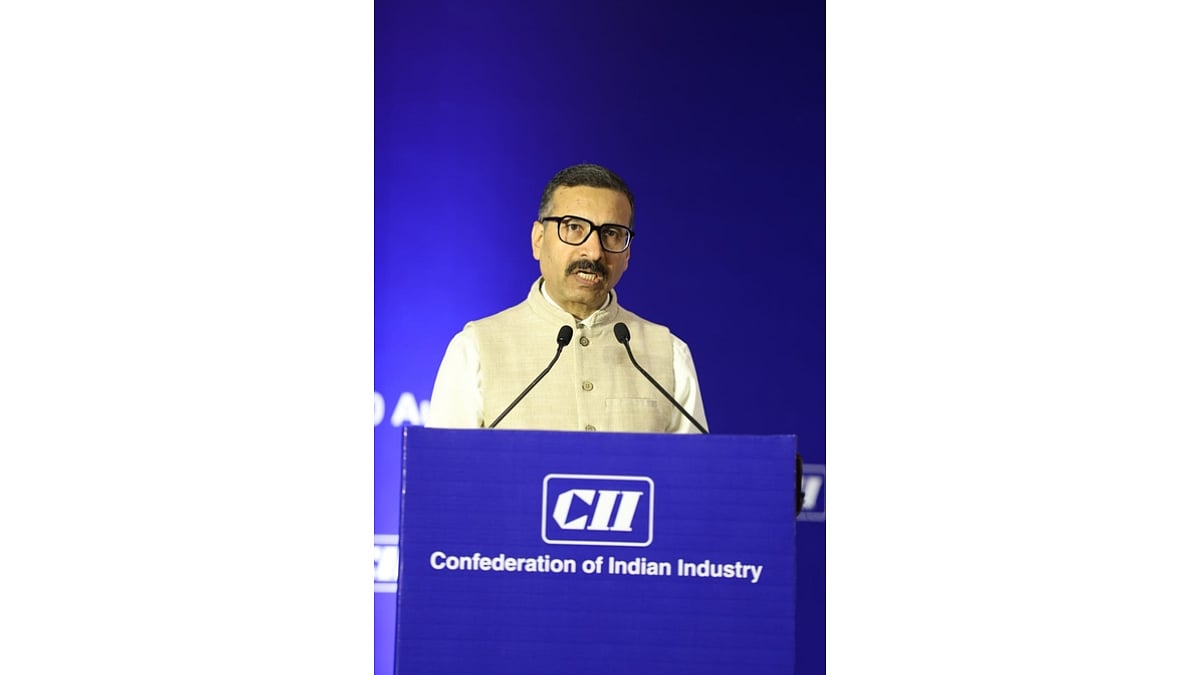
India will need to more than double its current export trajectory to achieve its ambitious target of $2 trillion in total exports by FY31. This requires a structural transformation of the country's manufacturing and trade ecosystem, according to Commerce Ministry Additional Secretary Yashvir Singh.
Singh addressed the CII Manufacturing Conclave in New Delhi, where he stated that India's total exports had reached an all-time high of $863 billion in FY26, compared with $468 billion in 2014-15. However, he emphasized that achieving the $2 trillion target would require more than incremental improvements.
The ambition of $2 trillion of total exports by 2030 demands that India more than double its current trajectory. This acceleration will not come from incremental improvements, but rather from a structural transformation. Singh stressed that India should position itself as a trusted and resilient manufacturing partner, capable of offering transparent and reliable supply networks.
The ongoing global debate around the China-plus-one strategy should not be limited to replacing one supply-chain dependency with another. Instead, India should focus on becoming a trusted partner and a resilient manufacturer. Singh's remarks come amid growing strains in the global trading system, with trade increasingly being used as an instrument of geopolitical policy.
The multilateral trade order that supported decades of shared prosperity is undergoing significant structural realignment. Referring to developments at the World Trade Organisation, Singh pointed to differences at the WTO's 14th Ministerial Conference and the continued paralysis of its appellate body as signs of the challenges facing the multilateral trading system.
The most-favoured-nation principle, a key pillar of global trade, is increasingly being tested by reciprocal tariffs and the unilateral expansion of security exceptions. Export restrictions on critical minerals are being weaponised, and technology choke points are being deliberately engineered. Trade is no longer just an economic instrument, but has become a tool of geographic statecraft.
The increasing concentration of manufacturing and critical supply chains has emerged as a major economic security concern. China's share of global manufacturing value added increased from around 3 per cent in 1990 to nearly 28 per cent in 2024. China has also established a dominant position in the processing and refining of several critical minerals, including rare earths, graphite, and magnesium.
In order to achieve its export goals, India will need to focus on building a resilient and trusted manufacturing ecosystem. This will require significant investments in infrastructure, technology, and human capital. Additionally, India will need to navigate the complex and evolving global trade landscape, where trade is increasingly being used as a tool of geopolitical policy.
The success of India's export strategy will have significant implications for the country's economic growth and development. A structural transformation of the manufacturing and trade ecosystem will be necessary to achieve the ambitious target of $2 trillion in total exports by FY31. This will require a coordinated effort from government, industry, and other stakeholders to build a resilient and trusted manufacturing ecosystem.
In conclusion, India's aim to reach $2 trillion in exports by FY31 is an ambitious goal that will require a structural transformation of the country's manufacturing and trade ecosystem. This will involve significant investments in infrastructure, technology, and human capital, as well as a coordinated effort to navigate the complex and evolving global trade landscape.
The implications of this goal are significant, and the success of India's export strategy will have a major impact on the country's economic growth and development. As the global trade landscape continues to evolve, India will need to remain agile and adaptable in order to achieve its export goals and become a trusted and resilient manufacturing partner.
Overall, the challenge of reaching $2 trillion in exports by FY31 is a significant one, but it also presents an opportunity for India to build a resilient and trusted manufacturing ecosystem and become a major player in the global trade landscape.
In the end, the success of India's export strategy will depend on its ability to navigate the complex and evolving global trade landscape, and to build a manufacturing ecosystem that is resilient, trusted, and capable of competing with the best in the world.
Frequently asked questions
What is India's export target by FY31?
India aims to reach $2 trillion in total exports by FY31.
What is required for India to achieve its export target?
A structural transformation of the country's manufacturing and trade ecosystem is necessary to achieve the ambitious target.