Marathi Abhyas Kendra Opposes Language Initiative
Marathi Abhyas Kendra opposes 'Learn Another Indian Language' initiative, SCERT says programme optional.
'%3E%3Crect%20width%3D'96'%20height%3D'96'%20fill%3D'%23B3261E'%2F%3E%3Ccircle%20cx%3D'30'%20cy%3D'24'%20r%3D'44'%20fill%3D'%23fff'%20opacity%3D'.12'%2F%3E%3Ccircle%20cx%3D'60'%20cy%3D'74'%20r%3D'40'%20fill%3D'%23000'%20opacity%3D'.10'%2F%3E%3C%2Fg%3E%3Cg%20fill%3D'%23fff'%3E%3Crect%20x%3D'29'%20y%3D'49'%20width%3D'8'%20height%3D'19'%20rx%3D'1'%2F%3E%3Crect%20x%3D'39'%20y%3D'40'%20width%3D'9'%20height%3D'28'%20rx%3D'1'%2F%3E%3Crect%20x%3D'50'%20y%3D'45'%20width%3D'8'%20height%3D'23'%20rx%3D'1'%2F%3E%3Crect%20x%3D'60'%20y%3D'53'%20width%3D'7'%20height%3D'15'%20rx%3D'1'%2F%3E%3Crect%20x%3D'41'%20y%3D'34'%20width%3D'5'%20height%3D'6'%2F%3E%3C%2Fg%3E%3C%2Fsvg%3E)
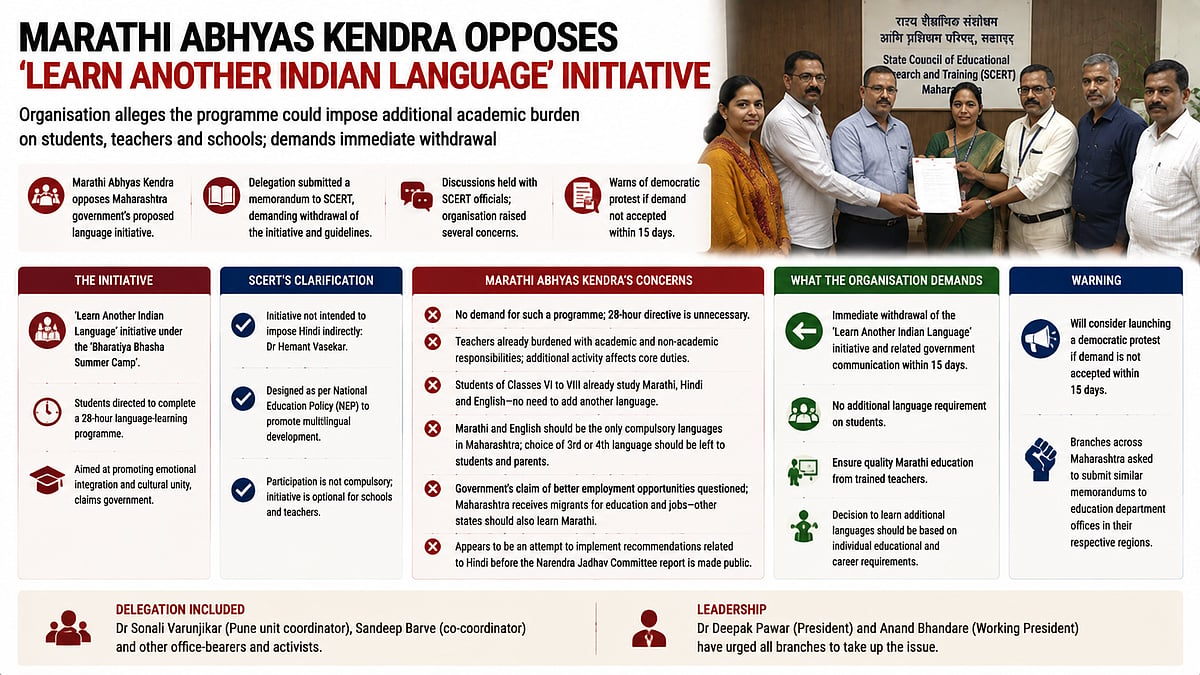
The Marathi Abhyas Kendra has opposed the Maharashtra government's proposed 'Learn Another Indian Language' initiative under the 'Bharatiya Bhasha Summer Camp'. The organisation alleges that it could impose an additional academic burden on students, teachers, and schools.
Representatives of the Marathi Abhyas Kendra's Pune unit visited the office of the State Council of Educational Research and Training (SCERT) and submitted a memorandum demanding the immediate withdrawal of the initiative and the related guidelines. The delegation held discussions with SCERT Director Dr Hemant Vasekar, Joint Director Kamaladevi Awate, and Deputy Director Anil Gautam.
According to the SCERT, the initiative was designed in accordance with the National Education Policy (NEP) to promote multilingual development among students. Dr Vasekar said that participation in the programme is not compulsory and the initiative is optional for schools and teachers.
However, the Marathi Abhyas Kendra questioned the need for the initiative, stating that the government had directed students to complete a 28-hour language-learning programme despite there being no specific demand for such an activity. The organisation argued that teachers were already handling several academic and non-academic responsibilities, and another activity could add to their workload and affect their core teaching duties.
The Marathi Abhyas Kendra also objected to the government's claim that learning other Indian languages could improve employment opportunities across the country. It argued that Maharashtra receives large-scale migration for education and employment and said other states should also encourage the learning of Marathi.
While supporting the objectives of national integration and cultural understanding, the organisation said these goals should not be pursued by placing an additional language requirement on students. It stressed that every student in Maharashtra should be able to learn Marathi and English, and the choice of a third or fourth language should be left to students and their parents.
The Marathi Abhyas Kendra's opposition to the initiative highlights the ongoing debate about language education in India. The National Education Policy (NEP) aims to promote multilingualism and cultural understanding among students. However, the implementation of such initiatives can be complex and may have unintended consequences, such as adding to the workload of teachers and students.
In Maharashtra, Marathi is the official language, and it is compulsory for students to learn Marathi and English in schools. The introduction of another Indian language may be seen as an attempt to promote national integration and cultural understanding. However, it is essential to consider the potential impact on students, teachers, and schools before implementing such initiatives.
The SCERT's clarification that the programme is optional may alleviate some concerns. However, the Marathi Abhyas Kendra's opposition to the initiative highlights the need for careful consideration and consultation with stakeholders before implementing language education policies.
In conclusion, the Marathi Abhyas Kendra's opposition to the 'Learn Another Indian Language' initiative underscores the importance of careful planning and consideration in language education policy. The initiative's potential impact on students, teachers, and schools must be carefully evaluated to ensure that it promotes multilingualism and cultural understanding without imposing an undue burden on stakeholders.
The issue also raises questions about the role of language in promoting national integration and cultural understanding. While learning other Indian languages can certainly promote cultural exchange and understanding, it is essential to consider the potential consequences of such initiatives on students, teachers, and schools. Ultimately, language education policies must be designed to promote the well-being and development of students, rather than imposing additional burdens on them.
The Maharashtra government's initiative is part of a broader effort to promote multilingualism and cultural understanding in India. The National Education Policy (NEP) aims to create a more inclusive and diverse education system that promotes the learning of multiple languages. However, the implementation of such initiatives requires careful consideration and consultation with stakeholders to ensure that they are effective and beneficial for all.
The Marathi Abhyas Kendra's opposition to the initiative highlights the need for ongoing dialogue and consultation between the government, educators, and stakeholders to ensure that language education policies are effective and beneficial for all. By working together, it is possible to create a more inclusive and diverse education system that promotes multilingualism and cultural understanding while also supporting the well-being and development of students.
Frequently asked questions
What is the 'Learn Another Indian Language' initiative?
The 'Learn Another Indian Language' initiative is a programme designed to promote multilingual development among students in Maharashtra.
Is participation in the programme compulsory?
No, participation in the programme is not compulsory, and it is optional for schools and teachers.