NIA Court To Summon Hafiz Saeed For Pahalgam Terror Trial
Lashkar founder Hafiz Saeed to face trial, summons to be sent via Ministry of External Affairs
'%3E%3Crect%20width%3D'96'%20height%3D'96'%20fill%3D'%234A235A'%2F%3E%3Ccircle%20cx%3D'30'%20cy%3D'24'%20r%3D'44'%20fill%3D'%23fff'%20opacity%3D'.12'%2F%3E%3Ccircle%20cx%3D'60'%20cy%3D'74'%20r%3D'40'%20fill%3D'%23000'%20opacity%3D'.10'%2F%3E%3C%2Fg%3E%3Cg%20fill%3D'none'%20stroke%3D'%23fff'%20stroke-width%3D'3'%3E%3Ccircle%20cx%3D'48'%20cy%3D'48'%20r%3D'16'%2F%3E%3Cellipse%20cx%3D'48'%20cy%3D'48'%20rx%3D'6.5'%20ry%3D'16'%2F%3E%3Cline%20x1%3D'32'%20y1%3D'42'%20x2%3D'64'%20y2%3D'42'%2F%3E%3Cline%20x1%3D'32'%20y1%3D'54'%20x2%3D'64'%20y2%3D'54'%2F%3E%3C%2Fg%3E%3C%2Fsvg%3E)
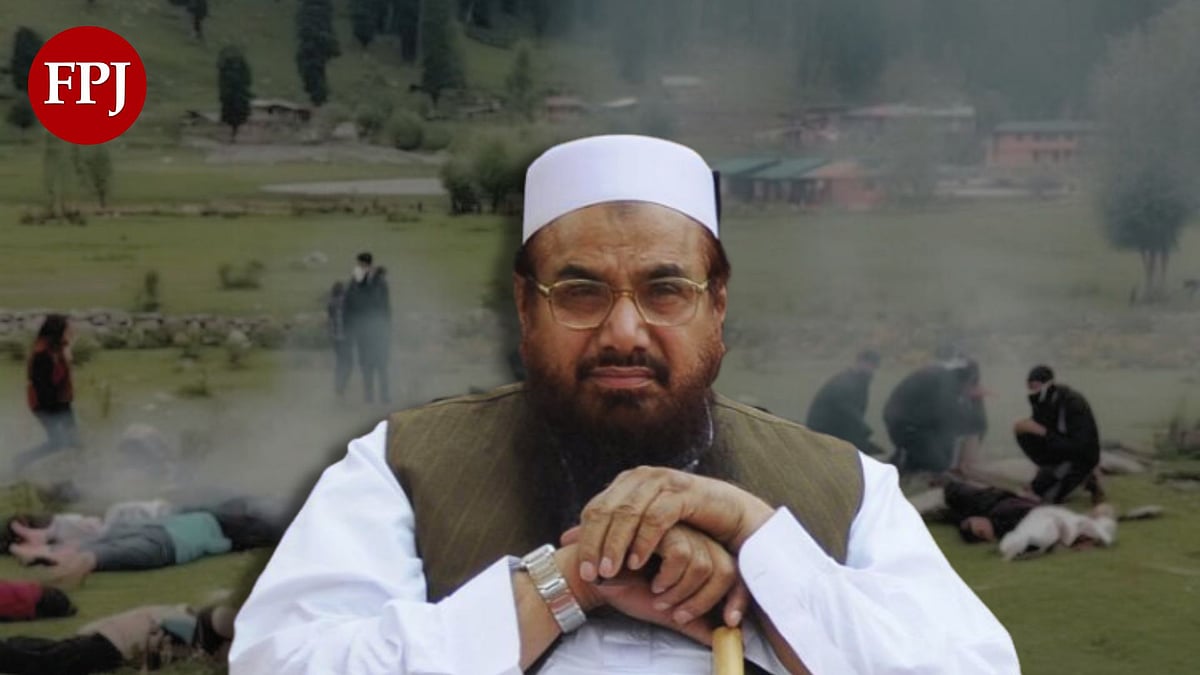
A special National Investigation Agency (NIA) court is set to issue summons to Lashkar-e-Taiba founder Hafiz Saeed, accused in the Pahalgam terror attack case. The summons will be sent through the Ministry of External Affairs, directing Saeed to appear before the special NIA court in Jammu for trial.
The NIA has alleged that Saeed was among the masterminds behind the April 2025 attack, which claimed the lives of 25 tourists and a local resident. A non-bailable warrant has already been issued against Saeed.
If Saeed fails to appear after all legal procedures are completed, the court may proceed with his trial in absentia under Section 356 of the Bharatiya Nagarik Suraksha Sanhita, 2023. This provision allows the court to conduct an inquiry or trial and deliver its judgment against a proclaimed offender who has absconded to avoid legal proceedings.
The NIA named Saeed as an accused in a supplementary chargesheet filed in July, indicting him both in his individual capacity and as the chief of the banned Lashkar-e-Taiba (LeT) and its proxy outfit, The Resistance Front (TRF). Saeed has been booked under provisions of the Bharatiya Nyaya Sanhita, 2023, and the Unlawful Activities (Prevention) Act, 1967, with charges including waging war against India and plotting the attack from Pakistan.
Before starting a trial in absentia, the court must fulfil certain procedural requirements, including issuing two successive arrest warrants and publishing a notice requiring the proclaimed offender to appear before the court. The trial in absentia can begin only after 90 days have elapsed from the framing of charges.
The move to summon Saeed is a significant step in India's efforts to bring the mastermind of the Pahalgam terror attack to justice. The Indian government has been pushing for Saeed's extradition, but Pakistan has yet to take concrete action against him.
The Pahalgam terror attack was a devastating incident that shook the nation, and the NIA's efforts to bring the perpetrators to justice are a welcome step. The trial of Hafiz Saeed, even if it is in absentia, will be a significant milestone in the fight against terrorism.
In the context of India's fight against terrorism, the move to summon Saeed is a major development. The Indian government has been working tirelessly to bring terrorists to justice, and this move is a testament to its commitment to combating terrorism.
The significance of this development cannot be overstated. The trial of Hafiz Saeed will send a strong message to terrorists and their supporters that India will not tolerate terrorism in any form. It will also be a major blow to the morale of terrorist organizations, which have been using Pakistan as a safe haven.
In conclusion, the NIA court's decision to summon Hafiz Saeed for trial is a major step forward in the fight against terrorism. It is a testament to India's commitment to bringing terrorists to justice and will have significant implications for the country's efforts to combat terrorism.
Frequently asked questions
What are the charges against Hafiz Saeed?
Saeed has been booked under provisions of the Bharatiya Nyaya Sanhita, 2023, and the Unlawful Activities (Prevention) Act, 1967, with charges including waging war against India and plotting the attack from Pakistan.
What is the next step in the trial process?
If Saeed fails to appear after all legal procedures are completed, the court may proceed with his trial in absentia under Section 356 of the Bharatiya Nagarik Suraksha Sanhita, 2023.