Sensex Gains 138 Points, Ends 3-Day Loss Streak
Indian equity benchmarks rebound, banking stocks lead recovery. Sensex and Nifty end three sessions of losses.
'%3E%3Crect%20width%3D'96'%20height%3D'96'%20fill%3D'%230B6E4F'%2F%3E%3Ccircle%20cx%3D'30'%20cy%3D'24'%20r%3D'44'%20fill%3D'%23fff'%20opacity%3D'.12'%2F%3E%3Ccircle%20cx%3D'60'%20cy%3D'74'%20r%3D'40'%20fill%3D'%23000'%20opacity%3D'.10'%2F%3E%3C%2Fg%3E%3Cg%20fill%3D'none'%20stroke%3D'%23fff'%20stroke-width%3D'3.2'%20stroke-linecap%3D'round'%20stroke-linejoin%3D'round'%3E%3Cpolyline%20points%3D'31%2C59%2041%2C49%2049%2C54%2063%2C37'%2F%3E%3Cpolyline%20points%3D'55%2C37%2063%2C37%2063%2C45'%2F%3E%3C%2Fg%3E%3C%2Fsvg%3E)
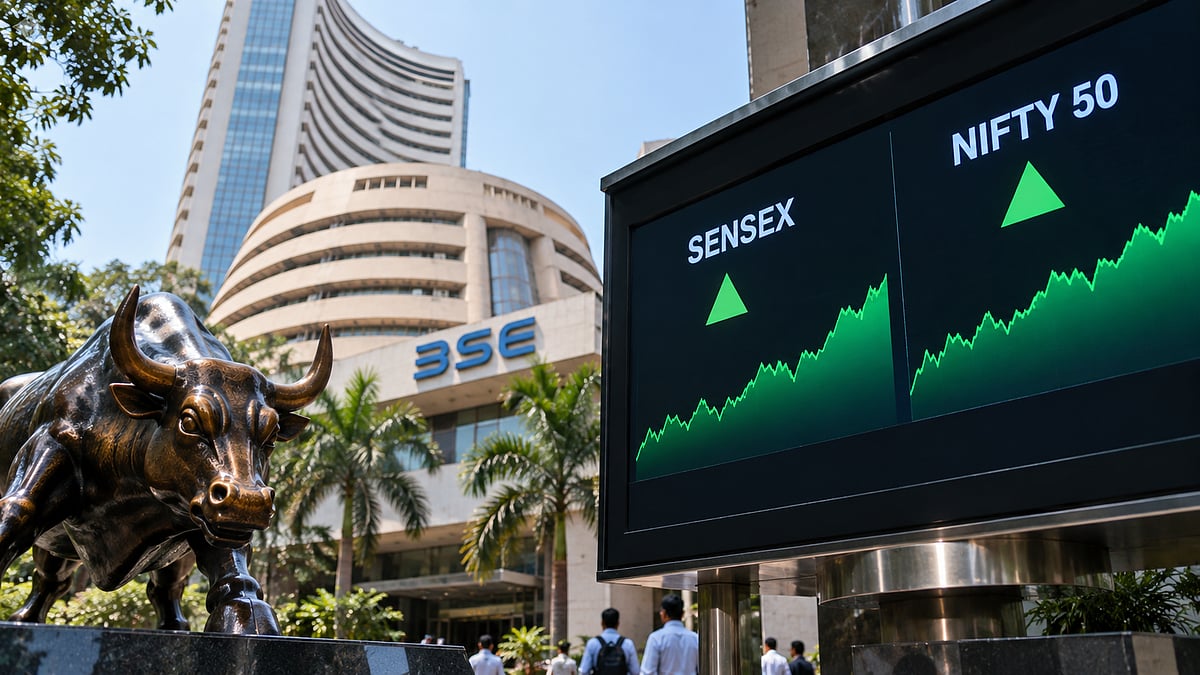
The Indian stock market witnessed a positive trend on Thursday, with the BSE Sensex gaining 138.36 points to close at 74,902.59. The NSE Nifty 50 also advanced, ending the day at 23,477.80. This rebound marked the end of a three-session losing streak for the Indian equity benchmarks.
The recovery was largely driven by buying in banking and financial shares. Nifty Financial Services, Nifty PSU Bank, and Nifty Private Bank were among the top-performing sectoral indices. HDFC Life Insurance Company, Power Grid Corporation of India, and Oil and Natural Gas Corporation were among the leading Nifty gainers.
However, the broader market failed to match the benchmark recovery. The Nifty MidCap index declined 0.38%, while the Nifty SmallCap index slipped 0.07%. Auto and metal stocks remained under pressure, with these sectors being among the major laggards.
The market witnessed a choppy session, with investors closely monitoring crude oil prices and their potential impact on India's inflation, import costs, and corporate earnings. Weak cues from Asian markets, a depreciating rupee, and firmer domestic bond yields also limited the upside.
Despite these challenges, strong equity mutual fund inflows in August and an improvement in the SIP stoppage ratio offered some support to investor sentiment. From a technical perspective, the Nifty continues to trade below its key daily moving averages, keeping the near-term trend under pressure.
Immediate Nifty support is placed at 23,400, followed by 23,300. On the upside, the 23,550-23,600 zone remains the first significant resistance area. A sustained move above this range could improve near-term momentum, while failure to hold support may keep the benchmark vulnerable to renewed selling pressure.
The Indian stock market is expected to remain volatile, with investors closely watching crude oil prices and their potential impact on the economy. The market will also be awaiting the release of US inflation data and the Fed's decision, which could have a significant impact on global markets.
In the context of the Indian economy, the stock market's performance is closely tied to the country's growth prospects. A strong stock market can boost investor confidence and attract foreign investment, which can help drive economic growth. On the other hand, a weak stock market can have a negative impact on the economy, making it more challenging for companies to raise capital and invest in growth initiatives.
Overall, the Indian stock market's rebound on Thursday was a positive sign, but the market is expected to remain volatile in the near term. Investors will need to closely monitor market trends and economic indicators to make informed investment decisions.
The significance of this rebound for Mumbai and India is that it indicates a potential shift in investor sentiment. If the market can sustain this momentum, it could have a positive impact on the economy, leading to increased investment and growth. However, if the market fails to hold support, it could lead to renewed selling pressure, which could have a negative impact on the economy.
In conclusion, the Indian stock market's rebound on Thursday was a welcome sign, but the market is expected to remain volatile in the near term. Investors will need to closely monitor market trends and economic indicators to make informed investment decisions.
Frequently asked questions
What was the main reason for the stock market's rebound on Thursday?
The rebound was largely driven by buying in banking and financial shares.
What is the immediate Nifty support?
Immediate Nifty support is placed at 23,400, followed by 23,300.