NMMC's English-Medium KG Move Questioned
Marathi Study Centre raises concerns, public meeting held in Vashi
'%3E%3Crect%20width%3D'96'%20height%3D'96'%20fill%3D'%23B3261E'%2F%3E%3Ccircle%20cx%3D'30'%20cy%3D'24'%20r%3D'44'%20fill%3D'%23fff'%20opacity%3D'.12'%2F%3E%3Ccircle%20cx%3D'60'%20cy%3D'74'%20r%3D'40'%20fill%3D'%23000'%20opacity%3D'.10'%2F%3E%3C%2Fg%3E%3Cg%20fill%3D'%23fff'%3E%3Crect%20x%3D'29'%20y%3D'49'%20width%3D'8'%20height%3D'19'%20rx%3D'1'%2F%3E%3Crect%20x%3D'39'%20y%3D'40'%20width%3D'9'%20height%3D'28'%20rx%3D'1'%2F%3E%3Crect%20x%3D'50'%20y%3D'45'%20width%3D'8'%20height%3D'23'%20rx%3D'1'%2F%3E%3Crect%20x%3D'60'%20y%3D'53'%20width%3D'7'%20height%3D'15'%20rx%3D'1'%2F%3E%3Crect%20x%3D'41'%20y%3D'34'%20width%3D'5'%20height%3D'6'%2F%3E%3C%2Fg%3E%3C%2Fsvg%3E)
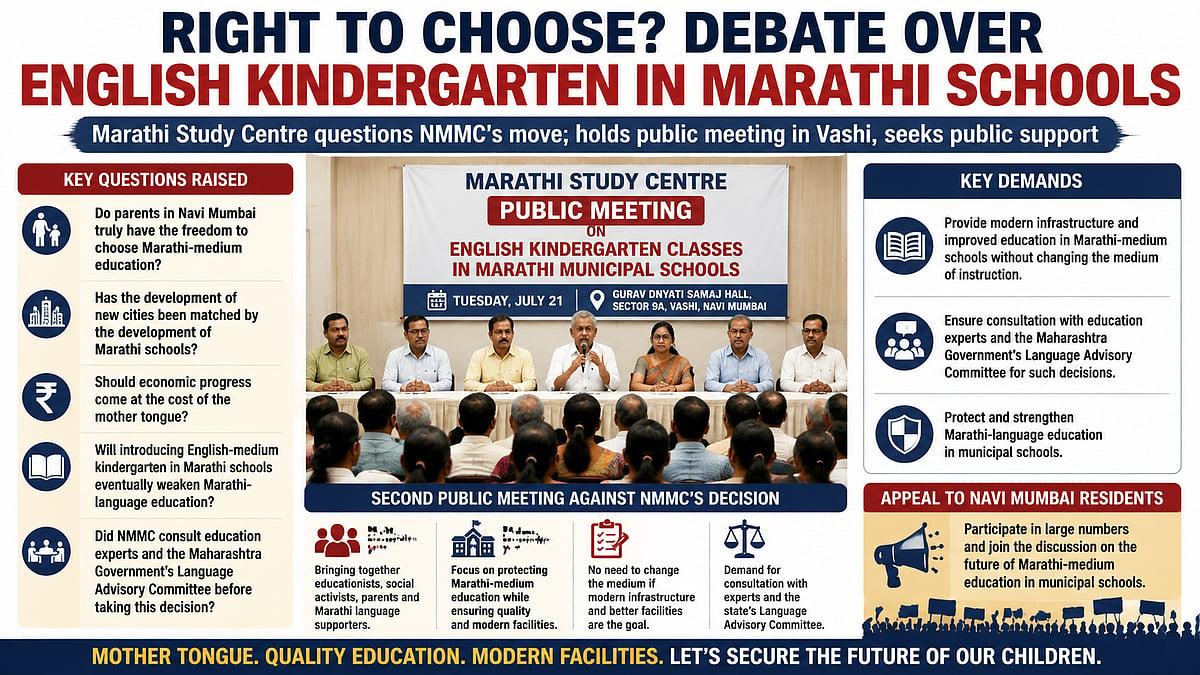
The Marathi Study Centre has expressed concerns over the Navi Mumbai Municipal Corporation's (NMMC) decision to introduce English-medium kindergarten classes in municipal Marathi schools.
The decision, which came into effect from the current academic year, has sparked debate about the freedom of parents to choose Marathi-medium education for their children.
On July 21, a public meeting was convened in Vashi to discuss the issue and formulate a collective response. The meeting, attended by educationists, social activists, parents, and Marathi language supporters, aimed to raise awareness about the potential impact of the NMMC's decision on Marathi-language education.
According to Dr. Deepak Pawar, president of the Marathi Study Centre, the organisation has raised several questions about the civic body's policy. These include whether the development of new cities has been matched by the development of Marathi schools and whether economic progress should come at the cost of the mother tongue.
The Marathi Study Centre has also questioned whether the NMMC's decision could eventually weaken Marathi-language education. The organisation argued that modern infrastructure and improved educational facilities can be provided without changing the medium of instruction.
The centre has sought to know whether the municipal corporation consulted education experts and the Maharashtra government's Language Advisory Committee before taking the decision. This is the second public meeting organised in Navi Mumbai to oppose the NMMC's move.
The discussion focused on protecting Marathi-medium education while ensuring quality schooling and modern facilities for students. The Marathi Study Centre has appealed to Navi Mumbai residents to participate in the discussion on the future of Marathi-medium education in municipal schools.
The introduction of English-medium kindergarten classes in municipal Marathi schools has significant implications for the education system in Navi Mumbai. The Marathi Study Centre's concerns highlight the need for a balanced approach that preserves the importance of the mother tongue while providing access to quality education.
In the context of Navi Mumbai's rapid development, the debate surrounding the NMMC's decision serves as a reminder of the importance of preserving linguistic and cultural heritage. As the city continues to grow and evolve, it is essential to ensure that the education system reflects the diverse needs and aspirations of its residents.
The outcome of this debate will have a significant impact on the future of education in Navi Mumbai, and it is crucial for stakeholders to engage in a constructive dialogue to find a solution that benefits all parties involved.
Ultimately, the decision to introduce English-medium kindergarten classes in municipal Marathi schools raises important questions about the role of language in education and the importance of preserving cultural heritage. As Navi Mumbai continues to develop and grow, it is essential to find a balance between progress and preservation, ensuring that the city's education system serves the needs of all its residents.
Frequently asked questions
What is the NMMC's decision on English-medium KG classes?
The NMMC has introduced English-medium kindergarten classes in municipal Marathi schools from the current academic year.
Why is the Marathi Study Centre opposing the NMMC's decision?
The Marathi Study Centre is concerned that the decision could weaken Marathi-language education and is seeking to protect Marathi-medium education in municipal schools.