Scientists Challenge 70-Year-Old Lizard Brain Theory
New research questions a decades-old idea about human intelligence. Scientists challenge a 70-year-old theory.
'%3E%3Crect%20width%3D'96'%20height%3D'96'%20fill%3D'%23B3261E'%2F%3E%3Ccircle%20cx%3D'30'%20cy%3D'24'%20r%3D'44'%20fill%3D'%23fff'%20opacity%3D'.12'%2F%3E%3Ccircle%20cx%3D'60'%20cy%3D'74'%20r%3D'40'%20fill%3D'%23000'%20opacity%3D'.10'%2F%3E%3C%2Fg%3E%3Cg%20fill%3D'%23fff'%3E%3Crect%20x%3D'29'%20y%3D'49'%20width%3D'8'%20height%3D'19'%20rx%3D'1'%2F%3E%3Crect%20x%3D'39'%20y%3D'40'%20width%3D'9'%20height%3D'28'%20rx%3D'1'%2F%3E%3Crect%20x%3D'50'%20y%3D'45'%20width%3D'8'%20height%3D'23'%20rx%3D'1'%2F%3E%3Crect%20x%3D'60'%20y%3D'53'%20width%3D'7'%20height%3D'15'%20rx%3D'1'%2F%3E%3Crect%20x%3D'41'%20y%3D'34'%20width%3D'5'%20height%3D'6'%2F%3E%3C%2Fg%3E%3C%2Fsvg%3E)
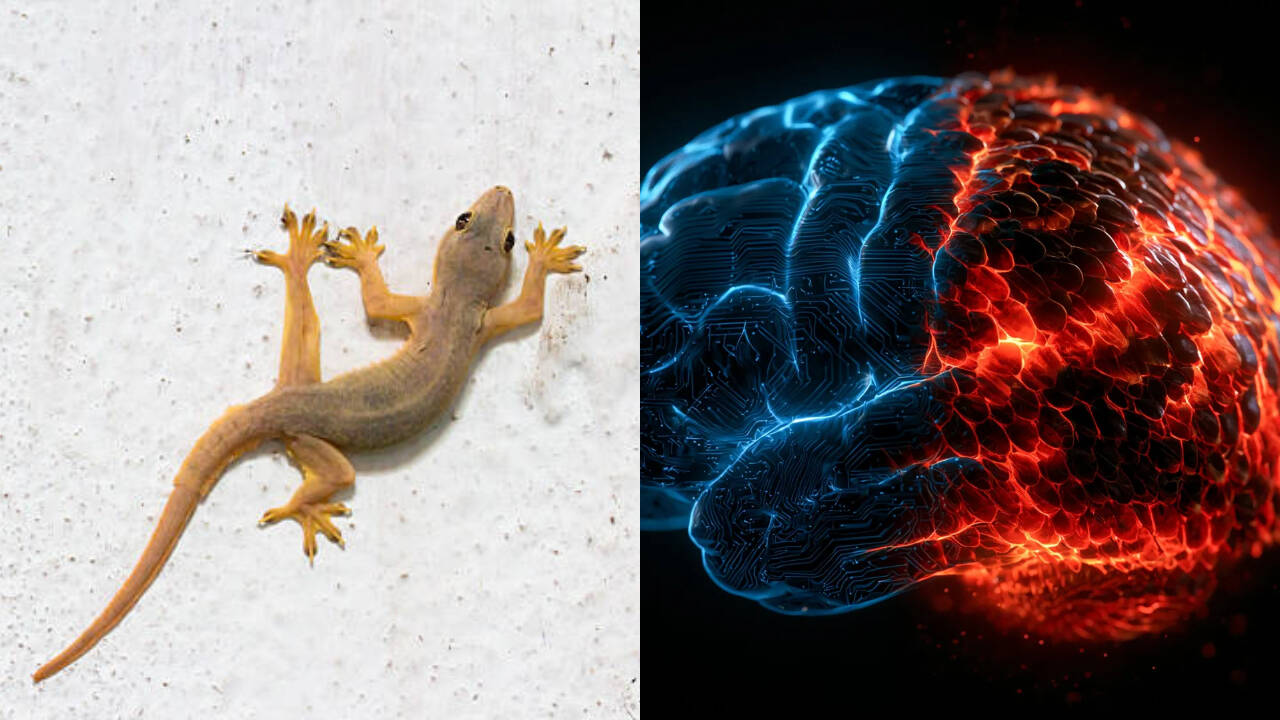
A team of scientists has challenged the long-standing 'Lizard brain' theory of human intelligence, which has been a cornerstone of neuroscience for over 70 years. The theory, also known as the triune brain theory, proposes that the human brain is composed of three distinct parts: the reptilian brain, the paleomammalian brain, and the neomammalian brain.
The reptilian brain, which is said to be the most primitive part of the brain, is responsible for basic functions such as breathing, heart rate, and instinctual behaviors. The paleomammalian brain, on the other hand, is associated with emotions and motivation, while the neomammalian brain is responsible for higher-order thinking and cognitive functions.
However, the new research suggests that this theory may be oversimplified and not entirely accurate. The scientists argue that the brain is a more complex and dynamic system than previously thought, and that the different parts of the brain are highly interconnected and interact with each other in complex ways.
The 'Lizard brain' theory was first proposed by neuroscientist Paul MacLean in the 1950s and has since been widely accepted and influential in the field of neuroscience. However, in recent years, some scientists have begun to question the theory, citing a lack of empirical evidence and inconsistencies in the data.
The new research is based on a comprehensive review of existing studies and data, as well as new experiments and analyses. The scientists used advanced imaging techniques, such as functional magnetic resonance imaging (fMRI), to study the brain and its functions in greater detail.
The findings of the study have significant implications for our understanding of human intelligence and behavior. If the 'Lizard brain' theory is indeed flawed, it could lead to a major shift in the way we think about the brain and its functions. It could also have implications for the treatment of neurological and psychiatric disorders, which are often based on the triune brain theory.
The study's authors emphasize that their findings do not necessarily mean that the 'Lizard brain' theory is completely wrong, but rather that it is incomplete and in need of revision. They hope that their research will stimulate further investigation and debate in the field of neuroscience.
In the context of neuroscience, the 'Lizard brain' theory has been a dominant paradigm for decades. However, with the advent of new technologies and techniques, scientists are now able to study the brain in greater detail and complexity. The new research is part of a growing trend of challenging established theories and pushing the boundaries of our understanding of the human brain.
The implications of this research are far-reaching and could have significant impacts on our understanding of human behavior and intelligence. As scientists continue to study the brain and its functions, we can expect to see new and exciting developments in the field of neuroscience.
In conclusion, the challenge to the 'Lizard brain' theory is a significant development in the field of neuroscience. While the theory has been influential and widely accepted, the new research suggests that it may be in need of revision. As scientists continue to study the brain and its functions, we can expect to see new and exciting developments in our understanding of human intelligence and behavior.
Frequently asked questions
What is the Lizard brain theory?
The Lizard brain theory, also known as the triune brain theory, proposes that the human brain is composed of three distinct parts: the reptilian brain, the paleomammalian brain, and the neomammalian brain.
Why is the Lizard brain theory being challenged?
The theory is being challenged because new research suggests that it may be oversimplified and not entirely accurate, and that the brain is a more complex and dynamic system than previously thought.