Air India Flight Loses Control For 4 Seconds After Hydraulic Failure
Air India flight from Phuket to Delhi experienced severe altitude loss. 20 passengers and 4 crew members injured.
'%3E%3Crect%20width%3D'96'%20height%3D'96'%20fill%3D'%23B3261E'%2F%3E%3Ccircle%20cx%3D'30'%20cy%3D'24'%20r%3D'44'%20fill%3D'%23fff'%20opacity%3D'.12'%2F%3E%3Ccircle%20cx%3D'60'%20cy%3D'74'%20r%3D'40'%20fill%3D'%23000'%20opacity%3D'.10'%2F%3E%3C%2Fg%3E%3Cg%20fill%3D'%23fff'%3E%3Crect%20x%3D'29'%20y%3D'49'%20width%3D'8'%20height%3D'19'%20rx%3D'1'%2F%3E%3Crect%20x%3D'39'%20y%3D'40'%20width%3D'9'%20height%3D'28'%20rx%3D'1'%2F%3E%3Crect%20x%3D'50'%20y%3D'45'%20width%3D'8'%20height%3D'23'%20rx%3D'1'%2F%3E%3Crect%20x%3D'60'%20y%3D'53'%20width%3D'7'%20height%3D'15'%20rx%3D'1'%2F%3E%3Crect%20x%3D'41'%20y%3D'34'%20width%3D'5'%20height%3D'6'%2F%3E%3C%2Fg%3E%3C%2Fsvg%3E)
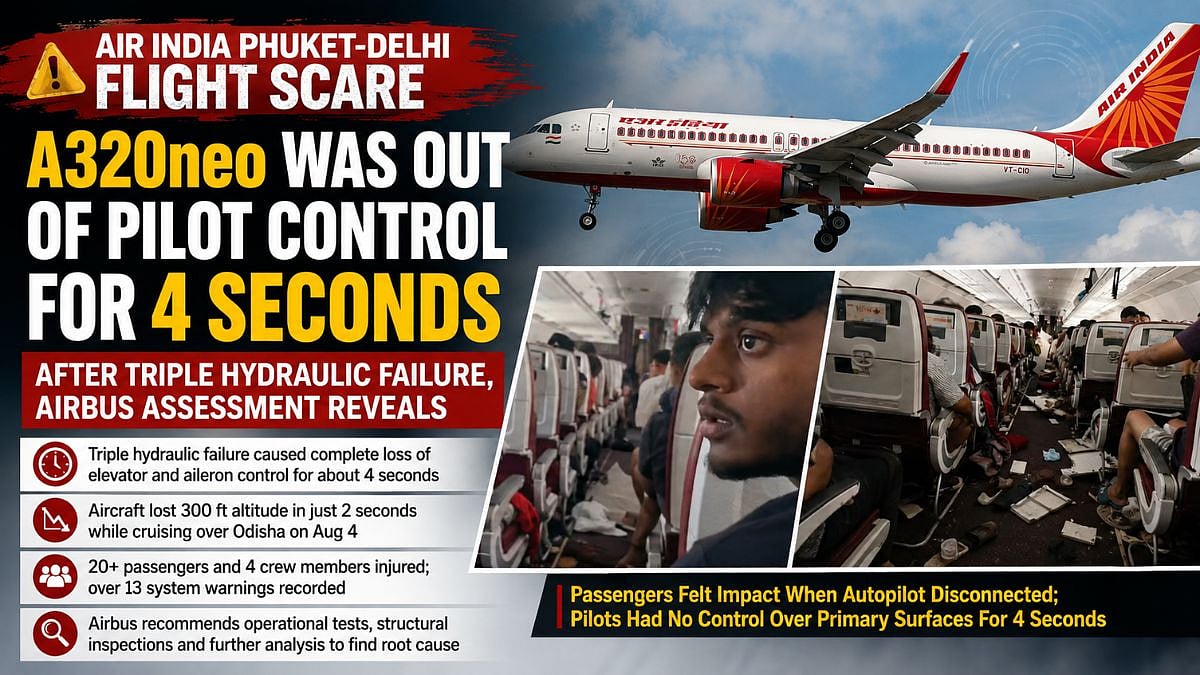
An Air India flight from Phuket to Delhi experienced a severe technical failure, resulting in a loss of control for approximately four seconds. The incident occurred on August 4, 2026, when the Airbus A320neo, registered as VT-EXO, was cruising over Odisha with 137 passengers and eight crew members on board.
According to a preliminary technical analysis from Airbus, the aircraft suffered a triple hydraulic system failure, which is considered a novel issue for A320neo pilots. The failure caused a complete loss of elevator and aileron control surfaces, resulting in an altitude drop of 300 ft within two seconds.
The incident left more than 20 passengers and four crew members injured, who had to be hospitalized for treatment. The aircraft's post-flight maintenance report logged 13 system warnings and three failure messages during the Phuket-Delhi route, highlighting various issues, including multi-system hydraulic pressure drop and autopilot trip.
Airbus submitted its preliminary assessment to Air India, which revealed a cascade of hydraulic system losses. The assessment showed that the aircraft experienced an initial loss of the Green hydraulic system, followed by the loss of the Blue and Yellow hydraulic systems. This sequential failure caused a complete loss of control surfaces for approximately four seconds.
During this critical window, the elevators shifted unexpectedly, while the ailerons went into a damping mode, deflecting towards zero hinge moment and causing an initial pitch increase. The pilots temporarily lost control of the aircraft, and the flight control surfaces did not respond even after the first officer applied full nose-down pitch input.
The systems recovered when the Blue hydraulic system recovered, quickly followed by the Yellow and Green systems, restoring full control of the flight control surfaces. Airbus noted that the flight control behavior resulted from a loss of hydraulic pressure.
This incident is considered a rare and unusual occurrence, as A320-rated pilots are not trained for a simultaneous failure of all three hydraulic systems. The incident highlights the importance of robust safety protocols and emergency procedures in place to mitigate such risks.
The Air India flight incident has raised concerns about the safety of air travel and the need for airlines and aircraft manufacturers to be prepared for unexpected technical failures. The incident is under investigation, and further analysis is being conducted to determine the root cause of the failure.
In the meantime, Air India has taken steps to ensure the safety of its passengers and crew, and the airline is cooperating with the investigation. The incident serves as a reminder of the importance of safety in air travel and the need for constant vigilance and preparedness.
The Air India flight incident has significant implications for the aviation industry, highlighting the need for robust safety protocols and emergency procedures. The incident also underscores the importance of ongoing training and preparedness for pilots and crew members to respond to unexpected technical failures.
In conclusion, the Air India flight incident was a serious and unusual occurrence that highlights the importance of safety in air travel. The incident is under investigation, and further analysis is being conducted to determine the root cause of the failure. The aviation industry must take steps to ensure that such incidents are prevented in the future, and that passengers and crew members are protected from harm.
Frequently asked questions
What happened to the Air India flight from Phuket to Delhi?
The flight experienced a severe technical failure, resulting in a loss of control for approximately four seconds due to a triple hydraulic system failure.
How many passengers and crew members were injured in the incident?
More than 20 passengers and four crew members were injured and had to be hospitalized for treatment.