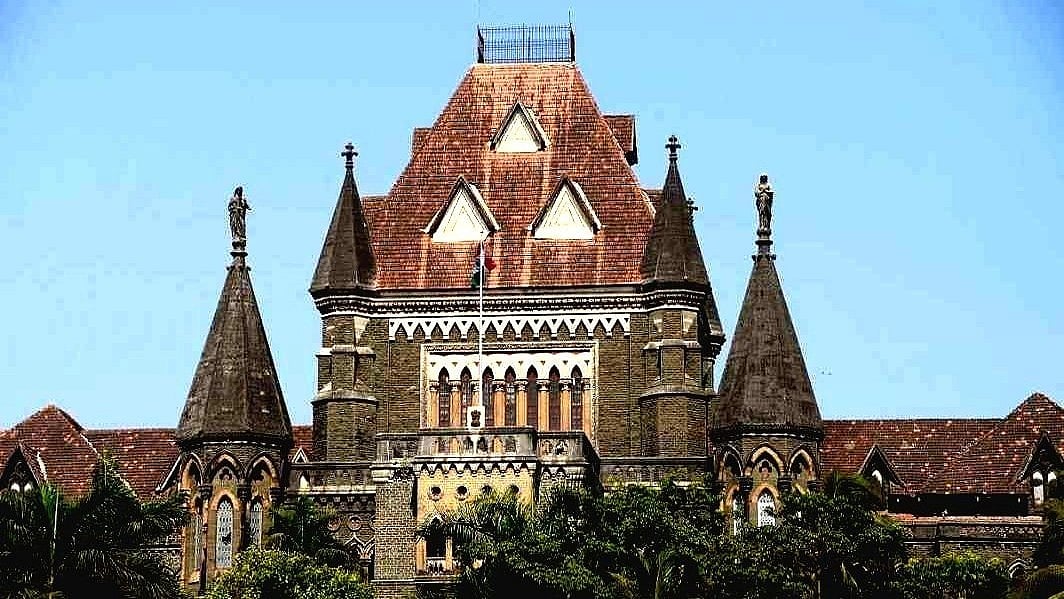
Bombay HC Allows Felling Of 847 Mangroves For Bullet Train Project
Bombay HC permits tree felling, emphasizes local ecology.
'%3E%3Crect%20width%3D'96'%20height%3D'96'%20fill%3D'%23B3261E'%2F%3E%3Ccircle%20cx%3D'30'%20cy%3D'24'%20r%3D'44'%20fill%3D'%23fff'%20opacity%3D'.12'%2F%3E%3Ccircle%20cx%3D'60'%20cy%3D'74'%20r%3D'40'%20fill%3D'%23000'%20opacity%3D'.10'%2F%3E%3C%2Fg%3E%3Cg%20fill%3D'%23fff'%3E%3Crect%20x%3D'29'%20y%3D'49'%20width%3D'8'%20height%3D'19'%20rx%3D'1'%2F%3E%3Crect%20x%3D'39'%20y%3D'40'%20width%3D'9'%20height%3D'28'%20rx%3D'1'%2F%3E%3Crect%20x%3D'50'%20y%3D'45'%20width%3D'8'%20height%3D'23'%20rx%3D'1'%2F%3E%3Crect%20x%3D'60'%20y%3D'53'%20width%3D'7'%20height%3D'15'%20rx%3D'1'%2F%3E%3Crect%20x%3D'41'%20y%3D'34'%20width%3D'5'%20height%3D'6'%2F%3E%3C%2Fg%3E%3C%2Fsvg%3E)
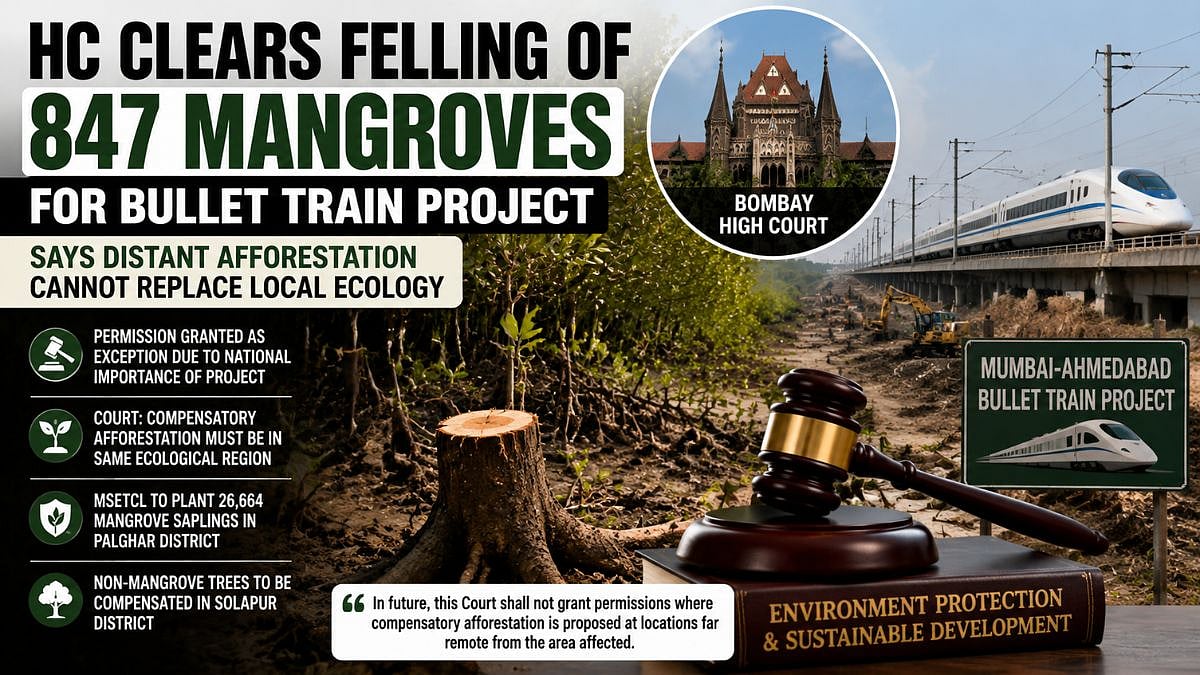
The Bombay High Court has permitted the felling of 847 mangrove trees and 196 non-mangrove trees for a transmission line linked to the Mumbai-Ahmedabad bullet train project.
The permission was granted on Tuesday for a 132 KV transmission line from Dahanu to the proposed Ambesarai traction substation in Palghar district.
The court made it clear that the permission was being granted only because of the project's national importance and should not be treated as a precedent.
A Bench of Acting Chief Justice Ravindra Ghuge and Justice Gautam Ankhad observed that compensatory afforestation at locations far away from the affected area would not be allowed in future.
The order came on a petition filed by the Maharashtra State Electricity Transmission Company Ltd. (MSETCL), which sought permission to divert 3.3561 hectares of forest land for laying the transmission line.
The court emphasized that compensatory afforestation is not intended to be a mere numerical replacement of trees felled for a project, but rather ecological restoration.
The Bench said that restoration is meaningful only if plantations are carried out in the same ecological region or, if that is not possible, in the nearest adjoining area.
Under the approved plan, MSETCL will plant 26,664 mangrove saplings over six hectares at Panchali, Dehane and Asangaon in Palghar district.
For the 196 non-mangrove trees being cut, the Forest Department will undertake compensatory afforestation by planting 7,457 trees over 6.71 hectares of degraded forest land at Katphal village in Solapur district.
The Bombay Environmental Action Group opposed the proposal, arguing that plantations nearly 500 km away could not offset the ecological loss in Dahanu.
While accepting this concern, the High Court allowed it as a one-time exception since all statutory approvals had been obtained and the project was of national importance.
The court's decision highlights the importance of balancing development with environmental concerns.
The Mumbai-Ahmedabad bullet train project is a key infrastructure project that aims to reduce travel time between the two cities.
However, the project has also raised concerns about its impact on the environment, particularly the mangroves in the region.
The court's emphasis on local ecology and compensatory afforestation is a step in the right direction, but it remains to be seen how effective these measures will be in mitigating the project's environmental impact.
The decision is significant for Mumbai and the surrounding areas, as it sets a precedent for how development projects should be balanced with environmental concerns.
In conclusion, the Bombay High Court's decision to permit the felling of mangrove trees for the bullet train project is a complex issue that requires careful consideration of both development and environmental concerns.
Frequently asked questions
How many mangrove trees will be cut for the bullet train project?
847 mangrove trees will be cut for the project.
What is the plan for compensatory afforestation?
MSETCL will plant 26,664 mangrove saplings over six hectares at Panchali, Dehane and Asangaon in Palghar district.