
India's Strategic Reserves to Reach 11.88 MMT
India boosts energy security, UAE partnership
'%3E%3Crect%20width%3D'96'%20height%3D'96'%20fill%3D'%230B6E4F'%2F%3E%3Ccircle%20cx%3D'30'%20cy%3D'24'%20r%3D'44'%20fill%3D'%23fff'%20opacity%3D'.12'%2F%3E%3Ccircle%20cx%3D'60'%20cy%3D'74'%20r%3D'40'%20fill%3D'%23000'%20opacity%3D'.10'%2F%3E%3C%2Fg%3E%3Cg%20fill%3D'none'%20stroke%3D'%23fff'%20stroke-width%3D'3.2'%20stroke-linecap%3D'round'%20stroke-linejoin%3D'round'%3E%3Cpolyline%20points%3D'31%2C59%2041%2C49%2049%2C54%2063%2C37'%2F%3E%3Cpolyline%20points%3D'55%2C37%2063%2C37%2063%2C45'%2F%3E%3C%2Fg%3E%3C%2Fsvg%3E)
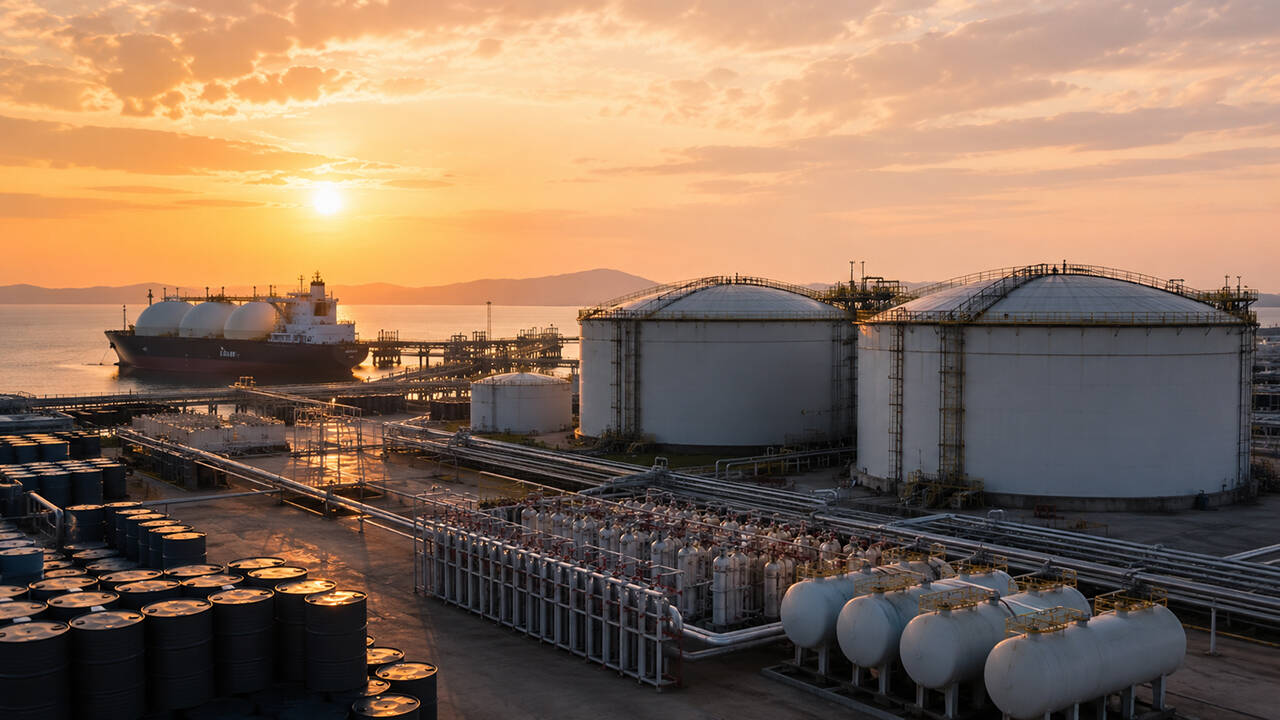
India is taking significant steps to enhance its energy security by expanding its strategic petroleum reserves. The total capacity of these reserves is expected to increase to 11.88 million metric tons (MMT) once the current projects are completed. This move will bring the country closer to its target of maintaining a 90-day reserve of crude oil, LPG, and LNG.
The expansion of strategic reserves is a crucial aspect of India's energy security strategy. The country is heavily reliant on imports to meet its energy needs, and having a sufficient reserve can help mitigate the impact of price volatility and supply disruptions. The 90-day reserve target is in line with the International Energy Agency's (IEA) recommendation for countries to maintain emergency oil stocks equivalent to at least 90 days of net oil imports.
India is also collaborating with the United Arab Emirates (UAE) to enhance its energy security. The two countries are working together to develop a storage capacity of 30 million barrels of crude oil. This partnership will not only help India increase its strategic reserves but also strengthen its ties with a key oil-producing country.
The expansion of strategic reserves is a complex process that requires significant investment and infrastructure development. India has already made substantial progress in this area, with the construction of underground storage facilities in various parts of the country. The completion of these projects will enable India to store more oil and gas, reducing its reliance on imports and enhancing its energy security.
The Indian government has identified several locations for the development of strategic reserves, including the states of Odisha, Karnataka, and Tamil Nadu. These locations have been chosen for their proximity to major ports and refineries, making it easier to transport and store oil and gas.
In addition to expanding its strategic reserves, India is also exploring other options to enhance its energy security. The country is investing heavily in renewable energy sources, such as solar and wind power, to reduce its dependence on fossil fuels. India is also promoting the use of biofuels and other alternative energy sources to diversify its energy mix.
The development of strategic reserves is a critical component of India's energy security strategy. By expanding its reserves and diversifying its energy mix, India can reduce its reliance on imports, mitigate the impact of price volatility, and ensure a stable energy supply. This will not only enhance the country's energy security but also support its economic growth and development.
In conclusion, India's strategic reserves strategy is a key aspect of its energy security plan. The expansion of reserves, partnership with the UAE, and investment in renewable energy sources will all contribute to enhancing the country's energy security. As India continues to grow and develop, its energy needs will increase, and a robust strategic reserves strategy will be essential to meeting these needs.
Frequently asked questions
What is India's target for strategic petroleum reserves?
India aims to maintain a 90-day reserve of crude oil, LPG, and LNG.
Which country is India partnering with for strategic reserves?
India is partnering with the United Arab Emirates (UAE) for 30 million barrels of crude oil storage capacity.