
Indian Pilots' Union Seeks Overhaul Of DGCA Drug-Testing Rules
Federation of Indian Pilots urges DGCA to increase random testing, introduce oral-fluid screening and enforce procedural safeguards.
'%3E%3Crect%20width%3D'96'%20height%3D'96'%20fill%3D'%230B6E4F'%2F%3E%3Ccircle%20cx%3D'30'%20cy%3D'24'%20r%3D'44'%20fill%3D'%23fff'%20opacity%3D'.12'%2F%3E%3Ccircle%20cx%3D'60'%20cy%3D'74'%20r%3D'40'%20fill%3D'%23000'%20opacity%3D'.10'%2F%3E%3C%2Fg%3E%3Cg%20fill%3D'none'%20stroke%3D'%23fff'%20stroke-width%3D'3.2'%20stroke-linecap%3D'round'%20stroke-linejoin%3D'round'%3E%3Cpolyline%20points%3D'31%2C59%2041%2C49%2049%2C54%2063%2C37'%2F%3E%3Cpolyline%20points%3D'55%2C37%2063%2C37%2063%2C45'%2F%3E%3C%2Fg%3E%3C%2Fsvg%3E)
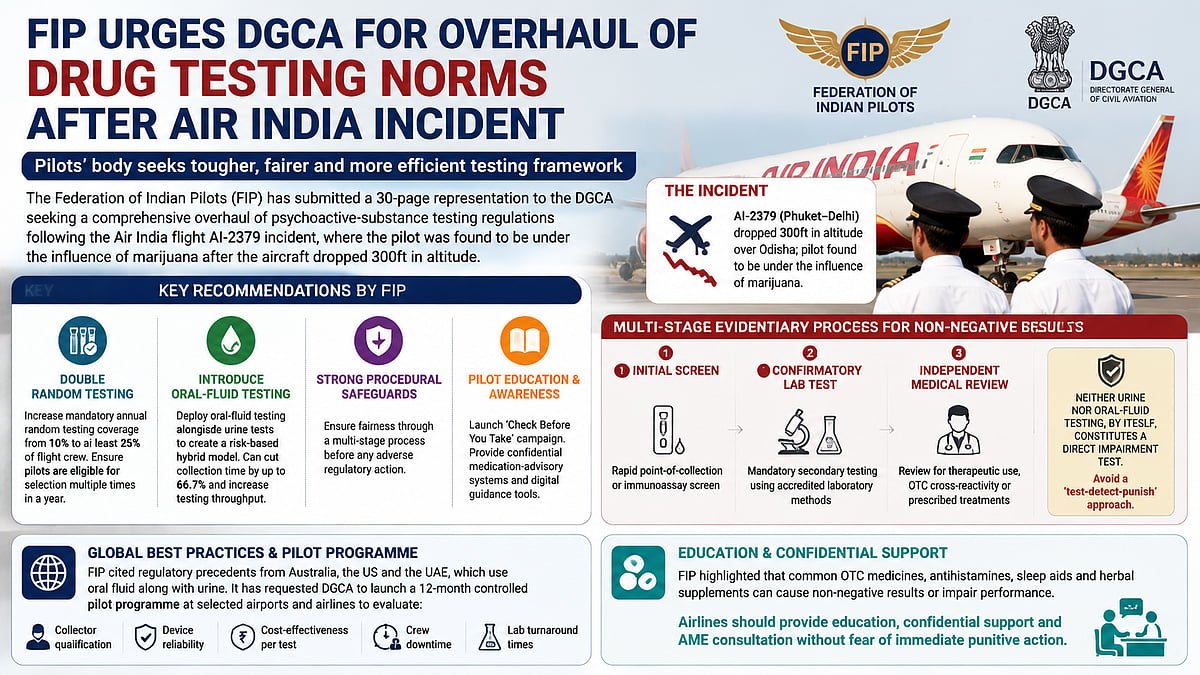
The Federation of Indian Pilots (FIP) has called for a comprehensive overhaul of the country's psychoactive-substance testing regulations following the incident on an Air India flight earlier this month.
The pilots' body has asked to double mandatory random drug testing, introduce oral-fluid screening alongside existing urine tests, and enforce strict procedural safeguards to protect crew members.
The 30-page representation to the aviation regulator follows the incident after the pilot-in-command of Air India's Phuket-Delhi flight AI-2379, which dropped 300ft in altitude while cruising over Odisha, was found to be under the influence of marijuana.
The FIP argued that the current regulatory framework, which requires pilots to undergo urine-based screening and mandates a minimum annual random-testing coverage of 10%, is outdated, citing the rapid expansion of India's aviation sector.
The union urged the DGCA to increase the mandatory annual random testing benchmark from 10% to at least 25% of flight crew and ensure that pilots remain eligible for selection multiple times in a single year to maintain genuine, continuous deterrence.
The association suggested deployment of oral-fluid testing as a complementary tool alongside urine sampling to create a risk-based hybrid model.
According to its study, adopting oral-fluid collection – which is directly observable and can be performed airside or at workplaces in approximately 15 minutes compared to 45 minutes for urine samples – could theoretically cut collection time and crew downtime by up to 66.7%, dramatically increasing testing throughput without causing severe flight disruptions.
A cornerstone of the FIP's 30-page submission is the demand for strict medical and procedural safeguards.
The union emphasised that detecting a substance during preliminary screening does not automatically establish functional impairment or deliberate misuse.
To ensure fairness, the federation insisted that every non-negative screening result must follow a multi-stage evidentiary sequence which includes a rapid point-of-collection or initial immunoassay screen, mandatory secondary testing of non-negative samples using accredited laboratory methods and an independent medical review to evaluate legitimate therapeutic drug use, over-the-counter cross-reactivity or prescribed treatments before any final adverse regulatory determination is made.
The FIP highlighted the regulatory precedent from major international civil aviation and transport authorities like those in Australia, the US, and other countries, which have implemented more stringent testing protocols.
The incident on Air India's Phuket-Delhi flight has raised concerns about the safety of air travel in India and the need for more effective measures to prevent such incidents in the future.
The FIP's call for an overhaul of the DGCA's drug-testing rules is a step in the right direction, as it seeks to ensure the safety of passengers and crew members by preventing pilots from flying under the influence of psychoactive substances.
In conclusion, the FIP's representation to the DGCA is a significant development in the Indian aviation sector, and its outcome will have a major impact on the safety of air travel in the country.
The DGCA must consider the FIP's suggestions seriously and take necessary steps to overhaul the existing drug-testing rules to ensure the safety of passengers and crew members.
Frequently asked questions
What is the current random drug testing coverage for pilots in India?
The current random drug testing coverage for pilots in India is 10%.
What is the FIP's suggested increase in random drug testing coverage?
The FIP has suggested increasing the random drug testing coverage to at least 25% of flight crew.