Wayanad Court Acquits 56 in Constable's Murder Case
56 acquitted, 4 convicted in attempt-to-murder case. Verdict comes 23 years after Muthanga agitation.
'%3E%3Crect%20width%3D'96'%20height%3D'96'%20fill%3D'%23B3261E'%2F%3E%3Ccircle%20cx%3D'30'%20cy%3D'24'%20r%3D'44'%20fill%3D'%23fff'%20opacity%3D'.12'%2F%3E%3Ccircle%20cx%3D'60'%20cy%3D'74'%20r%3D'40'%20fill%3D'%23000'%20opacity%3D'.10'%2F%3E%3C%2Fg%3E%3Cg%20fill%3D'%23fff'%3E%3Crect%20x%3D'29'%20y%3D'49'%20width%3D'8'%20height%3D'19'%20rx%3D'1'%2F%3E%3Crect%20x%3D'39'%20y%3D'40'%20width%3D'9'%20height%3D'28'%20rx%3D'1'%2F%3E%3Crect%20x%3D'50'%20y%3D'45'%20width%3D'8'%20height%3D'23'%20rx%3D'1'%2F%3E%3Crect%20x%3D'60'%20y%3D'53'%20width%3D'7'%20height%3D'15'%20rx%3D'1'%2F%3E%3Crect%20x%3D'41'%20y%3D'34'%20width%3D'5'%20height%3D'6'%2F%3E%3C%2Fg%3E%3C%2Fsvg%3E)
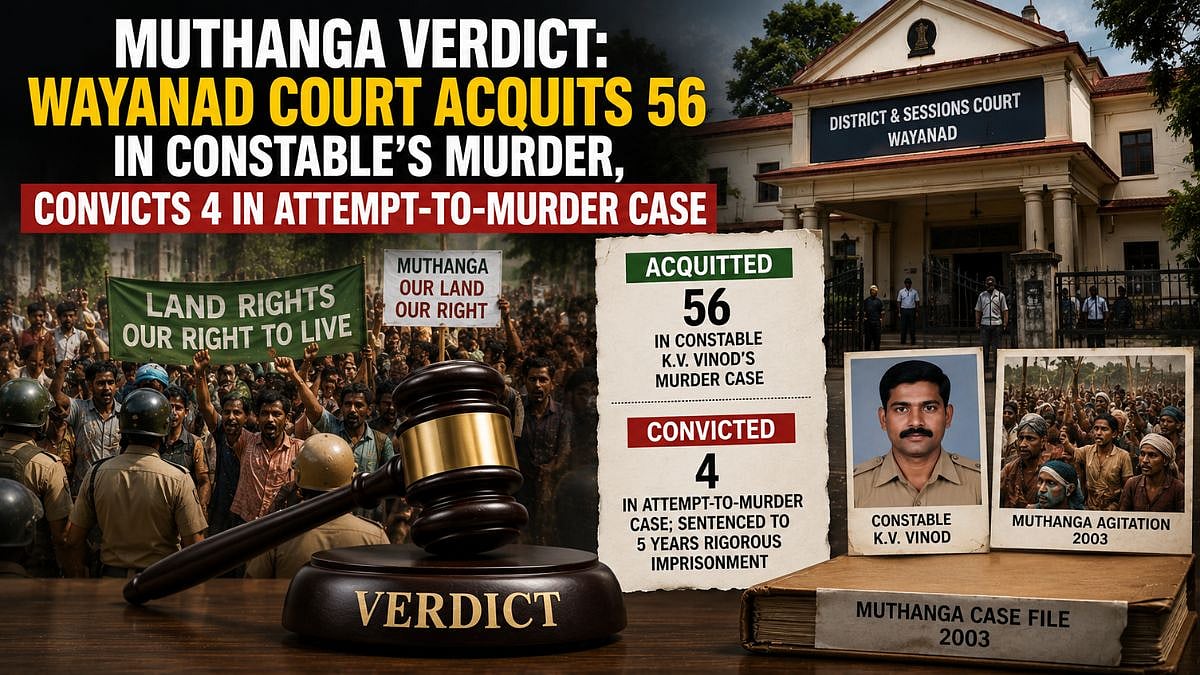
A court in Wayanad has acquitted 56 surviving accused, including tribal leader M. G. Geethanandan, in the 2003 murder of police constable K. V. Vinod. The acquittal comes more than 23 years after the Muthanga agitation shook Kerala.
The court, however, convicted four persons, including Geethanandan, in a related attempt-to-murder case and sentenced them to five years of rigorous imprisonment. The four convicted persons were found guilty of attempting to murder police officer Abdul Salam and forest officer Sasidharan during the same incident.
The Muthanga agitation was a 47-day land occupation protest led by tribal leaders C. K. Janu and Geethanandan, demanding land rights. The protest turned violent on February 19, 2003, when police attempted to evict the protesters, resulting in the death of constable Vinod.
The case was investigated by the local police, the Crime Branch, and later the Central Bureau of Investigation (CBI). The prosecution examined 47 witnesses and produced 13 material objects as evidence during the trial.
The court's verdict has been welcomed by the defence counsel, T. M. Rasheed, who said that the court had considered the social background of the convicted persons while deciding the sentence. Rasheed also alleged that the CBI failed to identify those actually responsible for the deaths of Vinod and tribal protester Jogi.
The court has ordered compensation under the victim compensation scheme, awarding Rs 7 lakh to Vinod's family, Rs 5 lakh to Abdul Salam, and Rs 2 lakh to Sasidharan. The convicted persons are expected to challenge the judgment before the Kerala High Court.
The Muthanga agitation was a significant event in Kerala's history, highlighting the struggles of the tribal community for land rights. The verdict brings closure to a long-standing case, but also raises questions about the investigation and the role of the CBI.
The case has been closely watched by human rights activists and tribal leaders, who have been demanding justice for the victims of the Muthanga agitation. The verdict is seen as a mixed outcome, with some welcoming the acquittal of the 56 accused, while others expressing disappointment at the conviction of the four persons.
In the end, the verdict is a reminder of the complexities and challenges of delivering justice in cases involving social and political unrest. The case will likely be appealed, and the final outcome will depend on the decision of the Kerala High Court.
The Muthanga agitation and its aftermath have had a lasting impact on Kerala's social and political landscape. The verdict is a significant development in the case, but it is also a reminder that the struggle for justice and human rights is ongoing.
The court's decision to award compensation to the victims' families is a positive step, recognizing the suffering and loss caused by the violence. However, the case also highlights the need for a more thorough investigation into the events surrounding the Muthanga agitation and the role of the authorities in the violence.
In conclusion, the verdict in the Muthanga case is a significant development, but it is also a reminder of the complexities and challenges of delivering justice in cases involving social and political unrest. The case will likely be appealed, and the final outcome will depend on the decision of the Kerala High Court.
Frequently asked questions
What was the Muthanga agitation about?
The Muthanga agitation was a 47-day land occupation protest led by tribal leaders demanding land rights.
How many people were acquitted in the constable's murder case?
56 people were acquitted in the constable's murder case.