Bombay HC Monitors Melghat Crisis Amid Malnutrition, Water Scarcity
Melghat region struggles with malnutrition and water scarcity. Bombay HC continues monitoring.
'%3E%3Crect%20width%3D'96'%20height%3D'96'%20fill%3D'%23B3261E'%2F%3E%3Ccircle%20cx%3D'30'%20cy%3D'24'%20r%3D'44'%20fill%3D'%23fff'%20opacity%3D'.12'%2F%3E%3Ccircle%20cx%3D'60'%20cy%3D'74'%20r%3D'40'%20fill%3D'%23000'%20opacity%3D'.10'%2F%3E%3C%2Fg%3E%3Cg%20fill%3D'%23fff'%3E%3Crect%20x%3D'29'%20y%3D'49'%20width%3D'8'%20height%3D'19'%20rx%3D'1'%2F%3E%3Crect%20x%3D'39'%20y%3D'40'%20width%3D'9'%20height%3D'28'%20rx%3D'1'%2F%3E%3Crect%20x%3D'50'%20y%3D'45'%20width%3D'8'%20height%3D'23'%20rx%3D'1'%2F%3E%3Crect%20x%3D'60'%20y%3D'53'%20width%3D'7'%20height%3D'15'%20rx%3D'1'%2F%3E%3Crect%20x%3D'41'%20y%3D'34'%20width%3D'5'%20height%3D'6'%2F%3E%3C%2Fg%3E%3C%2Fsvg%3E)
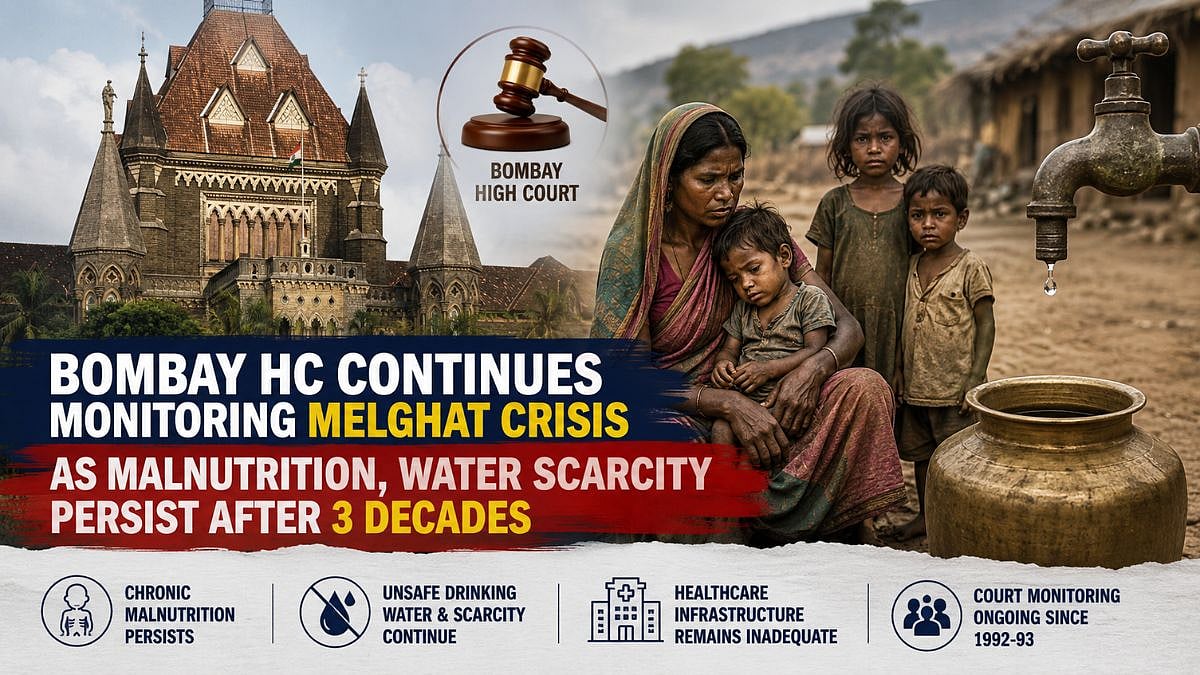
The Bombay High Court has been monitoring the Melghat crisis for over three decades, and the situation remains dire. Despite the court's interventions, the region continues to struggle with malnutrition, poor healthcare, and water scarcity.
The court's attention was first drawn to the issue in 1992-93, when a batch of public interest litigations was filed by activists, including Dr Rajendra Burma and Bandu Sampatrao Sane. The litigations highlighted chronic malnutrition, child deaths, poor health infrastructure, and lack of safe drinking water in the tribal belt.
Since then, the high court has passed several directions, constituted monitoring committees, and sought reports from senior bureaucrats. However, the court has repeatedly noted that little has changed on the ground. In March this year, a bench led by Justice Ravindra Ghuge strongly criticised the Maharashtra government over continuing malnutrition-related deaths.
The court has also expressed concern over recurring shortages of safe drinking water. During an April hearing, it was informed that 13 people had died and 86 others had been hospitalised due to water contamination. The court directed the state to ensure regular supply of potable water through tankers.
However, during the latest hearing, advocate Jugalkishor Gilda, appearing for one of the petitioners, said tanker supply remained highly irregular and the water supplied was not of good quality. The healthcare infrastructure in the region continues to remain one of the biggest challenges. A proposed 300-bed hospital at Dharni, promised years ago, is yet to be built, while several primary health centres remain understaffed or non-functional.
The government has attributed the shortage of doctors to their unwillingness to serve in the remote region despite higher incentives. However, Gilda argued that doctors avoid postings because basic facilities, including accommodation, are unavailable. The shortage of specialists has also drawn judicial attention.
The situation in Melghat is a stark contrast to the floods affecting other parts of Maharashtra. While some regions are grappling with excess water, Melghat is struggling to access even basic necessities like safe drinking water. The Bombay High Court's continued monitoring of the crisis highlights the need for urgent attention and action from the government.
The court's remarks that water is a basic necessity and not a luxury underscore the gravity of the situation. The fact that the court has to hear submissions on deaths occurring due to malnutrition, lack of medication, and proper medical support to children, pregnant women, and lactating mothers is a tragedy.
The Melghat crisis is a complex issue that requires a multi-faceted approach. The government needs to address the root causes of the problem, including poverty, lack of access to education and healthcare, and inadequate infrastructure. The Bombay High Court's monitoring of the crisis is a crucial step towards ensuring that the government takes concrete actions to address the issue.
In conclusion, the Melghat crisis is a pressing issue that requires immediate attention and action from the government. The Bombay High Court's continued monitoring of the crisis is a testament to the need for urgent intervention. The government must take concrete steps to address the root causes of the problem and ensure that the people of Melghat have access to basic necessities like safe drinking water, healthcare, and education.
Frequently asked questions
What is the Melghat crisis?
The Melghat crisis refers to the persistent issues of malnutrition, poor healthcare, and water scarcity in the Melghat region of Maharashtra.
How long has the Bombay High Court been monitoring the crisis?
The Bombay High Court has been monitoring the Melghat crisis for over three decades, since 1992-93.