Bombay HC: Directors Can't Use Personal Insolvency To Stop Cheque-Bounce Trials
Bombay HC rejects directors' plea, rules personal insolvency doesn't stop cheque-bounce trials. Directors of Mohan India, Lotus Refineries, and others affected.
'%3E%3Crect%20width%3D'96'%20height%3D'96'%20fill%3D'%23B3261E'%2F%3E%3Ccircle%20cx%3D'30'%20cy%3D'24'%20r%3D'44'%20fill%3D'%23fff'%20opacity%3D'.12'%2F%3E%3Ccircle%20cx%3D'60'%20cy%3D'74'%20r%3D'40'%20fill%3D'%23000'%20opacity%3D'.10'%2F%3E%3C%2Fg%3E%3Cg%20fill%3D'%23fff'%3E%3Crect%20x%3D'29'%20y%3D'49'%20width%3D'8'%20height%3D'19'%20rx%3D'1'%2F%3E%3Crect%20x%3D'39'%20y%3D'40'%20width%3D'9'%20height%3D'28'%20rx%3D'1'%2F%3E%3Crect%20x%3D'50'%20y%3D'45'%20width%3D'8'%20height%3D'23'%20rx%3D'1'%2F%3E%3Crect%20x%3D'60'%20y%3D'53'%20width%3D'7'%20height%3D'15'%20rx%3D'1'%2F%3E%3Crect%20x%3D'41'%20y%3D'34'%20width%3D'5'%20height%3D'6'%2F%3E%3C%2Fg%3E%3C%2Fsvg%3E)
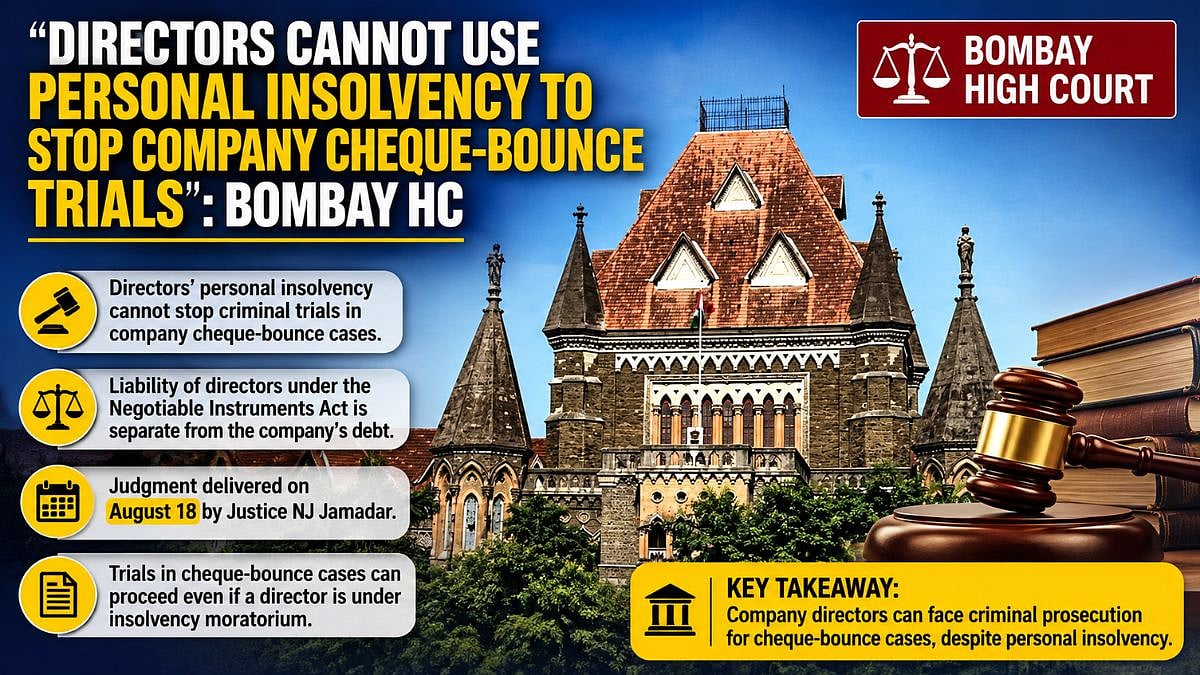
The Bombay High Court has ruled that company directors cannot use personal insolvency proceedings to stop criminal trials over cheques issued by their companies. This decision was made by Justice NJ Jamadar on August 18, 2026, in a detailed 64-page judgment.
The case involved several directors, including those from Mohan India Private Limited, Lotus Refineries, Metkore Alloys, and White Water Foods, who had filed petitions seeking a stay on cheque-bounce cases. The complaints were filed by National Spot Exchange Limited (NSEL) over unpaid dues running into hundreds of crores.
The directors argued that they had initiated personal insolvency proceedings under the Insolvency and Bankruptcy Code (IBC) and that the interim moratorium under Section 96 should protect them from prosecution. However, NSEL opposed the pleas, contending that the debt belonged to the respective companies and was not the directors' personal debt.
The court rejected the directors' argument, stating that the debt in question is that of the corporate entity and that the liability of directors under the Negotiable Instruments Act is personal and can continue even when a moratorium applies to the company.
In one of the cases, NSEL had filed a cheque-bounce complaint against Mohan India Private Limited and its directors, including Jagmohan Garg. The company had defaulted on a settlement award of Rs 771 crore and had issued a Rs 30 crore cheque towards the liability, which was returned unpaid.
Garg later approached the NCLT, Delhi, under Section 94 of the IBC for initiation of his insolvency resolution process and sought a stay of the complaint under Section 96. However, the High Court rejected his plea, ruling that the trial can continue despite the personal insolvency proceedings.
The court also considered a pending Supreme Court reference concerning the effect of insolvency proceedings on the compensation-related aspect of cheque-bounce cases. It held that the reference did not require the trials to be stayed, and that the moratorium could apply to recovery of compensation ordered against an individual director, but did not halt the criminal trial.
This decision has significant implications for company directors who may try to use personal insolvency proceedings to avoid prosecution in cheque-bounce cases. It reinforces the principle that directors can be held personally liable for their actions under the Negotiable Instruments Act, even if the company is facing financial difficulties.
The ruling is also a victory for NSEL, which had filed the complaints against the directors. The company can now proceed with the prosecution, and the directors will have to face the consequences of their actions.
In conclusion, the Bombay High Court's decision is a significant development in the realm of corporate law and insolvency proceedings. It sends a strong message to company directors that they cannot use personal insolvency as a means to avoid prosecution for their actions, and that they will be held accountable for their role in the company's affairs.
The decision is also a reminder that the law is designed to protect the interests of creditors and to ensure that companies and their directors are held accountable for their actions. It is a welcome development for those who have been affected by the actions of these companies and their directors, and it provides a sense of justice and closure for those who have been wronged.
The implications of this decision are far-reaching, and it will be interesting to see how it affects the corporate landscape in India. It is likely to have a significant impact on the way companies and their directors operate, and it will provide a new level of protection for creditors and investors.
Overall, the Bombay High Court's decision is a significant step forward in the fight against corporate fraud and misconduct. It sends a strong message that those who engage in such activities will be held accountable, and that the law will be used to protect the interests of all stakeholders.
The decision is a testament to the independence and integrity of the Indian judiciary, and it demonstrates the commitment of the courts to upholding the law and protecting the rights of all citizens. It is a welcome development for the business community, and it provides a sense of confidence and stability in the corporate sector.
In the end, the decision of the Bombay High Court is a significant victory for justice and accountability. It is a reminder that the law is designed to protect the interests of all stakeholders, and that those who engage in corporate fraud and misconduct will be held accountable for their actions.
Frequently asked questions
Can company directors use personal insolvency to stop cheque-bounce trials?
No, according to the Bombay High Court, company directors cannot use personal insolvency proceedings to stop criminal trials over cheques issued by their companies.
What is the implication of the Bombay High Court's decision on company directors?
The decision implies that company directors can be held personally liable for their actions under the Negotiable Instruments Act, even if the company is facing financial difficulties.