India Sees Rise In Exotic Primate Smuggling
Five baby orangutans found in Odisha, highlighting India's exotic pet trade issue. Customs seize 30 primates in 16 cases.
'%3E%3Crect%20width%3D'96'%20height%3D'96'%20fill%3D'%23B3261E'%2F%3E%3Ccircle%20cx%3D'30'%20cy%3D'24'%20r%3D'44'%20fill%3D'%23fff'%20opacity%3D'.12'%2F%3E%3Ccircle%20cx%3D'60'%20cy%3D'74'%20r%3D'40'%20fill%3D'%23000'%20opacity%3D'.10'%2F%3E%3C%2Fg%3E%3Cg%20fill%3D'%23fff'%3E%3Crect%20x%3D'29'%20y%3D'49'%20width%3D'8'%20height%3D'19'%20rx%3D'1'%2F%3E%3Crect%20x%3D'39'%20y%3D'40'%20width%3D'9'%20height%3D'28'%20rx%3D'1'%2F%3E%3Crect%20x%3D'50'%20y%3D'45'%20width%3D'8'%20height%3D'23'%20rx%3D'1'%2F%3E%3Crect%20x%3D'60'%20y%3D'53'%20width%3D'7'%20height%3D'15'%20rx%3D'1'%2F%3E%3Crect%20x%3D'41'%20y%3D'34'%20width%3D'5'%20height%3D'6'%2F%3E%3C%2Fg%3E%3C%2Fsvg%3E)
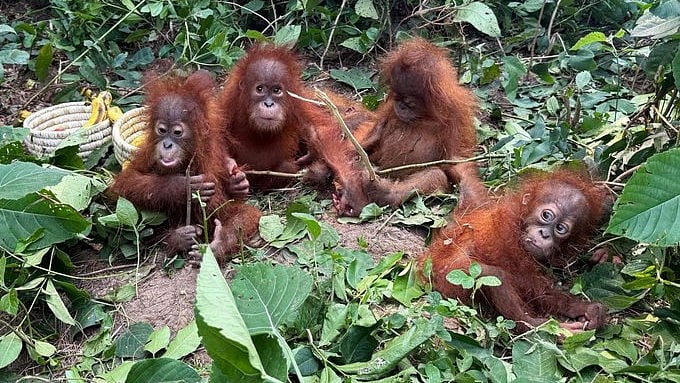
The discovery of five baby orangutans in an Odisha forest has shed light on the growing problem of exotic primate smuggling in India. The orangutans, native to Indonesia, were found earlier this week, and their presence in the country is not an isolated incident.
Information obtained through the Right to Information Act (RTI) reveals that Customs officials at Mumbai and Bengaluru airports have seized at least 30 gibbons, tamarins, marmosets, and doucs being trafficked from Thailand and Malaysia in 16 cases in 2024 and 2025 alone.
Chennai has emerged as a hotspot for primate smuggling, with multiple cases reported over the past seven years. In November 2024, the Maharashtra forest department recovered a rare orangutan from a flat in Dombivli. In July 2020, a veterinarian confirmed the presence of a baby orangutan in a house in Mumbai's Agripada area.
Primate trafficking cases have been on the rise, with four Chennai police personnel suspended in February 2023 for allegedly taking bribes to allow a gang of traffickers to escape. The gang was carrying eight orangutans trafficked from Southeast Asia to Bengaluru and transporting them by road to Chennai.
In January 2023, Directorate of Revenue Intelligence (DRI) officials found a Yaki monkey, an ape native to Indonesia, caged inside a toilet at a Bengaluru house. In September last year, Thane police arrested a Bengaluru resident while he was allegedly delivering two baby gibbons.
The animals had reportedly been obtained from a Chennai resident who had arrived in Mumbai from Bangkok. Around the same time, a baby gibbon was found swinging from trees and electrical wires in North Chennai after escaping from a house where it was being kept as a pet.
Just last month, actor Vikram was seen playing with a lar gibbon that had reportedly been trafficked from Southeast Asia through the Myanmar-India land border. Customs officials say many baby primates brought into India by air do not survive the journey.
Concerns over the exotic pet trade have been raised by wildlife activists, who say that baby primates are coveted as pets by the rich and famous because they resemble human babies. Chennai-based wildlife activist Shravan Krishnan said that American movies like Dunston Checks In have created an impression that keeping monkeys as pets is cute, but it is cruel and problematic at multiple levels.
The trade is particularly brutal because poachers often have to kill the mother to capture a baby, Shravan said. Apes such as gibbons spend most of their lives high in trees, and human habitation cannot replicate their natural ecosystem, leaving them stressed.
There is also a significant risk of zoonotic diseases spreading from primates to humans, he added. The Indian government has been called upon to take stronger action against exotic primate smuggling, which is not only cruel to the animals but also poses a risk to human health.
The rise in exotic primate smuggling in India is a complex issue that requires a multifaceted approach to address. It involves not only law enforcement but also raising awareness about the risks and consequences of the exotic pet trade.
As the demand for exotic apes and monkeys continues to grow, it is essential for the Indian government to take proactive measures to prevent the smuggling of these animals and protect both human and animal health.
Frequently asked questions
What is the main reason for the exotic pet trade in India?
The main reason for the exotic pet trade in India is the demand for baby primates, which resemble human babies and are coveted as pets by the rich and famous.
What is the risk of zoonotic diseases in exotic primate smuggling?
There is a significant risk of zoonotic diseases spreading from primates to humans, which can have serious consequences for human health.