RSS Chief Mohan Bhagwat Defends Gen Z Protests
RSS chief supports protests, says education is not commercial. Gen Z seeks logical answers.
'%3E%3Crect%20width%3D'96'%20height%3D'96'%20fill%3D'%231A5276'%2F%3E%3Ccircle%20cx%3D'30'%20cy%3D'24'%20r%3D'44'%20fill%3D'%23fff'%20opacity%3D'.12'%2F%3E%3Ccircle%20cx%3D'60'%20cy%3D'74'%20r%3D'40'%20fill%3D'%23000'%20opacity%3D'.10'%2F%3E%3C%2Fg%3E%3Cg%20fill%3D'%23fff'%3E%3Cpath%20d%3D'M31%2041%20L48%2031%20L65%2041%20Z'%2F%3E%3Crect%20x%3D'33'%20y%3D'43'%20width%3D'4'%20height%3D'17'%2F%3E%3Crect%20x%3D'41'%20y%3D'43'%20width%3D'4'%20height%3D'17'%2F%3E%3Crect%20x%3D'51'%20y%3D'43'%20width%3D'4'%20height%3D'17'%2F%3E%3Crect%20x%3D'59'%20y%3D'43'%20width%3D'4'%20height%3D'17'%2F%3E%3Crect%20x%3D'30'%20y%3D'62'%20width%3D'36'%20height%3D'4'%20rx%3D'1'%2F%3E%3C%2Fg%3E%3C%2Fsvg%3E)
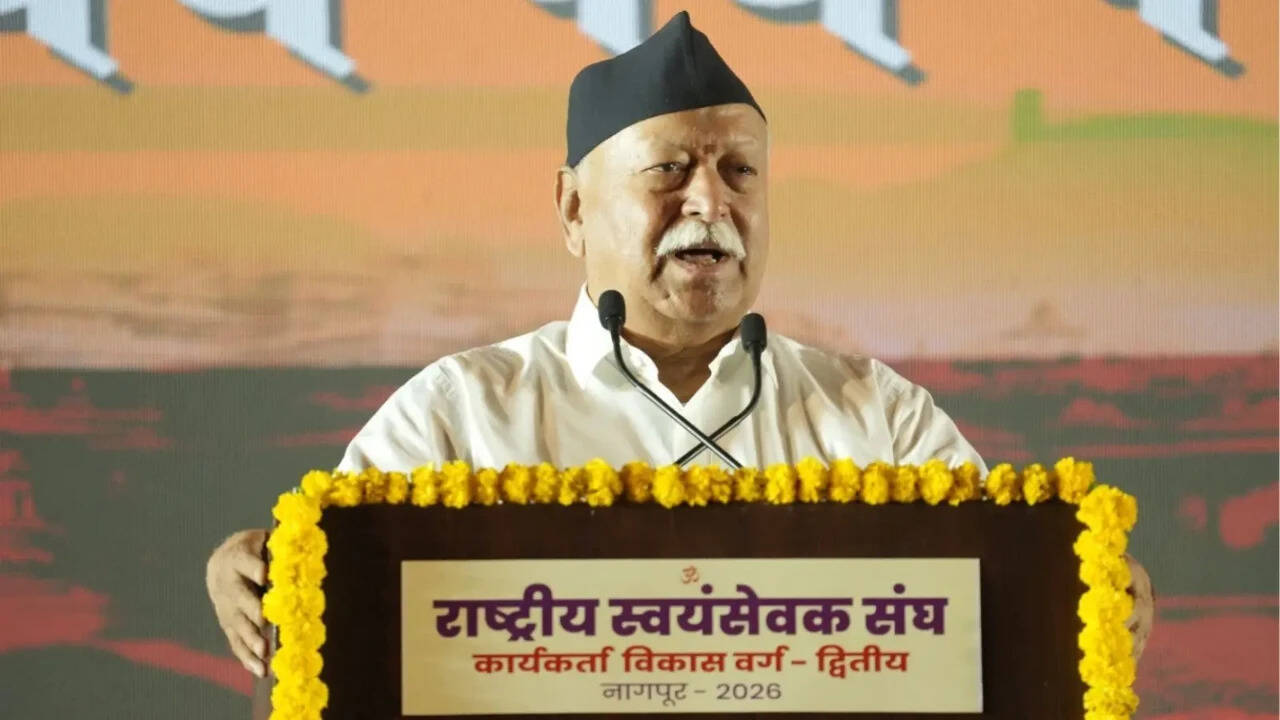
RSS chief Mohan Bhagwat has come out in support of protests by Gen Z, saying they are a legitimate way of dialogue in a democracy. Speaking on the issue, Bhagwat stated that protests are a means of reaching consensus and that the grievances of Gen Z are genuine.
He emphasized that in a democratic setup, there are established ways of protesting and it is essential to follow these methods. Bhagwat also highlighted that the younger generation, including Gen Z and Gen Alpha, are seeking logical answers to the questions they raise.
The RSS chief further stressed that education should not be treated as a commercial business. He urged parents to set an example for their children, implying that the values and principles demonstrated by parents play a significant role in shaping the minds of the younger generation.
Bhagwat's comments come at a time when there is a growing debate about the role of protests in a democratic society. His statement is likely to be seen as a significant endorsement of the right to protest, which is a fundamental aspect of democracy.
The RSS chief's emphasis on the importance of logical answers for Gen Z and Gen Alpha reflects the changing expectations of the younger generation. They are no longer satisfied with mere assertions or dogma and instead demand reasoned explanations and justifications.
In the context of Indian society, Bhagwat's statement assumes significance as it acknowledges the evolving nature of democracy and the need for dialogue and consensus-building. His remarks on education not being a commercial business also underscore the importance of making quality education accessible to all.
The RSS chief's support for Gen Z protests is likely to spark a wider debate about the role of the younger generation in shaping the future of democracy in India. As the country continues to evolve and grow, it is essential to engage with the concerns and aspirations of the younger generation.
In conclusion, Mohan Bhagwat's defense of Gen Z protests highlights the importance of dialogue, consensus-building, and logical reasoning in a democratic society. His statement is a significant contribution to the ongoing debate about the role of protests and the evolving nature of democracy in India.
The implications of Bhagwat's statement are far-reaching, and it will be interesting to see how his views are received by different sections of society. However, one thing is clear - the RSS chief's support for Gen Z protests is a significant endorsement of the right to free speech and assembly, which are fundamental pillars of democracy.
As India continues to navigate the complexities of democracy, it is essential to engage with the concerns and aspirations of all sections of society, including the younger generation. By doing so, we can build a more inclusive, equitable, and just society, where everyone has the opportunity to participate and contribute.
In the end, Bhagwat's statement serves as a reminder that democracy is a dynamic and evolving system, and it is essential to adapt and respond to the changing needs and aspirations of society. By embracing this spirit of dialogue and consensus-building, we can build a brighter future for ourselves and for generations to come.
What it means for India is that the country is slowly but surely recognizing the importance of the younger generation's voice and their right to protest. This shift in attitude is likely to have a significant impact on the country's democratic landscape, as it acknowledges the need for dialogue and consensus-building in a rapidly changing world.
Frequently asked questions
What did RSS chief Mohan Bhagwat say about Gen Z protests?
He said that protests are a way of dialogue and that the grievances of Gen Z are genuine.
What does Bhagwat think about education?
He believes that education should not be treated as a commercial business.