NITI Aayog VC: Manufacturing Share Remains India's Key Challenge
NITI Aayog Vice Chairman Ashok Kumar Lahiri says India's economy is doing well, but manufacturing share is a challenge. He expects India to regain its momentum and achieve a current account surplus soon.
'%3E%3Crect%20width%3D'96'%20height%3D'96'%20fill%3D'%23B3261E'%2F%3E%3Ccircle%20cx%3D'30'%20cy%3D'24'%20r%3D'44'%20fill%3D'%23fff'%20opacity%3D'.12'%2F%3E%3Ccircle%20cx%3D'60'%20cy%3D'74'%20r%3D'40'%20fill%3D'%23000'%20opacity%3D'.10'%2F%3E%3C%2Fg%3E%3Cg%20fill%3D'%23fff'%3E%3Crect%20x%3D'29'%20y%3D'49'%20width%3D'8'%20height%3D'19'%20rx%3D'1'%2F%3E%3Crect%20x%3D'39'%20y%3D'40'%20width%3D'9'%20height%3D'28'%20rx%3D'1'%2F%3E%3Crect%20x%3D'50'%20y%3D'45'%20width%3D'8'%20height%3D'23'%20rx%3D'1'%2F%3E%3Crect%20x%3D'60'%20y%3D'53'%20width%3D'7'%20height%3D'15'%20rx%3D'1'%2F%3E%3Crect%20x%3D'41'%20y%3D'34'%20width%3D'5'%20height%3D'6'%2F%3E%3C%2Fg%3E%3C%2Fsvg%3E)
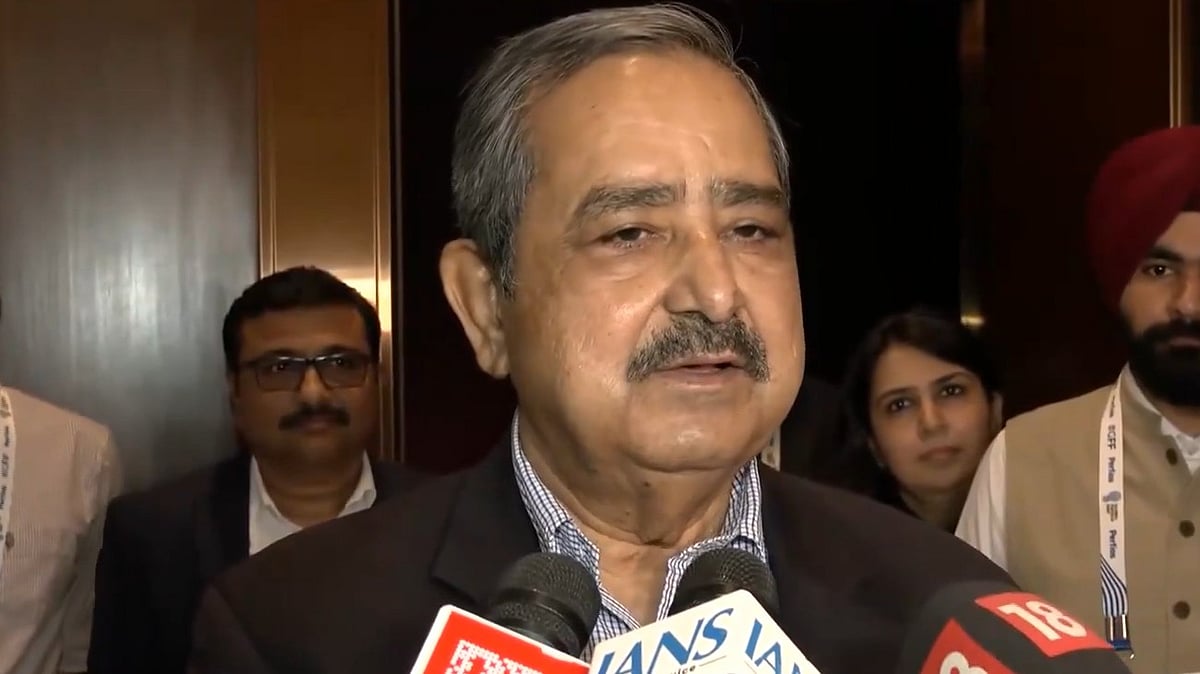
NITI Aayog Vice Chairman Ashok Kumar Lahiri stated that the Indian economy has been performing reasonably well and is expected to regain its momentum and achieve a current account surplus soon.
Lahiri made these comments at the Global Fintech Fest 2026, where he also highlighted the major challenge facing the Indian economy: the low share of manufacturing in the country's overall GDP.
Despite concerns over global uncertainty due to the war in Iran, India's economy grew at a faster-than-expected 7.8 percent in the April-June quarter. Lahiri attributed this resilience to domestic factors, but emphasized the need for increased manufacturing to drive growth.
The NITI Aayog Vice Chairman noted that in developed countries, the share of manufacturing in GDP tends to decrease as per capita income rises. However, he pointed out that India's per capita income is still relatively low, making it essential to boost manufacturing.
Lahiri also discussed foreign investment in India, stating that domestic savings should play a more significant role in driving growth. He cited the example of East Asia, which has consistently run current account surpluses due to high domestic savings.
For fiscal 2025-26, India's current account deficit stood at USD 25.2 billion, or 0.6 percent of GDP. Lahiri expressed confidence that India will soon generate current account surpluses, citing the country's strong economic fundamentals.
The recent GDP data shows an increase in the share of manufacturing in India's GDP, but Lahiri emphasized that more needs to be done to boost this sector. He highlighted the positive investments in renewable energy, data centers, semiconductors, and electronic manufacturing systems.
In conclusion, while India's economy is performing reasonably well, the low share of manufacturing remains a key challenge. Lahiri's comments suggest that the government is aware of this issue and is working to address it through increased investments and reforms.
The Indian economy's ability to regain its momentum and achieve a current account surplus will depend on its ability to boost manufacturing and drive growth through domestic savings. As the country continues to navigate global uncertainty, it is essential to focus on domestic factors that can drive growth and stability.
Lahiri's comments provide a positive outlook for India's economy, but also highlight the need for continued reforms and investments to drive growth. As the country moves forward, it is essential to prioritize manufacturing and domestic savings to achieve long-term economic stability.
The Global Fintech Fest 2026 provided a platform for Lahiri to share his insights on India's economy and the challenges it faces. His comments emphasize the need for a balanced approach to economic growth, one that prioritizes domestic savings and manufacturing.
In the coming months, it will be essential to monitor India's economic progress and assess the impact of the government's reforms and investments. As the country continues to grow and develop, it is crucial to address the challenges facing the manufacturing sector and drive growth through domestic savings.
The future of India's economy looks promising, but it will depend on the government's ability to address the key challenges facing the country. By prioritizing manufacturing and domestic savings, India can achieve long-term economic stability and regain its momentum as a major economic power.
Frequently asked questions
What is the current state of India's economy?
India's economy is doing reasonably well, with a growth rate of 7.8 percent in the April-June quarter.
What is the major challenge facing India's economy?
The low share of manufacturing in India's overall GDP is a major challenge facing the economy.